
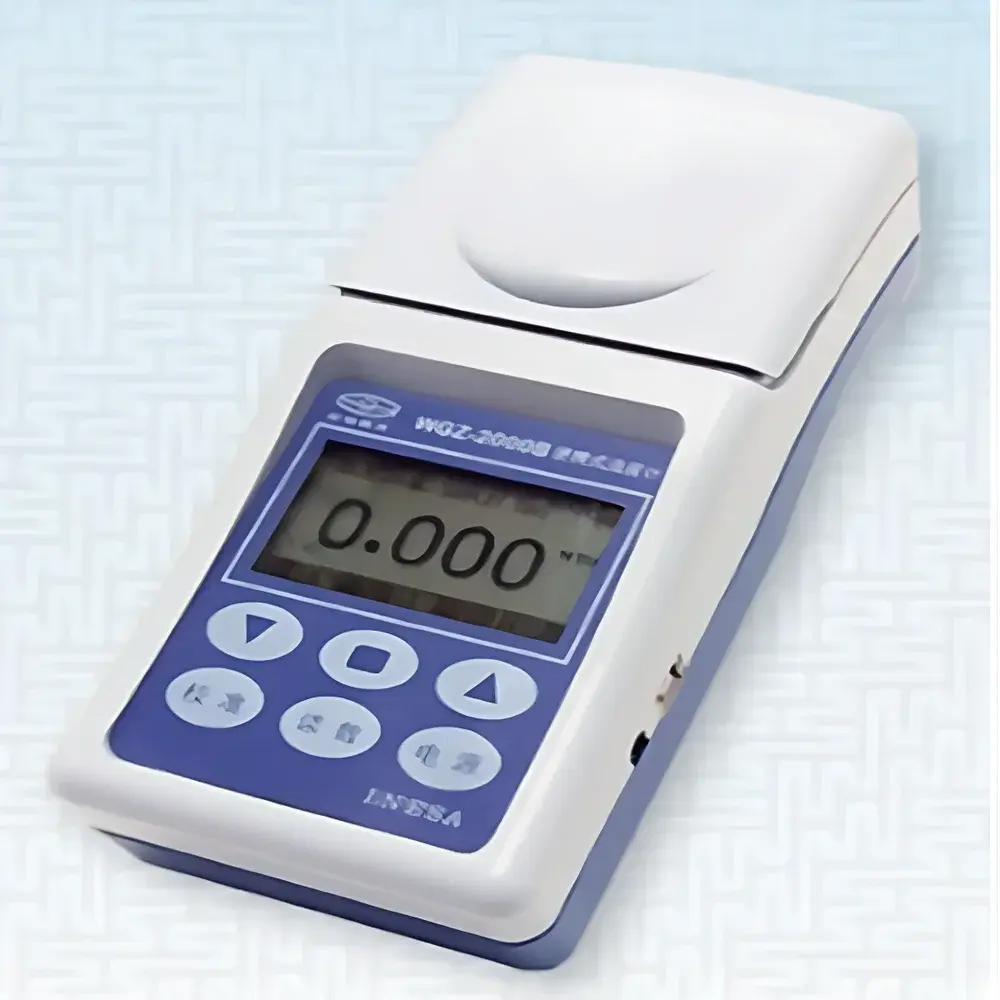
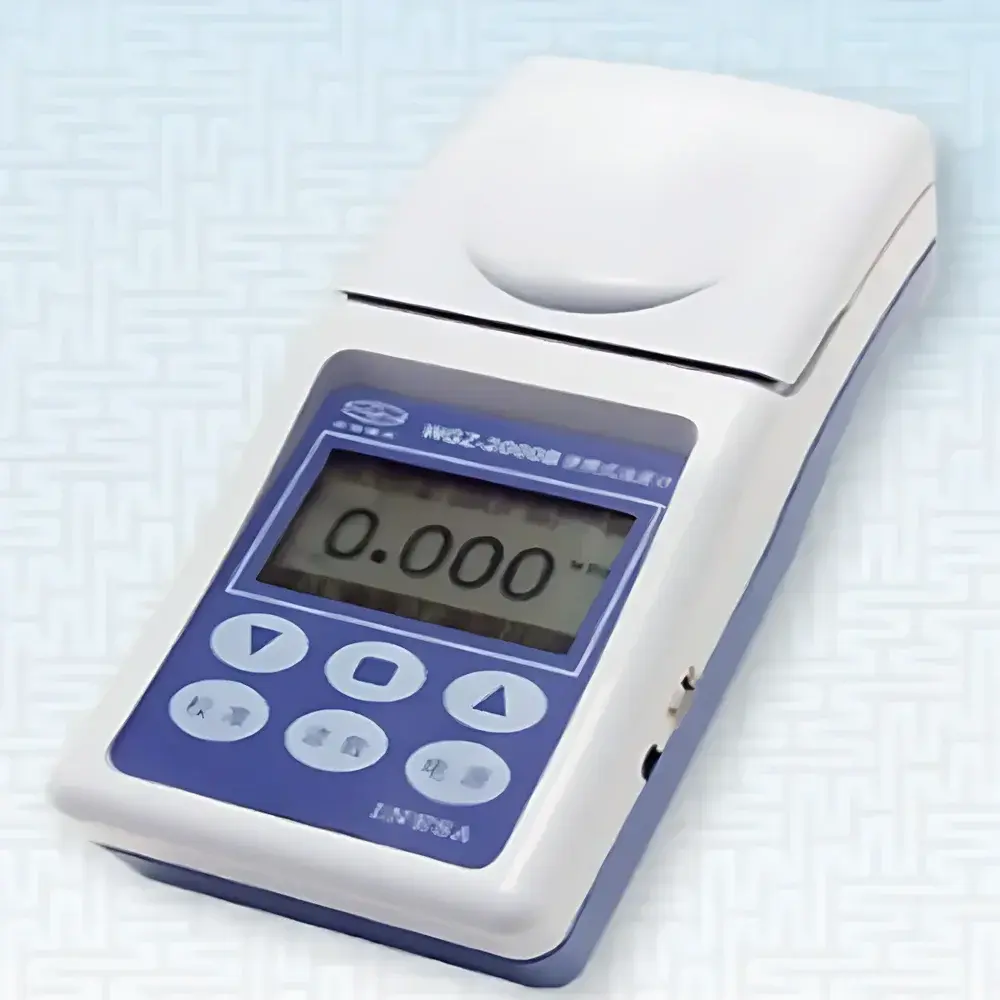
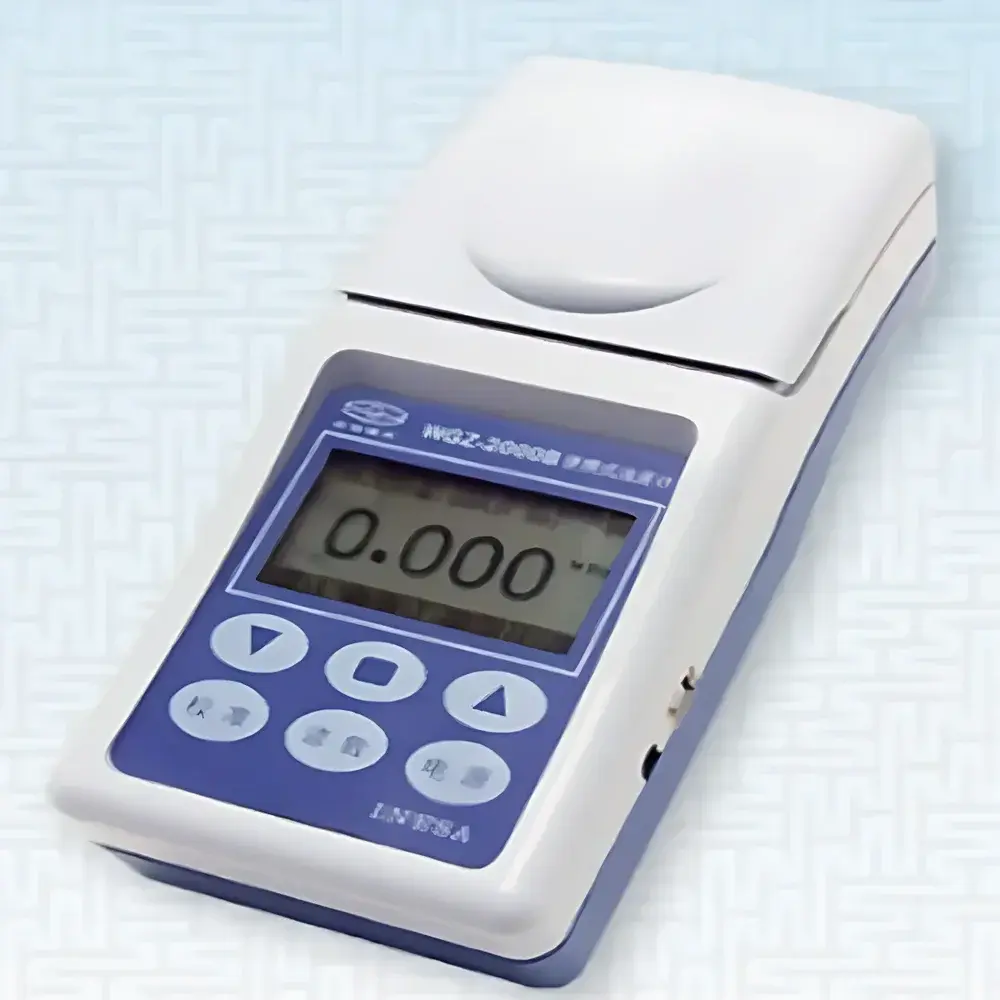
YDWG WGZ-200B Portable Turbidimeter
| Brand | YDWG |
|---|---|
| Origin | Shanghai, China |
| Model | WGZ-200B |
| Type | Portable |
| Measurement Range | 0.000–20.00 NTU |
| Resolution | 0.01 NTU |
| Operating Temperature | 5–40 °C |
| Accuracy | ≤ ±3% |
| Power Supply | 4×AA alkaline batteries or 5 V USB power |
Overview
The YDWG WGZ-200B Portable Turbidimeter is a compact, field-deployable optical instrument engineered for precise quantification of turbidity in clear liquids—primarily aqueous samples—based on the principle of 90° scattered light detection. It operates according to the nephelometric method defined in ISO 7027 and ASTM D6508, where incident light (typically from an LED source at 850 nm) passes through a sample cell, and the intensity of light scattered perpendicularly (at 90°) is measured by a calibrated photodetector. This scattered signal is directly proportional to the concentration and size distribution of suspended particulates—such as silt, clay, microorganisms, or colloidal matter—within the sample matrix. Unlike transmittance-based methods, nephelometry offers superior sensitivity at low turbidity levels (<1 NTU), making the WGZ-200B especially suitable for monitoring high-purity water streams in pharmaceutical manufacturing, drinking water distribution systems, and laboratory QC workflows.
Key Features
- Optimized 90° nephelometric detection geometry compliant with international turbidity standards (ISO 7027, EPA Method 180.1)
- High-resolution display with 0.01 NTU readability across a 0.000–20.00 NTU measurement range
- Dual-power operation: supports both 4×AA alkaline batteries (typical field runtime >20 hours) and regulated 5 V USB input for benchtop or mobile use
- Integrated temperature-compensated optical path to minimize drift under ambient fluctuations (5–40 °C operating range)
- Robust, IP65-rated housing with anti-slip rubberized grip and shock-absorbing corners for reliable transport and field deployment
- Zero-point calibration using certified formazin or StablCal® reference standards; single-point calibration supported via onboard menu
Sample Compatibility & Compliance
The WGZ-200B accepts standard 25 mm round glass or disposable plastic cuvettes (10 mL volume), ensuring compatibility with routine laboratory practices and regulatory sampling protocols. It is validated for use with clarified potable water, filtered process water, wastewater effluent (after settling), and low-viscosity non-aqueous transparent solvents where particulate dispersion remains stable during measurement. Instrument design adheres to electromagnetic compatibility (EMC) requirements per IEC 61326-1 for laboratory and industrial environments. While not intrinsically rated for hazardous locations, its low-voltage DC operation and absence of moving parts support safe deployment in GMP-aligned cleanrooms, utility water loops, and environmental field stations. Data output conforms to GLP documentation requirements when paired with optional timestamped manual logging.
Software & Data Management
The WGZ-200B operates autonomously without embedded software or connectivity interfaces—intentionally designed for simplicity, reliability, and audit-trail minimalism in resource-constrained or regulated settings. All measurements are displayed in real time on a backlit LCD with numeric NTU readout and status icons (e.g., battery level, calibration alert). For traceability, users manually record values alongside sample IDs, timestamps, and environmental conditions in bound logbooks or LIMS-integrated spreadsheets. The device supports repeatable manual calibration verification at user-defined intervals, satisfying internal QA procedures aligned with ISO/IEC 17025 clause 7.7 (monitoring of equipment performance). No firmware updates or driver installation is required; no data storage or export functionality is implemented—eliminating cybersecurity concerns associated with connected instrumentation.
Applications
- Drinking water quality verification at treatment plant outlets, distribution points, and point-of-use locations
- In-process monitoring of filtered rinse water in pharmaceutical equipment cleaning validation (e.g., post-CIP verification)
- QC testing of purified water (PW) and water-for-injection (WFI) feedstocks per USP and EU Ph. Eur. 2.2.2
- Environmental field surveys assessing sediment plume dispersion in rivers, lakes, and coastal zones
- Food & beverage production line checks for clarity of syrups, juices, and brewing wort prior to filtration
- Educational laboratories demonstrating colloid stability, coagulation kinetics, and flocculation efficiency
FAQ
What turbidity standard is recommended for calibration?
Formazin suspension (primary standard per ISO 7027) or NIST-traceable StablCal® suspensions are recommended; calibration at 0.02 NTU and 10 NTU is sufficient for routine verification.
Can the instrument measure samples above 20 NTU?
No—the linear dynamic range is strictly 0.000–20.00 NTU; samples exceeding this limit must be diluted with certified low-turbidity water and results mathematically corrected.
Is temperature compensation automatic?
Yes—the optical detector incorporates a thermistor-coupled circuit that applies real-time gain correction within the specified 5–40 °C operating envelope.
Does the WGZ-200B comply with FDA 21 CFR Part 11?
It does not generate electronic records; therefore, it falls outside the scope of Part 11 requirements. Its use satisfies paper-based GLP/GMP data integrity expectations when paired with controlled documentation practices.
How often should zero calibration be performed?
Before each measurement session and after any change in ambient temperature exceeding 5 °C; additionally, following extended storage or mechanical shock.



