
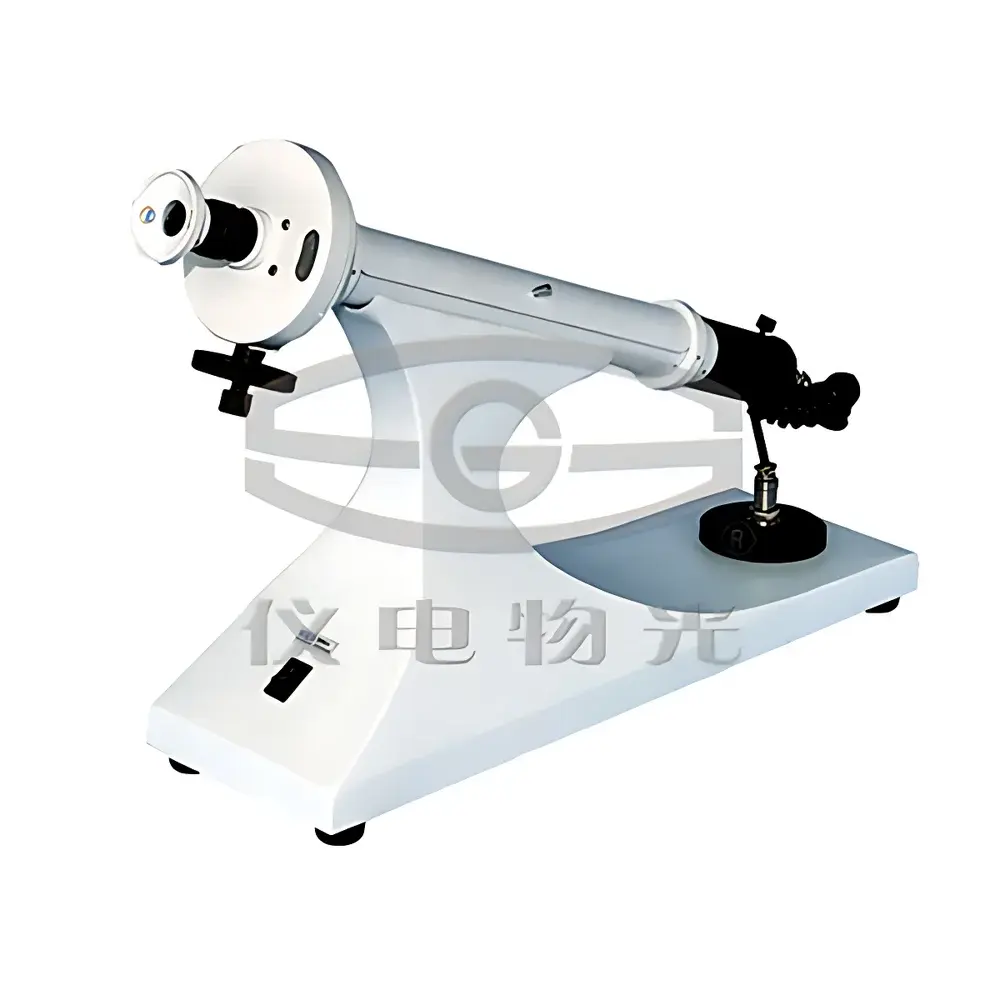
YDWG WXG-4L Visual Polarimeter with LED Light Source
| Brand | YDWG |
|---|---|
| Origin | Shanghai, China |
| Model | WXG-4L |
| Product Type | Circular Scale Visual Polarimeter |
| Temperature Control | None |
| Digital Display | None |
| Light Source | LED (589 nm via interference filter) |
| Measurement Range | ±180° |
| Angular Resolution | 0.05° |
| Angular Accuracy | ±0.05° |
| Scale Division | 1° |
| Eyepiece Magnification | 4× |
| Sample Tube Lengths | 100 mm and 200 mm (standard) |
| Power Supply | 220 V ± 22 V, 50 Hz ± 1 Hz |
| Dimensions (L×W×H) | 435 × 135 × 320 mm |
| Net Weight | 3 kg |
Overview
The YDWG WXG-4L Visual Polarimeter is a manually operated, circular-scale optical instrument engineered for the precise measurement of optical rotation in optically active substances. Based on the fundamental principle of polarimetry—namely, the rotation of plane-polarized light as it traverses chiral media—the WXG-4L delivers reliable angular quantification without electronic automation. It employs a fixed-wavelength LED light source centered at 589 nm (the sodium D-line equivalent), achieved through a high-stability LED coupled with an interference filter. This spectral configuration ensures compatibility with classical polarimetric reference standards and aligns with widely accepted methodology in pharmacopoeial and industrial quality control protocols, including USP , EP 2.2.7, and JP 6.07. Designed for routine use in teaching laboratories, QC environments, and small-scale production facilities, the WXG-4L prioritizes mechanical robustness, long-term calibration stability, and operator-controlled repeatability over digital convenience.
Key Features
- Manual visual alignment system with high-contrast circular scale and vernier readout, enabling direct angular interpolation to 0.05°
- Dedicated 589 nm LED illumination source—low power consumption, negligible thermal drift, and >50,000-hour operational lifetime—eliminating frequent lamp replacement and spectral instability associated with traditional sodium vapor lamps
- Optical path optimized for minimal stray light; includes precision polarizer and analyzer pair with calibrated half-shade field compensation for enhanced endpoint detection
- Interchangeable sample tubes (100 mm and 200 mm path lengths) accommodate standard quartz or glass cells used across pharmaceutical, food, and chemical applications
- Compact benchtop form factor (435 × 135 × 320 mm) and lightweight construction (3 kg) facilitate portability and integration into space-constrained lab workflows
- Mechanically stabilized base and rigid aluminum alloy housing minimize vibration-induced reading errors during manual adjustment
Sample Compatibility & Compliance
The WXG-4L supports transparent, non-scattering liquid samples in standard cylindrical cells with diameters compatible with 100 mm and 200 mm path lengths. It is routinely deployed for concentration determination of sucrose (ICUMSA), glucose, fructose, and other optically active carbohydrates; enantiomeric purity assessment of synthetic intermediates; and assay verification of chiral APIs per ICH Q5C and USP monographs. While the instrument itself does not incorporate temperature regulation or digital audit trails, its mechanical design conforms to ISO 13691:2022 (Optics and photonics — Polarimeters — Vocabulary and general principles) and supports GLP-compliant operation when paired with documented SOPs, calibrated reference standards (e.g., quartz control plates traceable to NIST SRM 8500 series), and manual logbook entries. No software validation or 21 CFR Part 11 compliance is applicable due to absence of electronic data capture.
Software & Data Management
The WXG-4L operates entirely without embedded firmware, microprocessor control, or data output interfaces. All measurements are recorded manually by the operator using the vernier scale and documented externally—either in paper-based laboratory notebooks or in validated LIMS or ELN systems. This analog architecture eliminates cybersecurity risks, software obsolescence, and validation overhead associated with regulated environments where simplicity and deterministic behavior are prioritized. Users are advised to implement dual-operator verification protocols and periodic recalibration against certified reference materials to maintain measurement integrity over time.
Applications
- Teaching laboratories: Demonstrating foundational principles of molecular chirality, Fresnel’s theory of optical activity, and manual polarimetric technique development
- Pharmaceutical QC: Identity testing and assay of chiral drug substances (e.g., levodopa, ibuprofen, chloramphenicol) per pharmacopoeial methods
- Sugar industry: Brix-equivalent concentration estimation in cane and beet sugar solutions using standardized calibration curves
- Food & beverage: Verification of honey authenticity (detecting adulteration with invert sugar), citrus juice composition analysis, and maple syrup grading
- Academic research: Low-cost polarization characterization in undergraduate chemistry and biochemistry curricula where budget and maintenance constraints preclude automated instrumentation
FAQ
Is the WXG-4L compliant with pharmacopoeial requirements for polarimetric assays?
Yes—its 589 nm LED source, ±0.05° accuracy, and mechanical stability meet the instrumental criteria outlined in USP , EP 2.2.7, and JP 6.07 for manual polarimeters.
Can temperature-sensitive measurements be performed with this instrument?
No—the WXG-4L lacks integrated temperature control or monitoring. For temperature-dependent optical rotation studies, users must employ external thermostatted cell holders and record ambient or bath temperature separately.
What calibration standards are recommended for routine verification?
Quartz control plates (e.g., NIST SRM 8500 series) or certified sucrose solutions prepared gravimetrically per USP guidelines are strongly recommended for daily system suitability checks.
Does the instrument support data export or computer connectivity?
No—it is a purely manual, analog instrument with no USB, RS-232, or Bluetooth interface. All readings are interpreted visually and transcribed externally.
What maintenance is required to ensure long-term performance?
Periodic cleaning of optical surfaces with lens-grade tissue and solvent, inspection of vernier scale legibility, and annual verification against traceable standards constitute the full maintenance regimen.




