
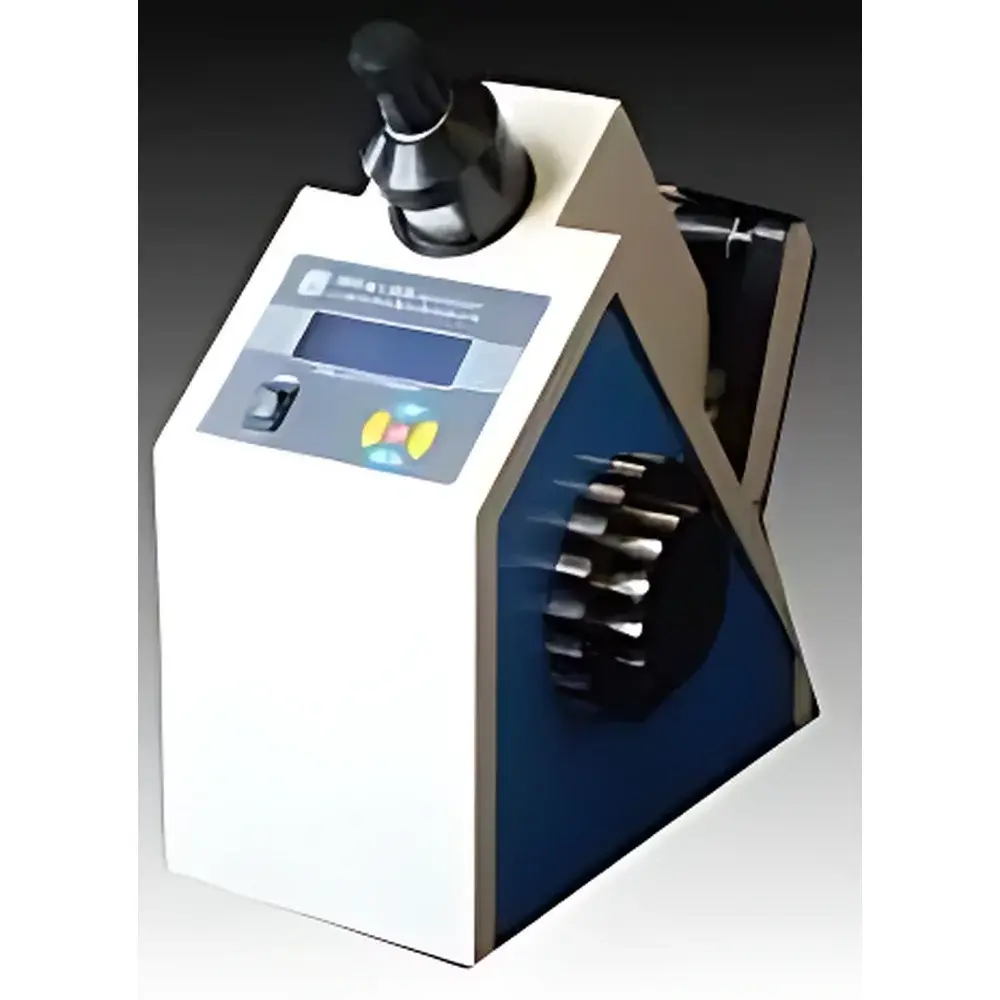
YDWG WYA-2S Digital Abbe Refractometer
| Brand | YDWG |
|---|---|
| Origin | Shanghai, China |
| Type | Benchtop Abbe Refractometer |
| Temperature Control | Yes |
| Digital Display | Yes |
| Refractive Index (nD) Range | 1.3000–1.7000 |
| Brix Range | 0–100% |
| Refractive Index Accuracy | ≤ ±0.0002 |
| Brix Accuracy | ≤ ±0.1% |
| Temperature Display Resolution | 0.1 °C |
| Temperature Control Range | 0–50 °C |
| Dimensions | 330 × 180 × 380 mm |
| Weight | 10 kg |
| Power Supply | 220–240 V AC, 50 Hz ±1 Hz |
| Operating Ambient Temperature | 20–35 °C |
| Interface | RS232 |
Overview
The YDWG WYA-2S Digital Abbe Refractometer is a precision benchtop optical instrument engineered for accurate and repeatable measurement of refractive index (nD) and Brix concentration in transparent or semi-transparent liquid and solid samples. Based on the classical Abbe principle—utilizing total internal reflection at the prism-sample interface—the instrument determines nD by locating the critical angle of refraction under monochromatic sodium D-line illumination (589.3 nm). Its integrated Peltier-based temperature control system maintains sample prism temperature within a stable 0–50 °C range, enabling direct compensation for thermal effects on refractive index—a critical requirement for compliance with ASTM D1218, ISO 2859, and USP . Designed for routine QC laboratories, food & beverage R&D, pharmaceutical excipient characterization, and academic physical chemistry labs, the WYA-2S delivers metrological traceability through factory calibration against NIST-traceable reference standards.
Key Features
- High-precision Abbe optical design with hardened optical glass prisms (BK7 grade), offering exceptional surface durability and long-term refractive stability
- Backlit LCD display with real-time digital readout of nD, Brix (% w/w), and prism temperature (0.1 °C resolution)
- Integrated thermoelectric (Peltier) temperature regulation, eliminating external water baths and ensuring rapid thermal equilibration (±0.2 °C stability over 10 min)
- Minimal sample volume requirement: only 0.1–0.3 mL per measurement—ideal for high-value, limited-availability samples
- RS232 serial interface compliant with standard laboratory data acquisition protocols; supports ASCII-formatted output for integration with LIMS or custom scripting environments
- Ergonomic manual focusing mechanism with coarse/fine adjustment knobs and illuminated crosshair reticle for precise critical-angle alignment
Sample Compatibility & Compliance
The WYA-2S accommodates a broad spectrum of homogeneous, optically clear samples—including aqueous sugar solutions, organic solvents (e.g., ethanol, acetone), glycerol-water mixtures, essential oils, polymer melts (in molten state), and polished solid crystals (e.g., silicon wafers, optical glasses). It is not suitable for opaque, highly scattering, or volatile samples requiring sealed cells. The instrument meets general requirements for GLP-compliant refractometric analysis when operated with documented calibration procedures and temperature-controlled validation runs. While not inherently 21 CFR Part 11 compliant, its RS232 output enables audit-trail-capable data capture when paired with validated third-party software supporting electronic signatures and change control.
Software & Data Management
The WYA-2S operates as a standalone instrument with no embedded operating system or proprietary software dependency. All measurements are output via RS232 at 9600 baud, 8N1 configuration, transmitting three comma-separated values per line: nD, Brix, and temperature (°C). This protocol allows seamless ingestion into Excel, LabVIEW, Python (pySerial), or enterprise LIMS platforms. Users may implement automated calibration logging, statistical process control (SPC) charting, and trend analysis using off-the-shelf tools. Factory calibration certificates include uncertainty budgets traceable to national metrology institutes, supporting ISO/IEC 17025 documentation requirements.
Applications
- Quality control of sucrose, fructose, and glucose syrups in confectionery and beverage manufacturing (Brix verification per AOAC 932.12)
- Determination of purity and concentration in pharmaceutical solvents and active ingredient solutions
- Monitoring polymerization degree in resin synthesis via refractive index correlation
- Verification of antifreeze concentration (ethylene glycol/water) in automotive and HVAC maintenance
- Characterization of edible oil adulteration through nD deviation from reference baselines
- Teaching core optical physics concepts—Snell’s law, dispersion, and critical angle—in undergraduate laboratories
FAQ
What wavelength does the WYA-2S use for refractive index measurement?
The instrument employs a built-in sodium D-line filter (589.3 nm), conforming to the international definition of nD specified in ISO 17025 and ASTM E1223.
Is automatic temperature compensation (ATC) available?
No—the WYA-2S features active temperature control (not passive ATC); users must stabilize the prism at the target temperature before measurement, ensuring compliance with temperature-sensitive standards such as ISO 2114.
Can the device measure solids directly?
Yes—polished, flat-surface solids (e.g., glass slides, crystalline wafers) can be measured using high-refractive-index contact fluid (e.g., bromonaphthalene, n = 1.66) and proper surface preparation.
Does it support calibration verification with certified reference materials?
Yes—calibration verification is performed using NIST-traceable liquids (e.g., distilled water, nD = 1.3330 at 20 °C; benzene, nD = 1.5011 at 20 °C), with acceptance criteria defined by ±0.0002 nD tolerance.
What is the typical warm-up time before first measurement?
Allow 15 minutes after power-on for optical system thermal stabilization and 5 minutes after temperature setpoint adjustment to achieve ±0.2 °C equilibrium at the prism surface.





