
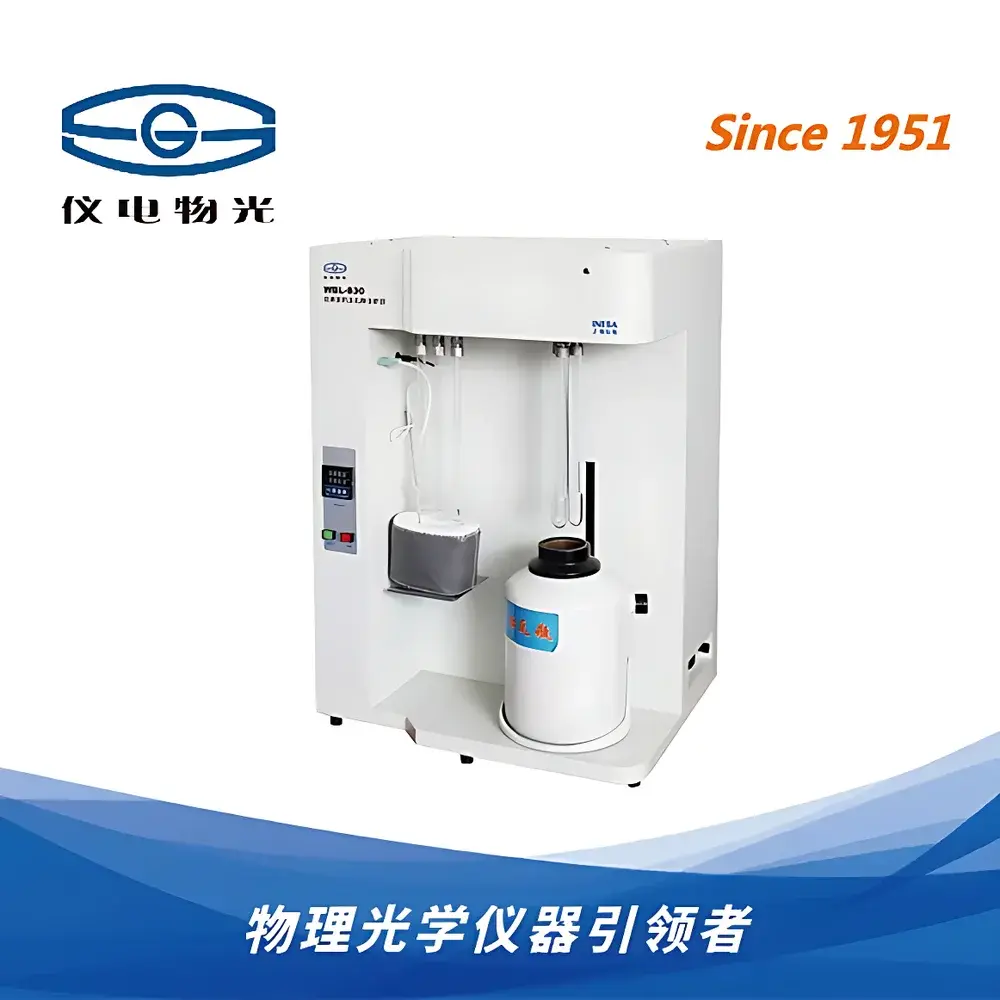
YDWO WBL Series Automated Specific Surface Area and Porosity Analyzer
| Brand | YDWO (Yidian Woguang) |
|---|---|
| Model | WBL Series |
| Measurement Principle | Static Volumetric Nitrogen Physisorption at 77 K |
| Adsorption Gas | High-Purity N₂ (99.999%), optional He |
| P/P₀ Range | 1×10⁻⁶ to 0.998 |
| Surface Area Range | ≥0.0005 m²/g (no upper limit) |
| Pore Size Analysis Range | 0.35–500 nm (3.5–5000 Å) |
| Pressure Sensors | 3–6 × high-accuracy absolute transducers (0–133 kPa, ±0.12% FS) |
| Temperature Sensor | PT-100 (±0.1 °C) |
| Cryostat | 2 L metal Dewar, >80 h hold time |
| Ultimate Vacuum | ≤1.0×10⁻⁴ Torr |
| Vacuum Pump | Imported dual-stage rotary vane pump |
| Sample Capacity | 1–3 stations (model-dependent) |
| Compliance | ISO 9277, ISO 15901, GB/T 119587 |
| Software | Integrated analysis suite for BET, Langmuir, BJH, t-plot, D-A, H-K, NLDFT, GCMC, and true density calculation |
| Output | Printable reports & Excel export (isotherms, surface area, pore volume/area distribution, cumulative metrics) |
Overview
The YDWO WBL Series Automated Specific Surface Area and Porosity Analyzer is an engineered solution for quantitative characterization of porous solids using static volumetric nitrogen physisorption at liquid nitrogen temperature (77.35 K). Based on the fundamental principles of gas adsorption thermodynamics and mass balance under controlled vacuum conditions, the system measures equilibrium adsorption/desorption isotherms by precisely monitoring pressure changes in a calibrated manifold following incremental dosing of high-purity nitrogen. These raw isotherm data serve as input for internationally recognized theoretical models—including BET, Langmuir, BJH, t-plot, Dubinin–Astakhov (D-A), Horvath–Kawazoe (H-K), Non-Local Density Functional Theory (NLDFT), and Grand Canonical Monte Carlo (GCMC)—to derive specific surface area, micropore/mesopore/macropore volume and distribution, total pore volume, and related structural parameters. Designed in strict accordance with ISO 9277 (BET surface area), ISO 15901 (pore size distribution), and GB/T 119587 (Chinese national standard), the WBL Series supports traceable, reproducible measurements required for R&D, QC, and regulatory documentation in materials science laboratories.
Key Features
- Modular all-stainless-steel ultra-high-vacuum gas handling system with integrated leak-tight fittings—eliminates traditional rubber tubing and multi-joint manifolds to ensure long-term vacuum integrity and eliminate hydrocarbon contamination.
- Proprietary metal Dewar cryostat (2 L capacity) with optimized thermal geometry enables stable 77 K sample environment for >80 hours without liquid nitrogen replenishment—enhancing measurement repeatability and eliminating risks associated with fragile glass Dewars.
- High-fidelity pressure metrology: configuration-specific deployment of 3–6 imported absolute pressure transducers (0–133 kPa, ±0.12% full scale) coupled with 22-bit ADC resolution ensures sub-micropascal-level pressure stability during low-P/P₀ isotherm acquisition.
- Automated isotherm acquisition and desorption cycling under full PC control—no manual valve operation or timing intervention required; sequence execution includes outgassing, degas hold, equilibration validation, and multi-point dosing per IUPAC recommendations.
- Multi-model analytical engine supporting standardized and advanced interpretations: single- and multi-point BET, Langmuir surface area, BJH meso/macropore analysis, t-plot micropore volume/surface area, D-A and H-K micropore distribution, and NLDFT/GCMC kernel-based pore size distribution with material-specific kernel libraries.
Sample Compatibility & Compliance
The WBL Series accommodates a broad spectrum of solid powders, granules, and monoliths—including zeolites, MOFs, activated carbons, silica gels, alumina catalysts, clays, soils, pharmaceutical excipients, battery electrode materials, and ceramic precursors. Sample holders are compatible with standard 6–12 mm quartz tubes; optional helium pycnometry modules enable true density determination for accurate skeletal density input into pore volume calculations. All operational protocols and data reporting align with ISO 9277 (surface area), ISO 15901 (pore size), and GB/T 119587. While not pre-certified for FDA 21 CFR Part 11, the software architecture supports audit-trail-enabled user accounts, electronic signatures, and immutable raw data storage—facilitating internal GLP/GMP alignment when deployed in regulated environments.
Software & Data Management
The embedded Windows-based analysis platform provides real-time isotherm visualization, automated baseline correction, outlier rejection, and model selection guidance based on IUPAC-recommended P/P₀ ranges. Raw pressure–time datasets are stored in vendor-neutral binary format with embedded metadata (date/time, operator ID, instrument serial, calibration timestamps). Export options include fully formatted PDF reports and structured Excel worksheets containing isotherm points, BET/Langmuir parameters, cumulative pore volume curves, differential pore size distributions, and summary tables compliant with journal submission standards (e.g., Microporous and Mesoporous Materials). Calibration records, sensor drift logs, and vacuum history are retained for traceability and quality system audits.
Applications
This analyzer serves critical functions across academic, industrial, and regulatory laboratories: catalyst development (active site quantification, support porosity mapping), battery material optimization (anode/cathode pore network design), pharmaceutical formulation (excipient surface energetics, tablet compaction modeling), environmental science (soil adsorption capacity, contaminant sequestration prediction), and nanomaterial certification (ISO-compliant surface area verification for ISO/IEC 17025 accredited testing). Its ability to resolve narrow micropore distributions via DFT kernels makes it particularly valuable for MOF and carbon molecular sieve characterization where <1 nm pore heterogeneity dictates performance.
FAQ
What gases are supported for adsorption analysis?
Nitrogen (99.999% purity) is the default adsorbate; helium is required for true density measurement and may be used as an alternative adsorbate for specific non-porous reference materials.
Is liquid nitrogen included with the system?
No—liquid nitrogen is a consumable supplied separately; users must provide a ≥30 L insulated storage dewar and compatible transfer hardware.
Can the instrument perform helium pycnometry?
Helium pycnometry capability requires optional hardware integration (gas expansion module and calibrated reference cell); contact technical support to configure this option prior to purchase.
What computing environment is required?
A dedicated Windows PC (Intel Core i5 or higher, 8 GB RAM, SSD boot drive, USB 3.0 port) running Windows 7 or later is mandatory; virtualized or remote desktop environments are not supported.
How is calibration verified and maintained?
System calibration is performed using certified standard reference materials (e.g., NIST SRM 1990a for surface area); pressure sensors are factory-calibrated and field-verifiable using known-volume expansion tests per ISO 15901 Annex C.
Related Products



