
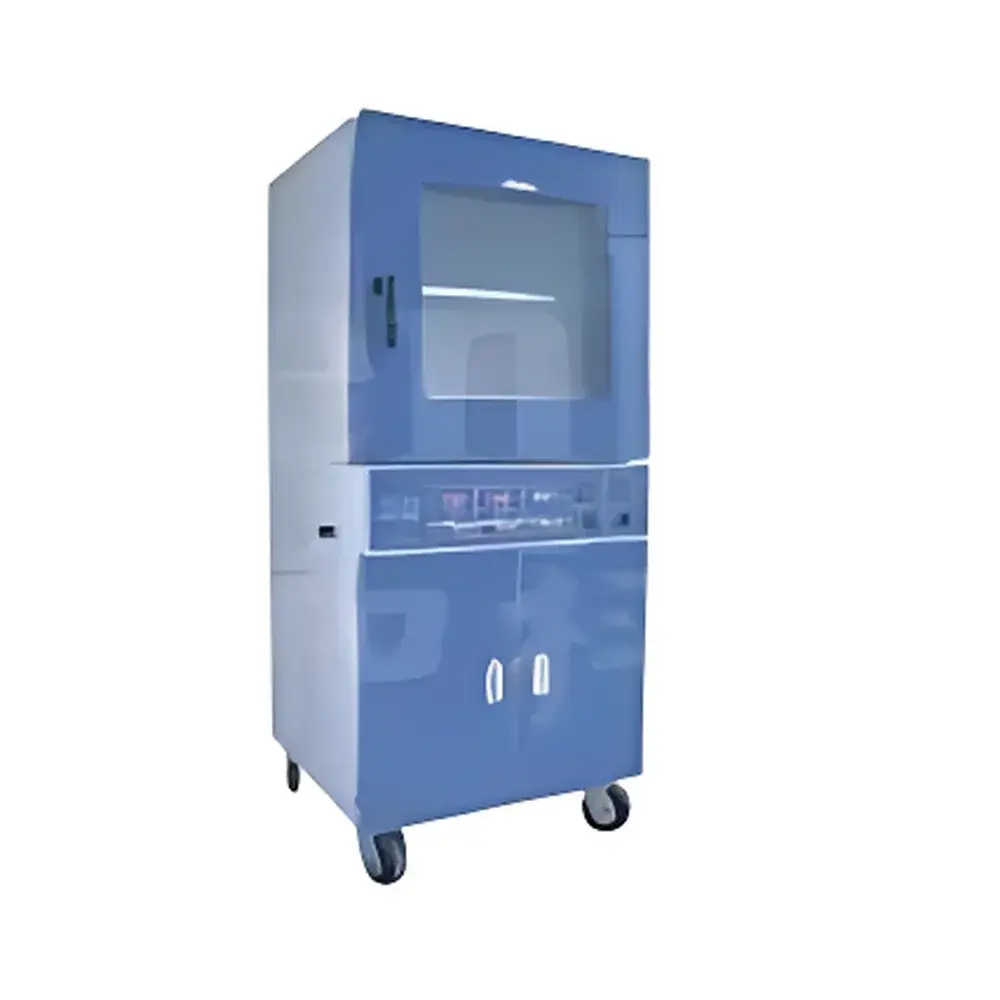
Yi Heng DZF-6050 Vacuum Drying Oven
| Brand | Yi Heng (Shanghai Yi Heng) |
|---|---|
| Origin | Shanghai, China |
| Model | DZF-6050 |
| Instrument Type | Vacuum Oven |
| Temperature Range | RT+10°C to 200°C |
| Temperature Resolution | 0.1°C |
| Temperature Uniformity | ±1°C |
| Ultimate Vacuum | 133 Pa |
| Interior Dimensions | 415 × 370 × 345 mm |
| Exterior Dimensions | 730 × 560 × 550 mm |
| Interior Material | Stainless Steel |
| Heating Method | Electric Resistance Heating |
| Power Input | 1400 W |
| Shelf Quantity | 2 pcs |
| Door | Double-Layer Tempered Glass with Silicone Sealing Gasket |
Overview
The Yi Heng DZF-6050 Vacuum Drying Oven is a precision-engineered laboratory instrument designed for controlled thermal processing under reduced pressure environments. Operating on the principle of vacuum-assisted heat transfer—where lowered ambient pressure reduces the boiling point of solvents and moisture—the DZF-6050 enables gentle, uniform drying of heat-sensitive, oxidation-prone, or volatile samples without thermal degradation. Unlike conventional forced-air ovens, this vacuum oven eliminates convective heat loss and oxygen exposure, making it suitable for applications requiring inert atmosphere processing, residual solvent removal, or moisture determination in compliance with ASTM E1218, ISO 15512, and USP <641> drying protocols. Its rectangular chamber maximizes usable volume while maintaining structural integrity under sustained sub-atmospheric conditions up to 133 Pa.
Key Features
- Microprocessor-based PID temperature controller with 0.1°C resolution and ±1°C uniformity across the stainless steel interior chamber (415 × 370 × 345 mm), ensuring repeatable thermal profiles.
- Double-layer tempered glass observation door with anti-shatter properties—enabling real-time visual monitoring without compromising vacuum integrity.
- Integrated silicone rubber door gasket with adjustable compression mechanism, engineered to maintain stable vacuum levels during extended operation cycles.
- Electric resistance heating system (1400 W input power) delivering rapid thermal response; typical heating time to setpoint is reduced by over 50% compared to legacy vacuum oven architectures.
- Corrosion-resistant 304 stainless steel inner chamber—welded, seamless, and passivated—designed for long-term stability in acidic, alkaline, or solvent-rich environments.
- Two removable stainless steel shelves included as standard, supporting flexible sample arrangement and optimized airflow distribution within the evacuated cavity.
Sample Compatibility & Compliance
The DZF-6050 accommodates a broad range of sample formats—including Petri dishes, weighing boats, glass vials, ceramic crucibles, and polymer films—without risk of oxidation or decomposition. Its oxygen-free operation supports ICH Q5C stability testing, pharmaceutical lyophilization pre-drying stages, catalyst activation, and electronic component desiccation per IPC-CC-830B. The unit complies with general electrical safety requirements per IEC 61010-1 and is compatible with external vacuum pump interfaces meeting ISO 8573-1 Class 4 purity standards. While not certified for Class I Div 1 hazardous locations, it is routinely deployed in GLP-compliant laboratories where audit-ready documentation (e.g., calibration logs, vacuum decay tests) is maintained per internal SOPs.
Software & Data Management
The DZF-6050 operates via an embedded digital controller with non-volatile memory for storing up to 10 user-defined programs, each configurable with ramp-hold segments, maximum temperature limits, and auto-shutdown timers. Real-time temperature and vacuum status are displayed on a high-contrast LED interface. Though natively standalone, the controller supports optional RS-485 serial output (with appropriate converter) for integration into centralized lab monitoring systems. Data logging requires external acquisition hardware; however, the unit’s stable thermal performance and low drift characteristics (<0.05°C/h) support manual recording traceable to NIST-traceable reference thermometers—fully aligned with FDA 21 CFR Part 11 principles when paired with validated procedural controls.
Applications
- Residual solvent removal from APIs and excipients prior to tablet compression or capsule filling.
- Drying of hygroscopic materials such as lithium battery cathode precursors (e.g., LiCoO₂ slurries) without carbonate decomposition.
- Pre-treatment of SEM/TEM specimens to prevent surface charging artifacts induced by water vapor.
- Moisture content validation in food-grade packaging films per AOAC 950.46 gravimetric methods.
- Curing of specialty adhesives and encapsulants under nitrogen-purged vacuum to eliminate microvoid formation.
- Accelerated aging studies of optical coatings and thin-film photovoltaic layers under controlled thermal-vacuum stress.
FAQ
What is the maximum operating temperature and vacuum level achievable?
The DZF-6050 achieves a maximum temperature of 200°C and a base vacuum of ≤133 Pa when used with a compatible two-stage rotary vane pump.
Is the chamber volume sufficient for industrial-scale sample batches?
With an internal capacity of ~53 L, the DZF-6050 is optimized for R&D, QC, and pilot-scale processing—not continuous production—but accommodates multiple standard 100-mm Petri dishes or six 20-mL scintillation vials simultaneously.
Can inert gas purging be integrated with the vacuum cycle?
Yes—via optional inlet valve modification, users may introduce nitrogen or argon prior to evacuation to establish a defined inert headspace, supporting applications like glovebox-compatible material handling.
How often does the silicone door seal require replacement?
Under normal use (≤8 h/day, 5 days/week), the molded silicone gasket maintains sealing efficacy for ≥24 months; visual inspection for compression set or cracking is recommended quarterly.
Does the unit include calibration documentation?
Factory calibration certificates for temperature sensors are provided; users must perform periodic verification using accredited dry-block calibrators or reference PRTs per ISO/IEC 17025 guidelines.



