
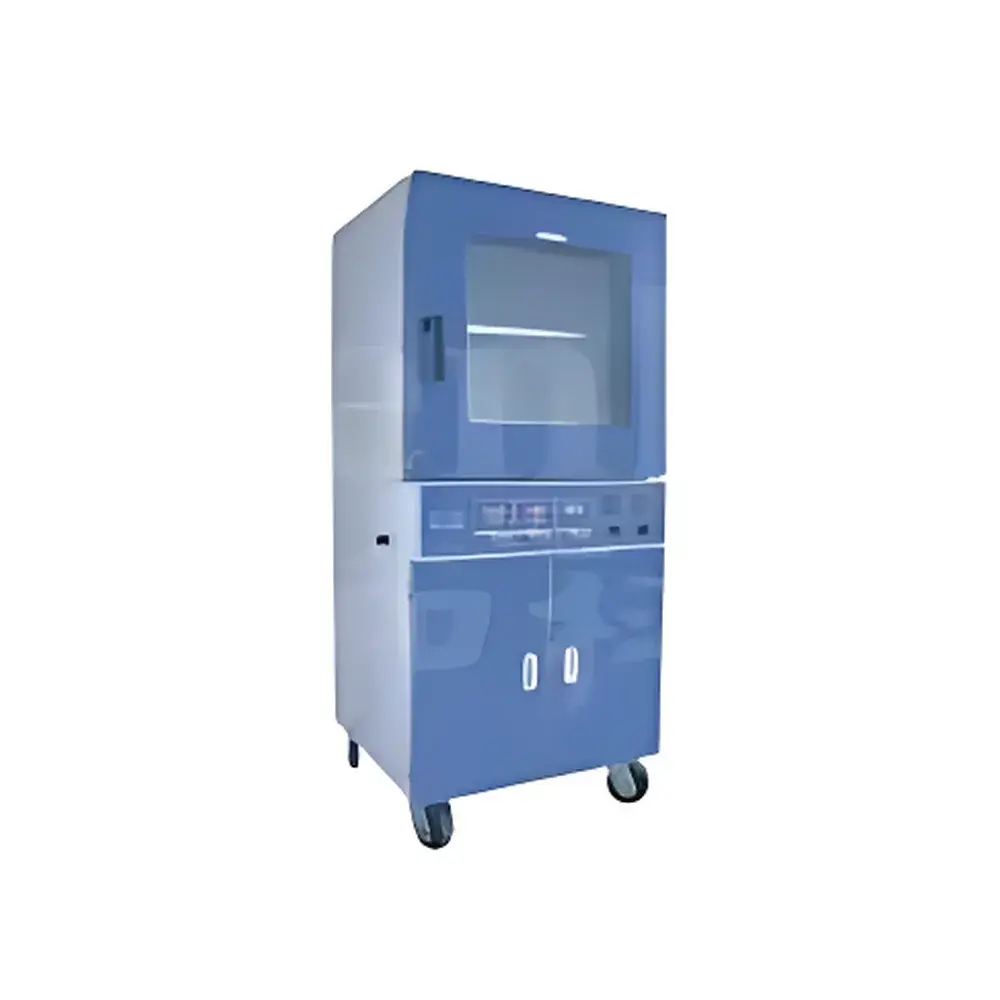
Yi Heng DZF-6090 Vacuum Drying Oven
| Brand | Shanghai Yi Heng |
|---|---|
| Origin | Shanghai, China |
| Model | DZF-6090 |
| Instrument Type | Vacuum Oven |
| Temperature Range | RT+10°C to 250°C |
| Temperature Uniformity | ±1°C |
| Internal Chamber Dimensions | 450 × 450 × 450 mm |
| External Dimensions | 610 × 680 × 1460 mm |
| Chamber Material | Stainless Steel (304) |
| Heating Method | Electric Resistive Heating |
| Power Input | 1150 W |
| Standard Configuration | Includes Vacuum Pump and Desiccator Chamber |
| Shelf Quantity | 2 pcs (independently configurable) |
| Door | Double-Layer Tempered Glass with Silicone Gasket Seal |
| Compliance | Designed for GLP-compliant laboratories |
Overview
The Yi Heng DZF-6090 Vacuum Drying Oven is an engineered solution for thermal processing under reduced-pressure conditions. It operates on the principle of lowering the boiling point of solvents and moisture through vacuum application—enabling efficient, low-temperature drying of heat-sensitive, hygroscopic, or oxidation-prone samples. Unlike conventional forced-air ovens, this unit maintains a controlled vacuum environment (typically down to ≤0.1 kPa, dependent on attached pump performance), minimizing thermal degradation while preserving sample integrity. Its rectangular chamber maximizes usable volume (91.1 L net capacity), and its microprocessor-based PID temperature controller delivers stable setpoint maintenance across the full operating range (RT+10°C to 250°C). The system is purpose-built for applications requiring inert-atmosphere processing—such as polymer curing, pharmaceutical intermediate drying, catalyst activation, and analytical sample preparation—where oxygen exclusion prevents oxidation and ensures reproducible mass-loss profiles.
Key Features
- Stainless steel (AISI 304) interior chamber with seamless welded construction, offering corrosion resistance and ease of cleaning in compliance with laboratory hygiene standards.
- Double-layer tempered glass door with adjustable clamping mechanism and integrated silicone gasket seal, enabling real-time visual monitoring without vacuum loss.
- Independent dual-shelf configuration (2 shelves included), each with dedicated positioning slots—facilitating simultaneous processing of dissimilar samples at identical or staggered thermal profiles.
- Optimized heating architecture featuring embedded tubular heaters along chamber walls and floor, reducing thermal gradient deviation to ±1°C across the working volume per IEC 61000-4-3 validation guidelines.
- Integrated vacuum interface (KF-25 flange) compatible with standard two-stage rotary vane pumps; vacuum level monitored via analog Bourdon-tube gauge (0–0.1 kPa range).
- Energy-efficient design with 1150 W rated power input and intelligent duty-cycle modulation—achieving target temperature up to 50% faster than legacy vacuum oven platforms under equivalent load conditions.
Sample Compatibility & Compliance
The DZF-6090 accommodates a broad spectrum of sample formats—including Petri dishes, weighing boats, crucibles, glass desiccators, and custom fixtures—within its 450 mm × 450 mm × 450 mm chamber. Its oxygen-free operation supports ASTM E1228-18 (Standard Practice for Vacuum Desiccation of Moist Solids) and aligns with USP requirements for moisture content determination in sterile pharmaceutical products. The stainless steel chamber meets FDA-recommended material criteria for non-reactive contact surfaces. While not certified to UL/CSA or CE for standalone medical device use, the unit satisfies general electrical safety (IEC 61010-1) and electromagnetic compatibility (IEC 61326-1) prerequisites for laboratory-grade equipment. Documentation packages support audit readiness for GLP and ISO/IEC 17025 accreditation pathways.
Software & Data Management
This model employs a standalone digital PID controller with LED display, supporting manual setpoint entry, ramp/soak programming (up to 8 segments), and real-time temperature readout. Though it does not include embedded data logging or PC connectivity, optional RS485 interface modules (sold separately) enable integration with SCADA systems or third-party LabVIEW-based acquisition platforms. All operational parameters—including elapsed time, current temperature, setpoint, and over-temperature alarm status—are retained in non-volatile memory during power interruption. Audit trails are maintained manually via operator logbooks, consistent with basic GLP documentation practices where electronic records are not mandated.
Applications
- Drying of thermolabile biological matrices (e.g., enzymes, antibodies, lyophilized intermediates) without denaturation.
- Moisture content analysis per AOAC 950.46 and ISO 712 for food, feed, and agricultural commodities.
- Pre-conditioning of reference standards and calibration materials prior to gravimetric analysis.
- Outgassing of electronic components and optical substrates in semiconductor R&D workflows.
- Curing of epoxy resins and silicone elastomers under inert nitrogen backfill (when coupled with gas inlet adapter).
- Accelerated stability testing of active pharmaceutical ingredients (APIs) per ICH Q1A(R2) guidelines.
FAQ
What vacuum level can the DZF-6090 achieve?
With a standard two-stage rotary vane pump (e.g., 2 m³/h capacity), the chamber typically reaches ≤0.1 kPa (100 Pa) within 20–30 minutes—sufficient for most solvent removal and dehydration protocols.
Is the temperature uniformity validated across the entire chamber volume?
Yes—per internal factory verification using 9-point thermocouple mapping, temperature deviation remains within ±1°C at 105°C and 150°C setpoints, meeting ISO 15504 Part 3 spatial uniformity benchmarks.
Can inert gas purging be performed in conjunction with vacuum cycles?
The unit includes a dedicated gas inlet port (¼” NPT); users may introduce nitrogen or argon before or after vacuum draw to establish and maintain inert atmospheres.
Are calibration certificates provided with shipment?
A factory-issued temperature calibration report (traceable to NIM, China) is included; full ISO/IEC 17025-accredited calibration is available upon request at additional cost.
What maintenance is required for long-term reliability?
Routine tasks include periodic inspection of the silicone door gasket for compression set, cleaning of chamber surfaces with ethanol or isopropanol, and annual oil change for the integrated vacuum pump.



