
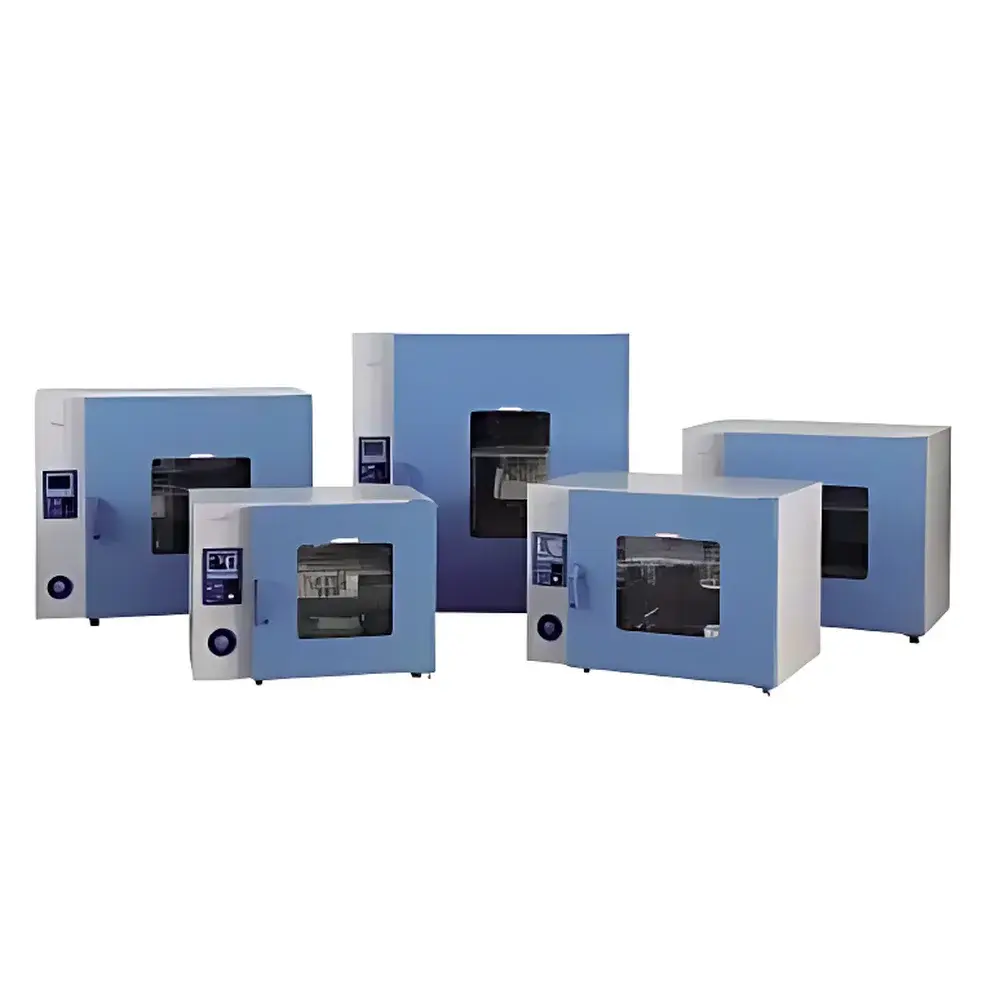
Yi Heng PH Series Dual-Function Incubator/Drying Oven
| Brand | Yi Heng (Shanghai Yi Heng) |
|---|---|
| Origin | Shanghai, China |
| Model | PH Series |
| Instrument Type | Precision Forced-Air Oven |
| Temperature Range | RT+5–80 °C (Incubation Mode) |
| Temperature Uniformity | ±3% at 100 °C |
| Temperature Fluctuation | ±0.5 °C (Incubation) |
| Temperature Resolution | 0.1 °C |
| Heating Method | Forced-air convection |
| Power Input | 650–2450 W (model-dependent) |
| Working Environment | +5 to +35 °C |
| Timer Range | 0–5999 min |
| Standard Shelving | 2 adjustable stainless-steel shelves |
| Interior Material | Mirror-finish stainless steel |
| Door Seal | Silicone rubber gasket with double-layer tempered glass viewport |
| Safety Interlock | Automatic heating and fan shutoff upon door opening |
Overview
The Yi Heng PH Series Dual-Function Incubator/Drying Oven is an engineered solution for laboratories requiring precise thermal control across two distinct operational regimes: low-temperature biological incubation and high-temperature moisture removal or thermal processing. Designed using validated forced-air convection principles, the PH Series maintains stable temperature distribution through a rear-mounted axial fan and optimized internal airflow channels—ensuring minimal thermal stratification and rapid recovery after door openings. Unlike static ovens, its dynamic air circulation architecture delivers reproducible thermal environments essential for cell culture maintenance, microbiological growth studies, desiccation of hygroscopic samples, polymer curing, and gravimetric analysis preparation. The dual-range capability eliminates the need for separate dedicated units, reducing footprint, energy overhead, and calibration management complexity in resource-constrained academic, QC, and R&D settings.
Key Features
- Mirror-polished 304 stainless-steel interior chamber with radius-rounded corners for seamless cleaning and resistance to corrosion from solvents, saline solutions, and sterilants.
- Microprocessor-based LCD controller with 0.1 °C resolution, real-time temperature display, and programmable ramp-hold profiles for process-critical workflows.
- Forced-air convection system featuring a high-efficiency centrifugal blower and directional ducting to achieve ≤±3% temperature uniformity (measured per ISO 17025-compliant protocols at 100 °C).
- Dual-layer tempered glass observation window with silicone rubber gasket seal, enabling non-invasive visual monitoring without compromising thermal integrity or humidity retention.
- Interlocked safety circuitry: automatic deactivation of heating elements and fan motor upon door opening—preventing overshoot, protecting samples, and complying with IEC 61010-1 Class II electrical safety requirements.
- Adjustable stainless-steel shelving (2 standard positions), accommodating varied sample heights and load configurations while maintaining unobstructed airflow paths.
Sample Compatibility & Compliance
The PH Series accommodates standard laboratory vessels including Petri dishes, multi-well plates, beakers, crucibles, and desiccation trays. Its RT+5–80 °C incubation range supports mesophilic bacterial cultivation (e.g., E. coli, Bacillus subtilis), fungal propagation, and enzyme activity assays under controlled ambient conditions. In drying mode (80–220 °C), it meets ASTM E145–22 criteria for gravity convection ovens used in moisture content determination (e.g., soil, pharmaceutical excipients, foodstuffs). The unit’s construction adheres to GB/T 23776–2018 (Chinese national standard for laboratory ovens) and incorporates design elements aligned with GLP documentation requirements—including non-volatile parameter storage, audit-ready timer logs, and traceable temperature setpoint history.
Software & Data Management
While the base PH Series operates via standalone microcontroller interface, optional RS-485 communication enables integration into centralized lab monitoring systems (e.g., LabVantage, Siemens Desigo CC). The controller records time-stamped temperature readings at user-defined intervals (1–60 min), storing up to 30 days of data internally. Export functionality supports CSV output via USB port for post-acquisition analysis in MATLAB, Python (Pandas), or Excel. All firmware updates are delivered via signed binary packages, ensuring version control and cryptographic integrity per ISO/IEC 17025 Clause 5.9.2. No cloud dependency or proprietary software installation is required for routine operation.
Applications
- Biological incubation: cell line maintenance, microbial enumeration (ISO 4833-1), mycological isolation, and tissue explant culture.
- Material conditioning: pre-weighing desiccation of filters (EPA Method 1664), ash content determination (AOAC 923.03), and solvent evaporation from HPLC fractions.
- Quality control: stability testing of raw materials per ICH Q1A(R2), residual solvent analysis support, and packaging validation (ASTM F1980).
- Education: undergraduate thermodynamics labs, calibration exercises for thermocouple arrays, and comparative studies of convection vs. conduction heating efficiency.
FAQ
Can the PH Series be used for sterile applications?
Yes—when operated with HEPA-filtered air intake kits (optional accessory), the chamber achieves ISO Class 5 particulate cleanliness during incubation mode. Sterilization via dry heat (160 °C for 2 hours) is validated per USP <1211>.
Is temperature mapping required for GMP compliance?
Per FDA Guidance for Industry (2022), mapping must be performed initially and after major maintenance. The PH Series’ documented uniformity profile simplifies IQ/OQ execution using calibrated NIST-traceable sensors.
Does the oven support remote monitoring?
RS-485 Modbus RTU protocol enables integration with SCADA or BMS platforms. Ethernet/Wi-Fi modules are available as field-upgradeable options.
What is the maximum load capacity per shelf?
Each 304 stainless-steel shelf supports up to 15 kg uniformly distributed. Load distribution must avoid blocking rear air inlets or top exhaust grilles.
How often should calibration be performed?
Annual calibration against a reference PRT (Class A, ±0.15 °C) is recommended. Internal sensor drift compensation is supported via user-accessible offset adjustment in service mode.



