
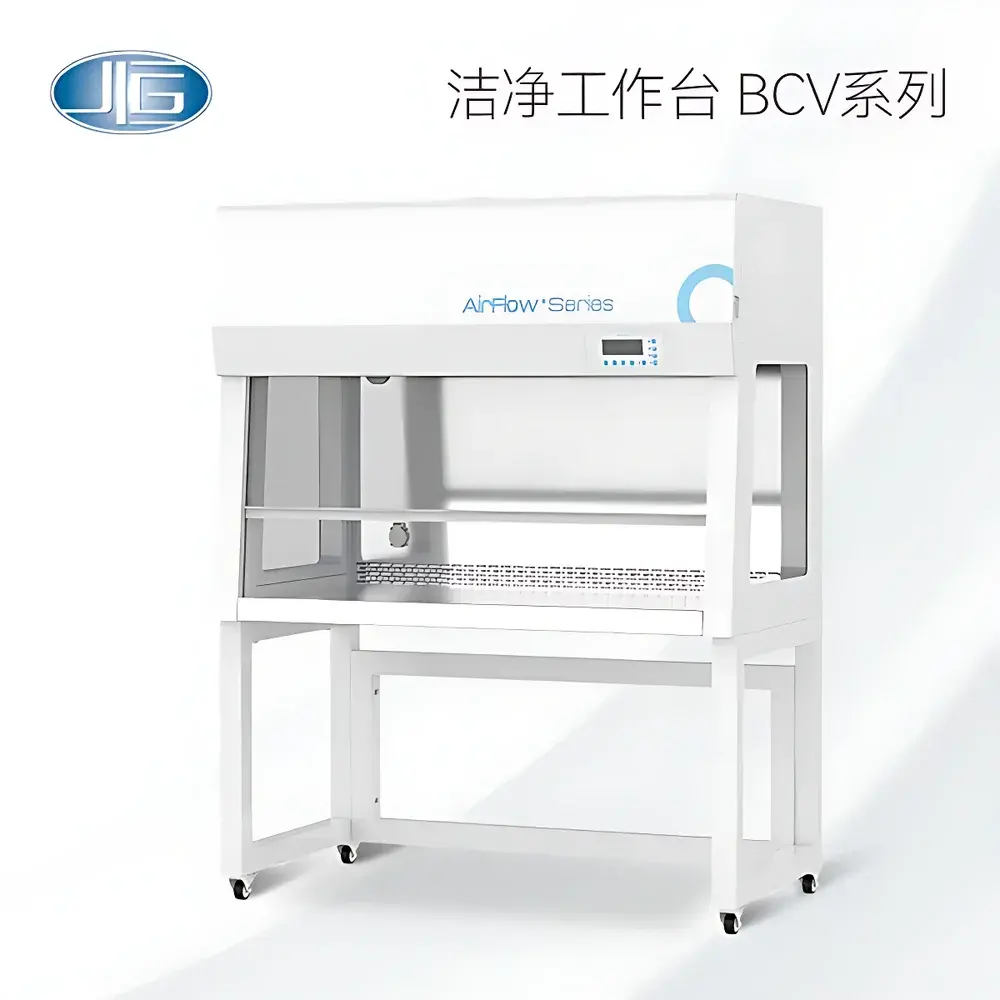
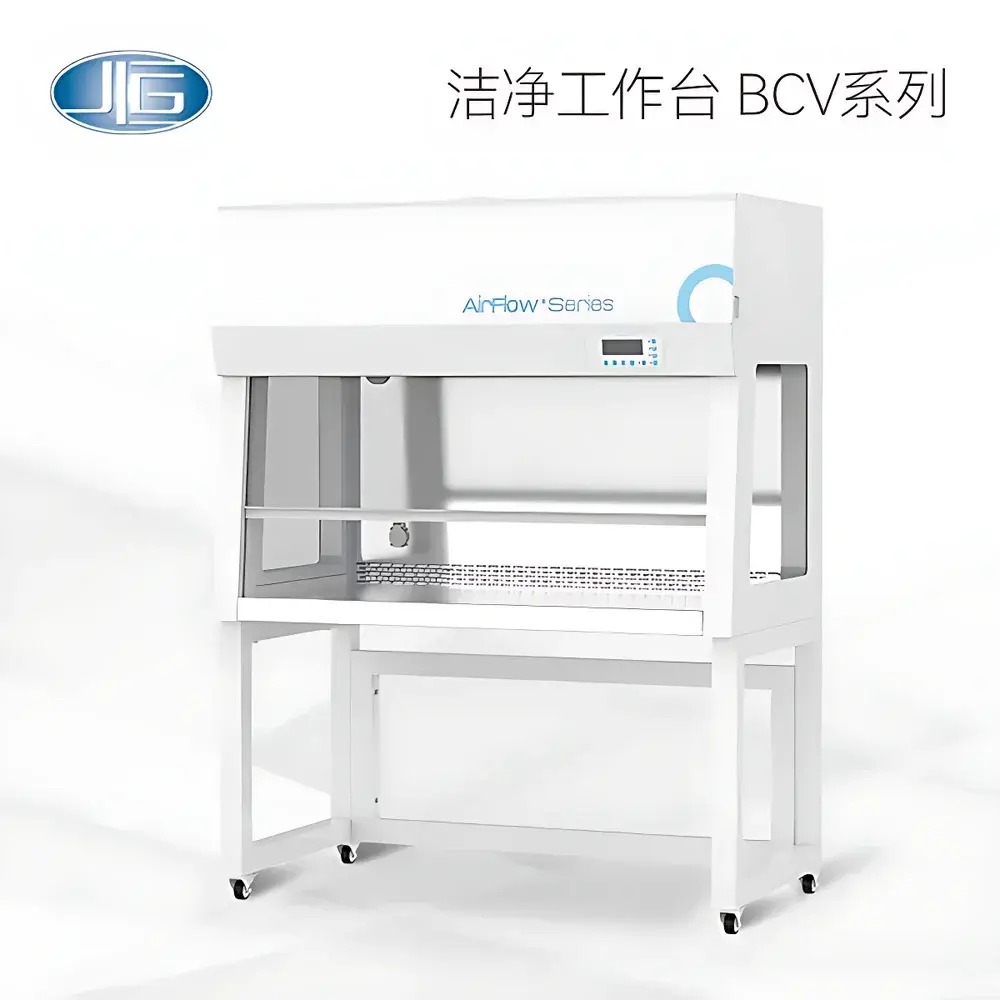
YIHENG BCV Series Vertical Laminar Flow Clean Bench
| Brand | YIHENG |
|---|---|
| Origin | Jiangsu, China |
| Manufacturer Type | Direct Manufacturer |
| Product Line | Domestic |
| Models | BCV-3S1, BCV-4S1, BCV-5S1, BCV-6S1 |
| Price Range | USD 2,300 – 3,900 (FOB Jiangsu) |
| Airflow Control | Stepless adjustment from 0.30 to 0.50 m/s with ±0.01 m/s setpoint accuracy |
| Filtration | ULPA-class HEPA filter (99.99% @ 0.3 µm) with pre-filter |
| Display | LCD showing real-time airflow velocity, clock, and filter operational hours |
| Safety Features | Filter integrity alarm (audible/visual), UV-light–lighting interlock, password-protected parameter access |
| Construction | Stainless steel work surface, tempered glass side panels and vertically sliding sash, 5° ergonomic tilt, built-in 1 kW power outlet |
| Compliance | Designed per ISO 14644-1 Class 5 (ISO Class 5) cleanroom performance requirements |
| Certifications | CE-marked |
Overview
The YIHENG BCV Series Vertical Laminar Flow Clean Bench is an ISO Class 5-compliant unidirectional airflow workstation engineered for contamination-sensitive laboratory procedures including aseptic cell culture, pharmaceutical formulation, microbiological assay preparation, and precision electronics assembly. Unlike horizontal flow hoods, the BCV Series directs filtered air vertically downward—from top-mounted HEPA or ULPA-grade filters—across the work surface and through perforated stainless steel grilles at the base, establishing a continuous, particle-free laminar curtain that isolates samples from ambient room contaminants. Its core architecture integrates constant-velocity airflow control via a digitally regulated centrifugal blower system, ensuring stable face velocity across variable filter loading conditions and extended service intervals. The unit operates as a non-recirculating device: 100% of supply air is drawn from the laboratory environment, conditioned through dual-stage filtration (pre-filter + main HEPA), and exhausted downward—eliminating cross-contamination risk between operator and sample.
Key Features
- Ergonomic 5° forward tilt of the work surface reduces operator fatigue during prolonged tasks while maintaining optimal arm positioning relative to the laminar airflow plane.
- Vertically sliding tempered glass sash with self-balancing counterweight mechanism enables precise, tool-free height adjustment and secure locking at any position—ensuring consistent airflow uniformity and operator safety.
- Integrated backlighting system with diffused LED illumination provides uniform, glare-free lighting (≥600 lux at work surface) without disrupting laminar flow patterns or inducing thermal convection currents.
- Stainless steel (AISI 304) work surface with raised perimeter lip prevents liquid spill migration and supports rapid decontamination using alcohol, hydrogen peroxide, or EPA-registered sporicidal agents.
- Microprocessor-controlled LCD interface displays real-time face velocity, cumulative filter runtime, system clock, and active alarm status—enabling traceable operational history per GLP/GMP documentation requirements.
- Programmable UV lamp timer (0–60 min) with automatic shutoff and interlocked activation ensures safe decontamination cycles: UV emission is disabled when sash is opened above 50 mm, preventing operator exposure.
Sample Compatibility & Compliance
The BCV Series accommodates standard biosafety Level 1 and Level 2 applications where personnel protection is not required but product protection is critical. It is validated for use with Petri dishes, T-flasks, microcentrifuge tubes, pipette tips, and sterile vials. Units comply with ISO 14644-1:2015 Class 5 (formerly Federal Standard 209E Class 100) airborne particulate limits (≤3,520 particles ≥0.5 µm/m³). Pre-filter and HEPA filter assemblies meet EN 1822-1:2019 H14 classification standards. All electrical components are CE-certified per IEC 61010-1, and the enclosure satisfies IP20 ingress protection rating. Optional third-party IQ/OQ documentation packages are available to support FDA 21 CFR Part 11–aligned validation protocols.
Software & Data Management
While the BCV Series operates via embedded firmware (no external PC dependency), its onboard controller logs and retains up to 12 months of operational metadata—including daily average velocity, total filter runtime, UV cycle count, and alarm event timestamps (type, duration, resolution status). Data export is supported via USB-C port (CSV format) for integration into LIMS or electronic lab notebooks. Password protection (three-tier access: operator, technician, administrator) governs parameter modification, UV scheduling, and calibration reset functions—ensuring audit trail integrity. All system events are time-stamped using an internal RTC synchronized to UTC, supporting ALCOA+ data governance principles.
Applications
- Aseptic handling of primary mammalian and insect cell lines in academic and contract research laboratories.
- Preparation of sterile media, reagents, and master cell banks under cGMP Annex 1-aligned environments.
- Quality control testing of medical devices requiring particulate-free assembly prior to packaging.
- Calibration and handling of reference standards in metrology labs where electrostatic or aerosol contamination must be minimized.
- Electronics prototyping involving solder paste dispensing, die bonding, and wire bonding under low-particulate conditions.
FAQ
What ISO cleanroom class does the BCV Series achieve?
It meets ISO 14644-1 Class 5 (≤3,520 particles ≥0.5 µm/m³) under steady-state operation with certified HEPA filtration.
Is the unit suitable for handling hazardous chemicals or volatile solvents?
No—it is not designed for chemical fume containment. For solvent-based work, a ducted chemical fume hood compliant with ANSI Z9.5 is required.
How often should the HEPA filter be replaced?
Filter replacement interval depends on ambient particulate load and usage frequency; typical service life ranges from 18 to 36 months, monitored via cumulative runtime and pressure differential alerts.
Can the BCV Series be integrated into a building management system (BMS)?
Standard models feature RS-485 Modbus RTU output for remote status monitoring (airflow OK/fail, UV active, filter alarm); BMS integration requires optional communication module.
Does the unit include validation documentation for GxP environments?
Factory-installed units ship with Factory Acceptance Test (FAT) report; Installation Qualification (IQ) and Operational Qualification (OQ) protocols are available as configurable service options.




