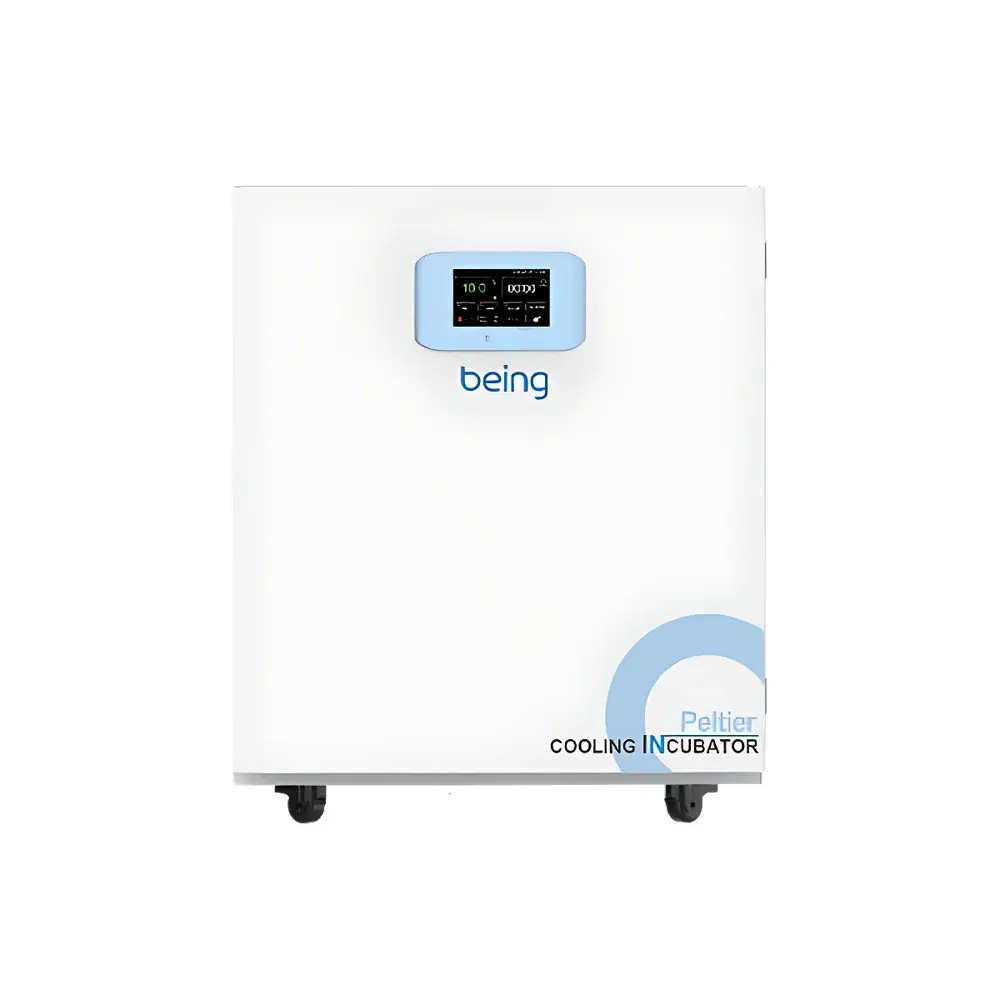
Yiheng BEC-50 Peltier-Based Low-Temperature Incubator
| Brand | Yiheng |
|---|---|
| Origin | Jiangsu, China |
| Manufacturer Type | Direct Manufacturer |
| Country of Origin | China |
| Model | BEC-50 |
| Cooling Method | Thermoelectric (Peltier) |
| Heating Method | Air-Jacketed |
| Temperature Range | 0–70°C (with ambient temperature reduction up to 20°C) |
| Temperature Accuracy | ±0.2°C |
| Temperature Uniformity | ±0.5°C (@37°C) and ±0.5°C (@25°C) |
| Internal Dimensions (W×D×H) | 340 × 430 × 350 mm |
| External Dimensions (W×D×H) | 540 × 630 × 690 mm |
Overview
The Yiheng BEC-50 Peltier-Based Low-Temperature Incubator is an engineered solution for precise, energy-efficient thermal control in life science laboratories requiring stable sub-ambient to moderate elevated temperatures. Unlike conventional compressor-based incubators, the BEC-50 employs solid-state thermoelectric (Peltier) cooling technology—enabling bidirectional temperature regulation (heating and active cooling) without refrigerants or moving mechanical compressors. This architecture delivers high reproducibility in microbial culture (e.g., psychrophilic bacteria, filamentous fungi), plant tissue culture, seed germination studies, and low-temperature sample storage protocols where thermal stability below ambient is critical. The air-jacketed heating system ensures rapid thermal response and minimal gradient formation, while the integrated insulation—achieved via high-density polyurethane foam molding—minimizes thermal leakage and supports consistent chamber performance under variable laboratory conditions.
Key Features
- Thermoelectric (Peltier) cooling module delivering >85% lower power consumption versus equivalent compressor-driven systems, with zero ozone-depleting refrigerants and silent operation.
- Intelligent air-jacketed heating system with optimized axial-flow fan circulation, ensuring uniform temperature distribution (±0.5°C at 25°C and 37°C) and fast recovery after door opening.
- 7-inch full-color capacitive touchscreen interface supporting multi-language (English/Chinese) menus, programmable 8-segment/64-step temperature profiles (1–99 h 59 min per segment), and automatic screen lock to prevent unauthorized parameter changes.
- Stainless steel 304 interior with mirror-finish electropolished surfaces and large-radius internal corners—designed for easy cleaning, corrosion resistance, and compliance with GLP hygiene standards.
- Sliding shelf mechanism with dual safety features: partial-extension locking and anti-tilt retention to prevent accidental shelf drop during loading/unloading.
- Dual independent overtemperature protection: primary controller-based cut-off and secondary hardware-limited thermal fuse conforming to IEC 61000-4-5 surge immunity and EN 61010-1 safety requirements.
Sample Compatibility & Compliance
The BEC-50 accommodates standard microbiological vessels—including Petri dishes, multi-well plates, flasks, and culture tubes—within its 52 L usable volume (340 × 430 × 350 mm). Its temperature range (0–70°C, with active cooling down to 20°C below ambient) supports ISO 8573-1-compliant low-temperature microbial growth validation, ASTM E2500-13 risk-based qualification of environmental chambers, and USP environmental monitoring applications. Optional UV-C germicidal irradiation (254 nm) mounted on the ceiling enables periodic decontamination of circulating air, reducing airborne bioburden in accordance with ISO 14644-1 Class 7 cleanroom support requirements. All electrical components meet CE marking directives (EMC 2014/30/EU, LVD 2014/35/EU), and firmware supports audit-trail-capable logging when paired with RS485-enabled data acquisition systems compliant with FDA 21 CFR Part 11 Annex 11 expectations.
Software & Data Management
The embedded controller logs real-time temperature, setpoint, alarm status, and runtime events with timestamping. Standard USB port allows direct export of CSV-formatted datasets to external drives for offline analysis in MATLAB, Python (pandas), or Excel. Optional RS485 Modbus RTU interface enables integration into centralized LabVantage or Siemens Desigo CC building management systems for remote monitoring and automated report generation. Firmware supports configurable user accounts (Administrator, Operator, Guest) with role-based access control—ensuring traceability per ALCOA+ principles. When equipped with optional cloud-connected IoT module, push notifications are transmitted via secure TLS 1.2 to mobile devices upon fault detection (e.g., sensor drift, fan failure, door ajar), facilitating proactive maintenance and minimizing experimental downtime.
Applications
- Cultivation of cold-adapted microorganisms (e.g., Pseudomonas fluorescens, Psychrobacter immobilis) under controlled sub-ambient conditions (4–15°C).
- Plant breeding programs requiring stratification, vernalization, or photoperiod-controlled germination at 2–10°C.
- Long-term stability testing of biologics, vaccines, and diagnostic reagents per ICH Q5C guidelines.
- Environmental simulation for ecotoxicology assays involving aquatic or soil-derived isolates.
- Pre-incubation conditioning of cryopreserved cell lines prior to thawing and expansion.
- Storage of temperature-sensitive enzymes, antibodies, and nucleic acid extracts requiring short-term stabilization at 2–8°C without refrigerant-based infrastructure.
FAQ
Does the BEC-50 require external ventilation or condensate drainage?
No—its Peltier module dissipates heat passively through integrated aluminum heatsinks and low-noise axial fans; no plumbing or dedicated exhaust ducting is required.
Can the incubator maintain 4°C reliably in a 30°C laboratory environment?
Yes—the specified 20°C ambient delta ensures stable operation at 4°C even in warm environments, provided ambient humidity remains below 80% RH non-condensing.
Is the UV lamp cycle programmable or manual-only?
UV irradiation is manually initiated via touchscreen with adjustable duration (1–60 min); automatic scheduling requires optional IoT firmware upgrade.
What calibration documentation is provided with shipment?
Each unit ships with NIST-traceable factory calibration certificate covering temperature accuracy (±0.2°C) and uniformity (±0.5°C) at three points (4°C, 25°C, 37°C).
How is data integrity ensured during power interruption?
Non-volatile flash memory retains all logged data and program settings for ≥72 hours without backup power; USB export is recommended for long-term archival.