
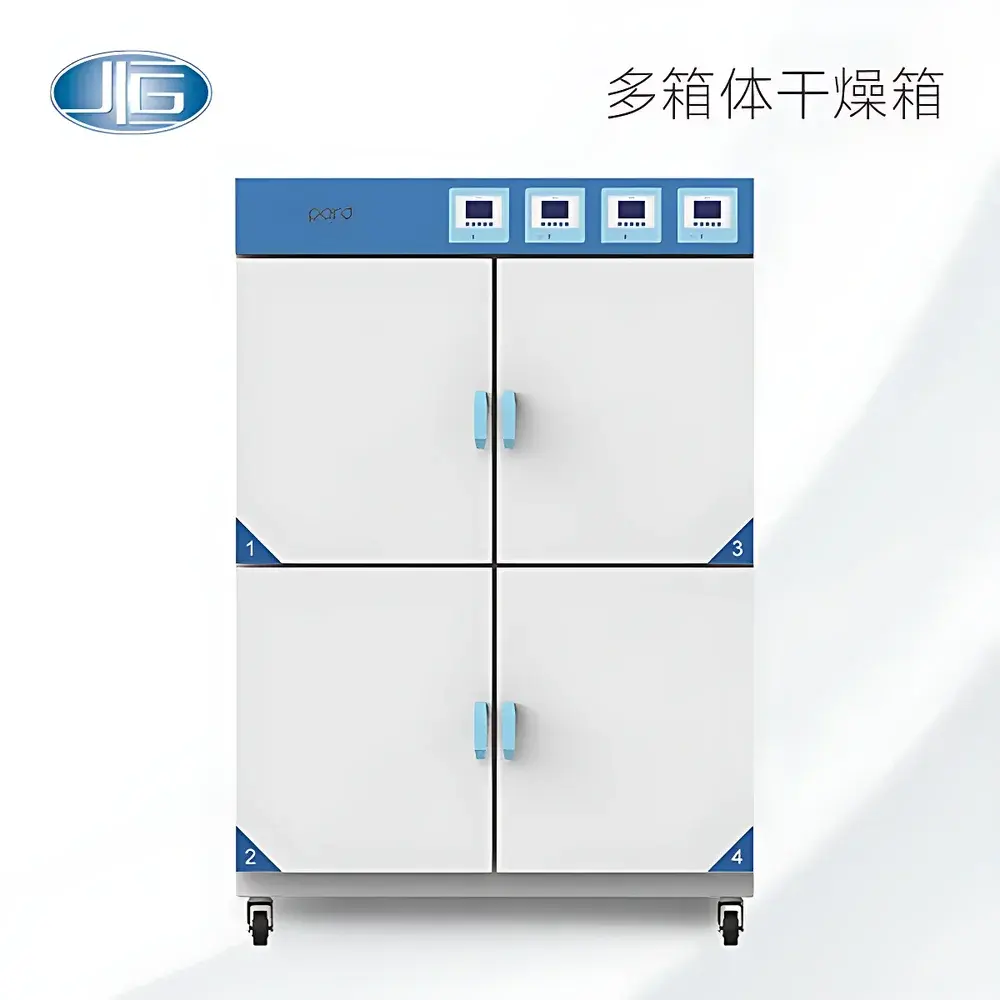
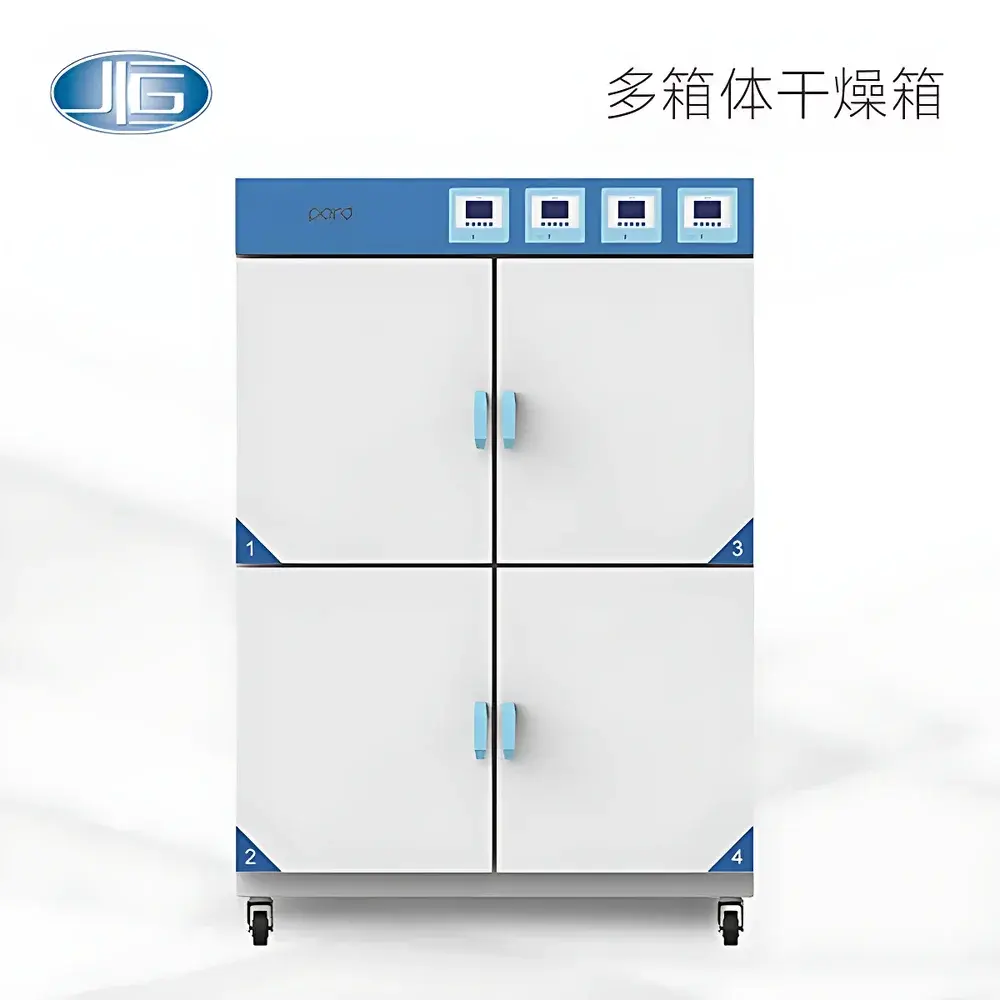
Yiheng DHG-150-2B & DHG-100-4B Multi-Chamber Drying Oven
| Brand | Yiheng |
|---|---|
| Origin | Jiangsu, China |
| Manufacturer Type | Direct Manufacturer |
| Region | Domestic (China) |
| Models | DHG-150-2B, DHG-100-4B |
| Price Range | USD 1,890–3,340 (approx.) |
| Oven Type | General-Purpose Forced-Air Drying Oven |
| Temperature Range | RT+10°C to 200°C / RT+10°C to 250°C |
| Temperature Fluctuation | ±1°C |
| External Dimensions | 705×740×1800 mm / 1220×616×1620 mm |
| Control Range | RT+10°C to 200°C / RT+10°C to 250°C |
| Chamber Configuration | Dual or Quad Independent Chambers |
| Temperature Resolution | 0.1°C |
| Interior Material | 304 Stainless Steel |
| Heating Method | Forced-Air Circulation |
| Temperature Uniformity | ±2.5°C (at 100°C test point) |
| Optional Features | Independent Over-Temperature Cut-Off, RS485 Interface, Thermal Printer Output |
Overview
The Yiheng DHG-150-2B and DHG-100-4B Multi-Chamber Drying Ovens are engineered for laboratories requiring simultaneous thermal processing of multiple sample batches under independent, precisely controlled conditions. Designed around a forced-air convection architecture, these ovens utilize high-temperature-stable axial fans and optimized airflow ducting to ensure uniform heat distribution across each chamber—critical for reproducible drying, curing, sterilization, and moisture-loss determination protocols. Unlike single-chamber ovens, the dual- and quad-chamber configurations enable parallel operation at different setpoints without cross-contamination or thermal interference, significantly improving throughput in QC labs, material science facilities, and pharmaceutical stability testing environments. Each chamber operates with its own microprocessor-based P.I.D. temperature controller, supporting real-time monitoring, programmable ramp-soak profiles, and user-defined timer functions—aligning with routine GLP-compliant workflows.
Key Features
- Independent dual or quad chamber design—four separate workspaces housed within a single footprint, reducing spatial demand by up to 60% compared to equivalent single-chamber units.
- Individual P.I.D. temperature control per chamber, with 0.1°C resolution and ±1°C fluctuation tolerance, ensuring process repeatability across extended operational cycles.
- 304 stainless steel interior construction—welded using argon-shielded TIG techniques for seamless, corrosion-resistant surfaces compatible with aqueous, acidic, or solvent-based residue handling.
- Forced-air circulation system featuring high-efficiency impellers rated for continuous operation at ≥250°C, coupled with adjustable inlet and exhaust dampers for fine-tuned humidity and volatile management.
- Dual-stage safety architecture: primary P.I.D. regulation plus an independent mechanical over-temperature cut-off (optional), compliant with IEC 61010-1 requirements for laboratory equipment safety.
- Integrated sealing system utilizing high-silica synthetic rubber gaskets—rated for >10,000 hours of service life at 250°C, minimizing maintenance frequency and downtime.
Sample Compatibility & Compliance
These ovens accommodate standard laboratory vessels—including glass Petri dishes, aluminum weighing pans, stainless steel trays, and polymer-coated racks—without risk of outgassing or dimensional distortion. The inert 304 stainless steel chamber walls resist oxidation and passivation under repeated thermal cycling, supporting ISO 17025-accredited moisture content analysis (e.g., ASTM D2231, USP <641>) and residual solvent removal per ICH Q5C guidelines. All electrical and thermal subsystems conform to GB/T 14710 (Chinese national standard for environmental adaptability of medical devices) and meet CE marking prerequisites for electromagnetic compatibility (EN 61326-1) and low-voltage safety (EN 61010-1). Optional RS485 communication supports integration into centralized lab monitoring systems adhering to FDA 21 CFR Part 11 data integrity principles when paired with validated software.
Software & Data Management
While the base configuration features a front-panel digital interface with push-button navigation and real-time setpoint/actual temperature display, optional connectivity modules enable external data logging and remote supervision. The RS485 port supports Modbus RTU protocol for bidirectional communication with SCADA platforms or LIMS servers, allowing automated timestamped recording of chamber-specific temperature trajectories, alarm events, and runtime logs. When equipped with the thermal printer option, the oven generates hard-copy audit trails—including date/time stamps, operator ID fields (via manual entry), and deviation flags—facilitating compliance with internal SOPs and external inspection requirements such as those imposed by CNAS or APAC accreditation bodies.
Applications
- Pharmaceutical quality control: residual moisture determination in APIs and excipients per USP <921> and EP 2.2.32.
- Materials testing: gravimetric analysis of polymer composites, ceramics, and battery electrode coatings.
- Food science: moisture loss profiling during shelf-life studies and accelerated stability trials.
- Environmental labs: preparation of soil and sediment samples prior to TOC or heavy metal digestion.
- Electronics manufacturing: pre-bake conditioning of PCB substrates and conformal coating substrates.
- Academic research: controlled dehydration of biological specimens, botanical samples, and mineralogical standards.
FAQ
Can all chambers operate at different temperatures simultaneously?
Yes—each chamber has its own dedicated temperature sensor, heating circuit, and P.I.D. controller, enabling fully independent setpoint programming and real-time regulation.
Is calibration documentation provided with the unit?
Factory calibration certificates (traceable to NIM China) are included; users may perform field verification using Class A PT100 probes per ISO/IEC 17025 Clause 6.5.
What is the maximum allowable load per chamber?
Maximum recommended load is 20 kg per chamber to maintain specified temperature uniformity and airflow efficiency—exceeding this may degrade ±2.5°C uniformity performance.
Does the oven support validation protocols such as IQ/OQ/PQ?
Yes—the modular hardware design, deterministic control logic, and optional data export features support full qualification under GMP Annex 15 and WHO TRS 986 Annex 11 frameworks.
Are replacement gaskets and fan assemblies available as spare parts?
All wear components—including silicone-free synthetic gaskets, high-temp fan motors, and P.I.D. controller modules—are stocked globally via Yiheng’s authorized distributor network with lead times under 10 business days.



