
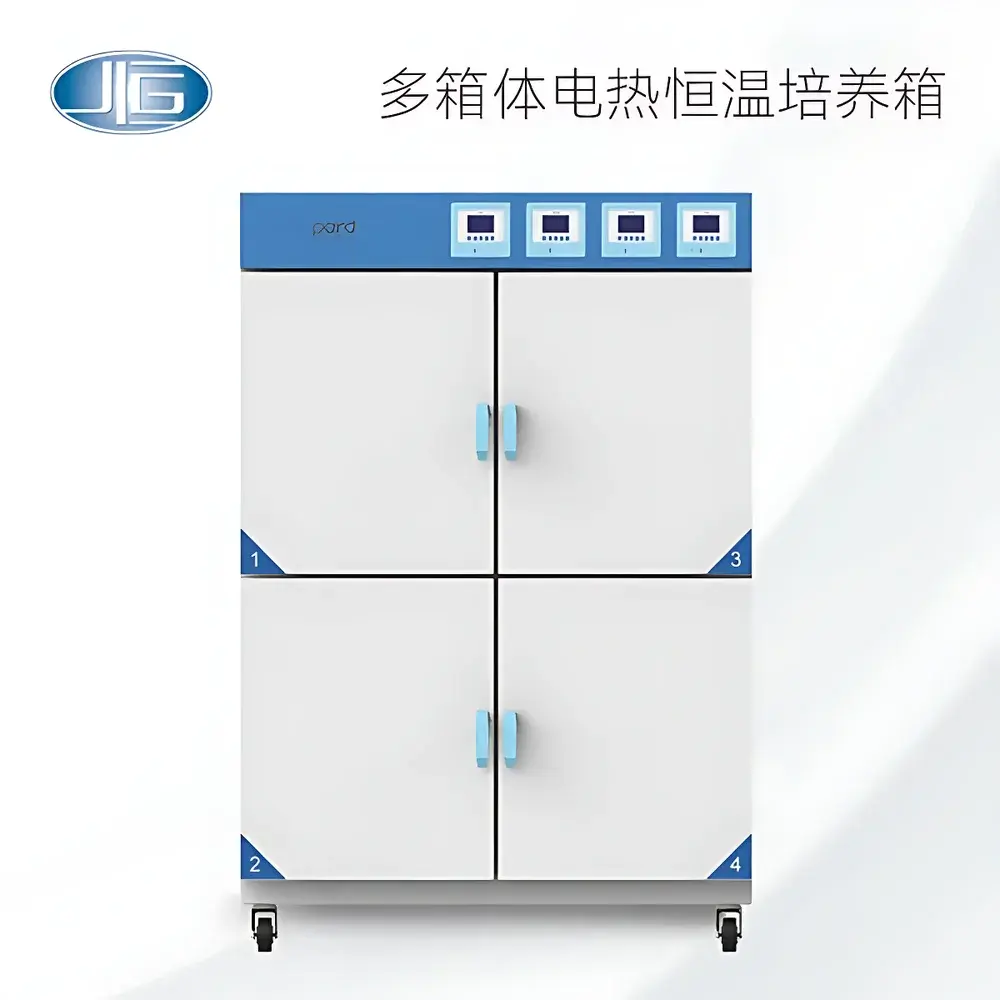
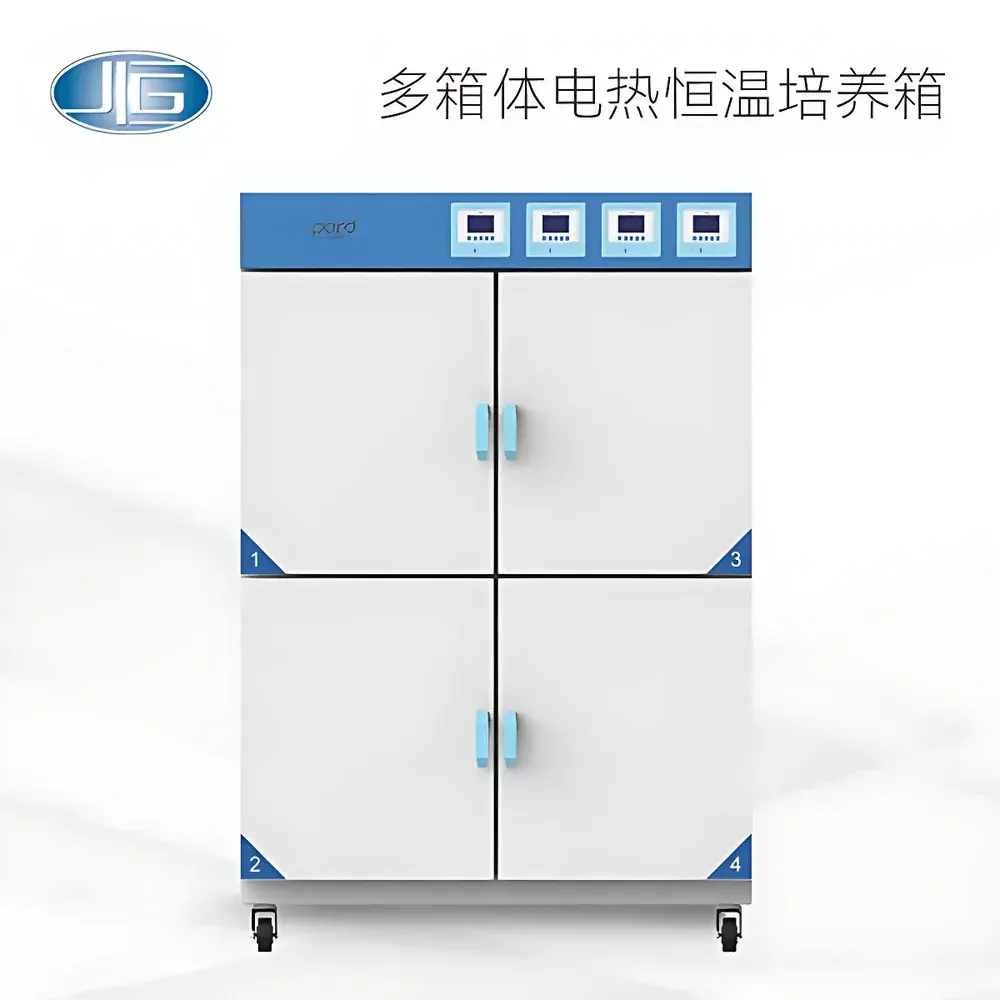
Yiheng DHP-150-2B & DHP-100-4B Multi-Chamber Forced-Air Incubators
| Brand | Yiheng |
|---|---|
| Origin | Jiangsu, China |
| Manufacturer Type | OEM/ODM Producer |
| Model | DHP-150-2B (Dual Chamber), DHP-100-4B (Quad Chamber) |
| Temperature Range | RT+5°C to 65°C |
| Chamber Dimensions (W×D×H) | 560×530×600 mm (DHP-150-2B per chamber), 455×430×510 mm (DHP-100-4B per chamber) |
| Control Accuracy | ±0.5°C (typical at 37°C), Uniformity: ±0.8°C (at setpoint), Stability: ±0.3°C (over 24 h) |
| Controller | Fuzzy PID with Timer (0–99 h 59 min) |
| Safety | Independent Over-Temperature Cut-Off, Dual-Level Thermal Alarm (High-Temp & Deviation Alert) |
Overview
The Yiheng DHP-150-2B and DHP-100-4B are multi-chamber incubators engineered for high-efficiency cell culture, microbiological growth, and environmental stability testing in academic, clinical, and industrial life science laboratories. Unlike single-chamber units, these models integrate two (DHP-150-2B) or four (DHP-100-4B) thermally isolated compartments within a single structural frame—enabling parallel experiments under distinct temperature conditions without cross-contamination or thermal crosstalk. Each chamber operates with independent microprocessor-based control, leveraging natural convection airflow to maintain uniform thermal distribution while eliminating mechanical noise and minimizing sample desiccation—a critical requirement for long-term microbial or mammalian cell assays. The design adheres to fundamental incubator performance principles defined in ISO 13408-1 (aseptic processing) and supports GLP-compliant workflows through traceable temperature logging and alarm event recording.
Key Features
- Independent chamber control: Each compartment features dedicated temperature sensors, heating elements, and PID algorithms—ensuring zero inter-chamber thermal interference and enabling simultaneous operation at different setpoints (e.g., 25°C, 30°C, 37°C, and 42°C).
- Natural convection architecture: No internal fans or blowers; heat transfer occurs via buoyancy-driven air movement—eliminating vibration, airflow-induced evaporation, and aerosol dispersion risks during sensitive culture work.
- Electropolished stainless-steel interior (304 grade): Seamless, non-porous surface resists corrosion, facilitates ISO 14644-1 Class 5-compatible cleaning, and withstands repeated disinfection with ethanol, hydrogen peroxide vapor, or quaternary ammonium agents.
- Fuzzy logic PID controller: Compensates for load-dependent thermal inertia and ambient fluctuations—achieving typical stability of ±0.3°C over 24 hours and uniformity of ±0.8°C across the working volume (per IEC 61000-4-3 immunity testing standards).
- Integrated observation window (tempered glass, double-sealed): Provides real-time visual monitoring without opening doors—reducing thermal disturbance and contamination risk during routine inspection.
- Dual-stage thermal safety system: Primary controller maintains setpoint; secondary independent thermostat triggers audible/visual alarm and cuts power if temperature exceeds user-defined limit by >2°C—meeting UL 61010-1 Clause 10.3.2 requirements for lab equipment overtemperature protection.
Sample Compatibility & Compliance
These incubators accommodate standard laboratory vessels including Petri dishes (up to 150 mm), multi-well plates (6–96-well), culture flasks (T25–T225), and glass serum bottles. The absence of forced airflow ensures compatibility with low-volatility media formulations and minimizes edge-effect drying in peripheral wells. Units comply with CE marking directives (2014/30/EU EMC, 2014/35/EU LVD), meet RoHS 2011/65/EU material restrictions, and support audit-ready documentation for FDA-regulated environments where temperature deviation logs and alarm histories must be retained per 21 CFR Part 11 Annex 11 guidelines. Optional RS-485 Modbus RTU interface enables integration into centralized BMS platforms for facility-wide environmental monitoring.
Software & Data Management
While the base configuration uses an embedded LCD interface with manual parameter entry, optional data-logging modules record temperature readings at user-selectable intervals (1–60 min) onto removable SD cards. Logs include timestamped chamber ID, setpoint, actual temperature, alarm status, and timer countdown—formatted as CSV for import into LIMS or statistical analysis tools (e.g., JMP, GraphPad Prism). All firmware updates are performed via USB port using signed binary files, ensuring integrity verification before installation. Audit trails capture operator ID (via optional keypad login), parameter changes, and alarm acknowledgments—supporting ALCOA+ data integrity principles (Attributable, Legible, Contemporaneous, Original, Accurate, Complete, Consistent, Enduring, Available).
Applications
- Mammalian and insect cell line propagation under controlled thermal conditions (e.g., CHO, HEK293, Sf9).
- Bacterial and fungal growth studies requiring isolation of strain-specific incubation profiles (e.g., E. coli at 37°C vs. Aspergillus niger at 30°C).
- Enzyme activity assays where thermal consistency directly impacts kinetic reproducibility (e.g., qPCR master mix equilibration).
- Stability testing of biologics and excipients per ICH Q1A(R2) guidelines—leveraging dual/triple chamber setups to run accelerated (40°C/75% RH) and real-time (25°C/60% RH) conditions concurrently.
- Teaching labs conducting comparative microbiology experiments—maximizing throughput per square meter of bench space.
FAQ
Can multiple chambers operate at different temperatures simultaneously?
Yes—each chamber has fully independent control circuitry, allowing concurrent operation across the full range of RT+5°C to 65°C.
Is humidity control available?
No—these models are dry-air incubators. Humidity management requires external humidification systems or separate CO2/humidity-enabled incubators.
What is the maximum allowable load per chamber?
For optimal thermal uniformity, loading should not exceed 70% of internal volume; recommended maximum mass is 15 kg per chamber when using standard racks.
Does the unit support remote monitoring or network connectivity?
Standard configuration includes local display only; RS-485 Modbus RTU or Ethernet-enabled controllers are available as factory-installed options.
How often does the temperature sensor require calibration verification?
Per ISO/IEC 17025:2017, annual verification against NIST-traceable reference probes is recommended—documentation templates are provided in the user manual.




