
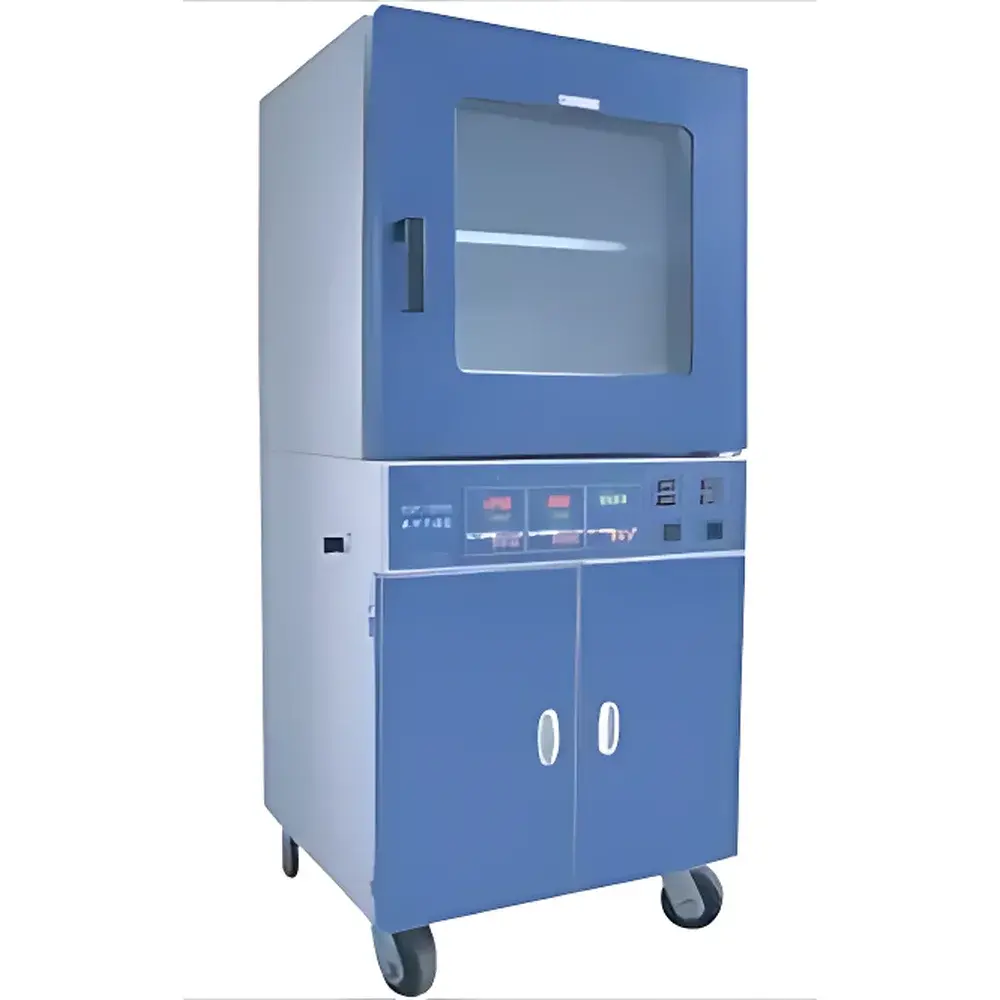
Yiheng DZF Series Vacuum Drying Oven
| Brand | Yiheng |
|---|---|
| Origin | Shanghai, China |
| Model Series | DZF |
| Power Supply | AC220V/50Hz (standard), AC380V/50Hz (DZF-6500) |
| Temperature Range | RT+10°C to 200°C (standard) |
| Temperature Resolution | 0.1°C |
| Temperature Uniformity | ±1°C |
| Ultimate Vacuum | ≤133 Pa |
| Chamber Dimensions (W×D×H mm) | 300×300×275 to 750×1160×1050 |
| External Dimensions (W×D×H mm) | 550×490×1240 to 790×1030×1855 |
| Shelf Configuration | 1–4 stainless steel shelves (some models with independent shelf temperature control) |
| Controller Type | Microprocessor-based digital timer (standard) |
| Vacuum Gauge | Imported analog or digital vacuum gauge (model-dependent) |
Overview
The Yiheng DZF Series Vacuum Drying Oven is an engineered solution for controlled, low-temperature dehydration of thermally sensitive, oxidation-prone, or chemically unstable materials. Operating on the principle of reduced-pressure evaporation—where lowering ambient pressure decreases the boiling point of solvents—the system enables drying at significantly lower temperatures than conventional convection ovens. This preserves structural integrity, prevents thermal degradation, and minimizes decomposition or oxidation risks in pharmaceutical intermediates, biological samples, polymer precursors, and high-purity reagents. The chamber’s double-layered, insulated stainless steel construction, combined with optimized internal heating element placement and uniform air-gap distribution, addresses thermal conduction inefficiencies commonly observed in legacy vacuum oven designs—resulting in improved temperature homogeneity across the working volume and enhanced reproducibility between cycles.
Key Features
- Microprocessor-controlled digital timer with adjustable dwell time (0–9999 minutes), enabling unattended operation and precise process repeatability.
- High-efficiency heating system with strategically distributed embedded heating elements in the chamber walls and door, minimizing thermal gradients and improving heat transfer fidelity.
- Stainless steel inner chamber (SUS304 standard) resistant to corrosion from organic solvents, acids, and alkaline vapors; seamless welded corners for easy cleaning and contamination control.
- Imported analog or digital vacuum gauge (depending on model), calibrated to ISO 27872 traceable standards, providing real-time feedback on chamber pressure down to ≤133 Pa.
- Select models (e.g., DZF-6500, DZF-6930, BPZ-6123) feature independently controllable heated shelves—critical for multi-layer sample processing requiring differential thermal profiles.
- Optional inert gas inlet port (N₂ or Ar) allows purging and backfilling under controlled atmosphere, supporting oxygen-sensitive applications including battery electrode drying and catalyst stabilization.
Sample Compatibility & Compliance
The DZF Series accommodates a broad range of sample formats—including glass vials, aluminum pans, ceramic crucibles, and custom trays—without compromising vacuum integrity. Its design conforms to general laboratory safety requirements per IEC 61010-1:2010 (Safety Requirements for Electrical Equipment for Measurement, Control, and Laboratory Use). While not certified as Class I or II medical devices, the oven supports GLP-compliant workflows when integrated into validated protocols for residual solvent analysis (per USP ), moisture content determination (ASTM E1868), and stability-indicating drying procedures. Data logging capability (when paired with optional RS485/Modbus interface or external DAQ systems) facilitates audit-ready documentation aligned with FDA 21 CFR Part 11 principles for electronic records and signatures.
Software & Data Management
Standard units operate via front-panel microcontroller interface with non-volatile memory storing up to 10 user-defined programs. BPZ-series models integrate programmable LCD controllers supporting ramp-hold profiles, multi-step sequences, and real-time parameter visualization (chamber temperature, setpoint, elapsed time, vacuum level). Optional communication modules enable integration with LabVIEW, MATLAB, or LIMS platforms via ASCII protocol over RS232/RS485. All recorded operational data—including start/stop timestamps, vacuum decay curves, and temperature deviation logs—can be exported in CSV format for trend analysis, deviation investigation, and regulatory reporting. Audit trails are maintained locally with timestamped event logs covering parameter changes, door openings, and alarm triggers.
Applications
- Pharmaceutical R&D: Drying of lyophilized intermediates, active pharmaceutical ingredients (APIs), and excipients without polymorphic transition.
- Materials Science: Solvent removal from MOFs, graphene oxide dispersions, and perovskite precursor films prior to annealing.
- Electronics Manufacturing: Moisture evacuation from PCB substrates and conformal coating pre-bake processes.
- Food & Agriculture: Dehydration of enzyme-rich botanical extracts and volatile flavor compounds under oxygen-free conditions.
- Academic Research: Controlled desolvation of coordination polymers, metal-organic gels, and supramolecular assemblies where thermal lability limits conventional drying methods.
FAQ
What vacuum level can the DZF series achieve, and how is it verified?
All standard DZF models reach ≤133 Pa (1 Torr) under no-load conditions, verified using factory-calibrated vacuum gauges traceable to national metrology institutes. Performance validation reports are available upon request.
Can the oven be used with flammable solvents?
Yes—provided appropriate explosion-proof vacuum pumps and solvent recovery traps are employed upstream, and chamber purge cycles with inert gas are implemented pre- and post-drying per OSHA 1910.106 guidelines.
Is independent shelf temperature control available across all models?
No—only select high-capacity models (DZF-6500, DZF-6930, DZF-6210, and all BPZ-series units) support individually regulated shelf heating. Standard DZF-60xx units maintain uniform chamber temperature only.
Does the system support IQ/OQ/PQ documentation packages?
Yiheng provides standard factory test reports and dimensional/mechanical certification. Full qualification support—including installation, operational, and performance qualification templates—is available through authorized service partners upon project engagement.
What maintenance intervals are recommended for long-term reliability?
Vacuum seal inspection every 6 months; gauge recalibration annually; heating element resistance check semiannually; oil change for connected rotary vane pumps per manufacturer schedule (typically every 500 operating hours).
Related Products



