
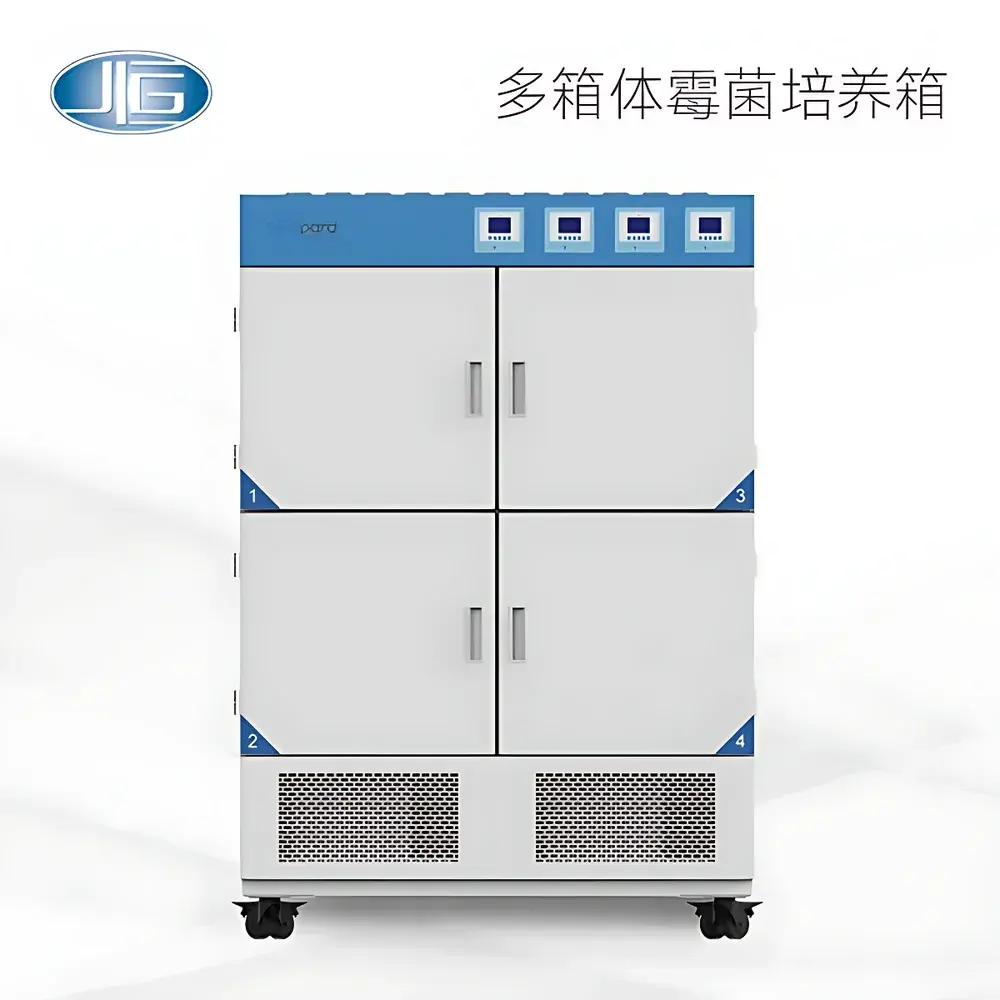
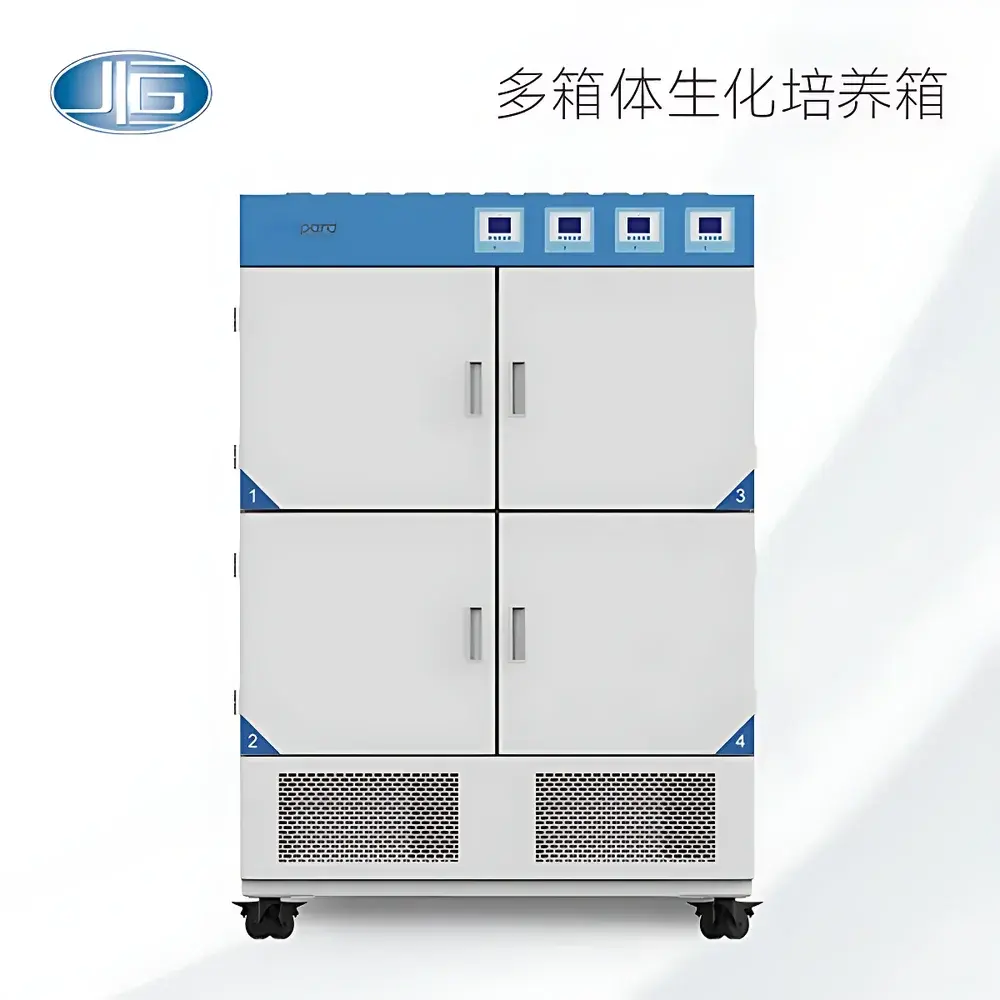
Yiheng LRH/MJ Series Multi-Chamber Biochemical & Mold Incubators
| Brand | Yiheng |
|---|---|
| Origin | Jiangsu, China |
| Manufacturer Type | Direct Manufacturer |
| Origin Category | Domestic (China) |
| Models | LRH-150-2B, LRH-100-4B, MJ-150-2B, MJ-100-4B |
| Price Range | USD 3,400 – 6,800 (FOB Jiangsu) |
| Control Method | Mechanical Push-Button Interface |
| Air Circulation | Natural Convection |
| Temperature Range | 0–60 °C |
| Temperature Fluctuation | ±0.5 °C (at both high and low setpoints) |
| Temperature Uniformity | ±1 °C (measured at 25 °C reference point) |
| Chamber Configuration | Dual-chamber (2B) or Quad-chamber (4B) |
| Interior Material | Mirror-Finish Stainless Steel (AISI 304), Radius-Corner Design |
| Shelf Adjustability | Yes, stepless vertical positioning |
| Compressor | Brand-name hermetic refrigeration unit with R134a or R600a eco-friendly refrigerant |
| Temperature Controller | Microprocessor-based PID controller with digital LCD display, timer function, and over-temperature cut-off (optional) |
| Fan Speed Control | Three-level manual adjustment |
| Data Output | Optional RS485 port or thermal printer interface (for temperature logging) |
Overview
The Yiheng LRH and MJ Series Multi-Chamber Incubators are engineered for laboratories requiring simultaneous yet independent environmental control across multiple sample zones. Designed specifically for biochemical culture, fungal growth studies (e.g., Aspergillus, Penicillium, Cladosporium), stability testing, and microbiological quality assurance, these units implement natural convection-based thermal management—eliminating forced airflow that may desiccate sensitive cultures or disrupt colony morphology. Each chamber operates autonomously with dedicated PID temperature regulation, enabling concurrent experiments at distinct setpoints (e.g., 25 °C for mesophilic bacteria and 37 °C for mammalian cell pre-incubation) without cross-chamber thermal coupling. The absence of fans ensures minimal vibration transfer and avoids aerosol dispersion—a critical consideration in BSL-1/BSL-2 biosafety environments where containment integrity is prioritized over rapid equilibration.
Key Features
- Modular dual-chamber (2B) and quad-chamber (4B) configurations reduce footprint by up to 40% compared to equivalent single-chamber units—ideal for space-constrained academic labs, QC facilities, and contract research organizations.
- Independent microprocessor PID controllers per chamber deliver ±0.5 °C fluctuation performance across the full 0–60 °C operating range, validated per ISO 13408-2 Annex C protocols for incubator qualification.
- Mirror-finish AISI 304 stainless steel interior with radius-corner geometry minimizes crevices, facilitating compliant cleaning validation (e.g., ATP bioluminescence swabbing) and reducing biofilm retention risk.
- Hermetically sealed, high-efficiency compressor system uses non-ozone-depleting refrigerants (R134a or R600a), achieving energy consumption ≤1.8 kWh/day (LRH-100-4B, 25 °C steady state), supporting ISO 50001-aligned lab sustainability goals.
- Three-position manual fan speed selector (off / low / medium) allows user-defined air exchange rates—critical for hyphal growth assays where excessive ventilation dries agar media surfaces.
- Redundant safety architecture includes hardware-based over-temperature cutoff (independent of main controller) and visual/audible alarm activation—meeting IEC 61010-1 Clause 11.3 requirements for laboratory equipment protection.
Sample Compatibility & Compliance
These incubators accommodate standard microbiological formats: Petri dishes (90 mm, 150 mm), test tubes (13×100 mm, 16×150 mm), multi-well plates (6–96-well), and Erlenmeyer flasks (up to 1 L). The natural convection design ensures compatibility with low-volatility media (e.g., Sabouraud Dextrose Agar, Potato Dextrose Agar) and filamentous fungi requiring high relative humidity retention (>85% RH at 25–30 °C, achievable via optional water pan). Units comply with GB/T 23789–2009 (Chinese national standard for incubators) and support IQ/OQ documentation packages aligned with FDA 21 CFR Part 11 data integrity expectations when equipped with RS485 logging interfaces.
Software & Data Management
While the base configuration features a standalone LCD controller with real-time temperature readout and programmable timer (1 min–999 h), optional RS485 communication enables integration into centralized lab monitoring systems (e.g., Siemens Desigo CC, LabVantage LIMS). Logged data—including timestamped chamber temperatures, alarm events, and runtime hours—is exportable as CSV for audit trail reconstruction. Thermal printer output satisfies GLP Annex 11 traceability requirements for short-term stability studies under ICH Q5C guidelines.
Applications
- Fungal identification and strain preservation per CLSI M38-A3 methodology
- Pharmaceutical environmental monitoring (EM) program incubation of settle plates and air samples
- Food safety testing: Aspergillus flavus aflatoxin production assays at 28 °C/85% RH
- Academic mycology: Comparative growth kinetics of psychrotolerant vs. thermotolerant molds
- Bioburden recovery validation per USP using tryptic soy agar plates
- Plant pathology: Spore germination studies on potato blight (Phytophthora infestans) under controlled moisture gradients
FAQ
Can these incubators maintain humidity without external humidifiers?
Natural convection limits internal air exchange; users achieve >85% RH at 25–30 °C by placing stainless steel water pans inside chambers—no active humidification system required.
Is calibration certificate included with shipment?
Factory calibration report (NIST-traceable RTD probe) is provided; UKAS or ISO/IEC 17025-accredited third-party certification is available upon request.
What is the mean time between failures (MTBF) for the compressor system?
Based on 2023 field reliability data from 1,247 installed units, MTBF exceeds 32,000 operational hours under continuous 25 °C operation.
Are shelves supplied with non-slip coating?
Standard shelves feature electropolished stainless steel; optional silicone-coated shelves (part #YH-SIL-200) prevent plate slippage during transport between incubator and laminar flow hood.
Does the RS485 interface support Modbus RTU protocol?
Yes—default configuration uses Modbus RTU over RS485 (addressable up to 32 devices), with register map documentation supplied in English per IEC 61158.



