
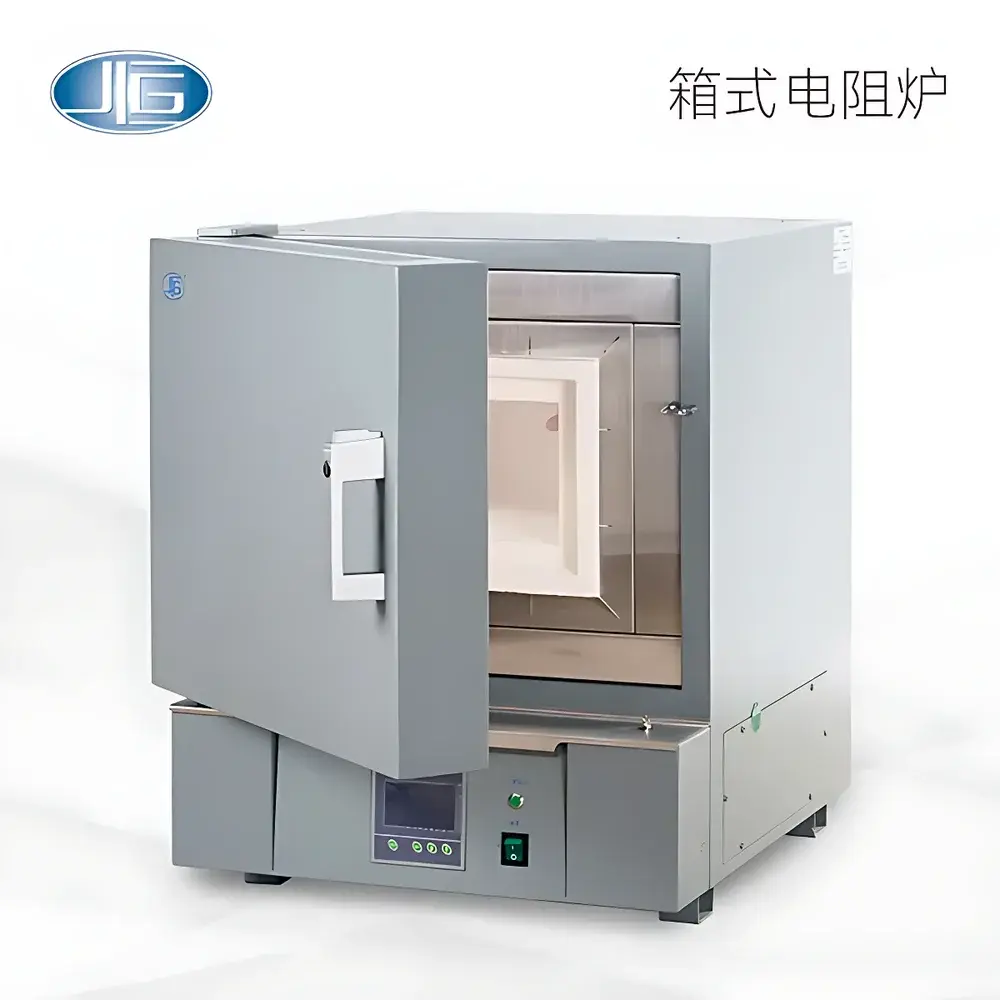
Yiheng SX2 Series Programmable Box-Type Muffle Furnace
| Brand | Yiheng |
|---|---|
| Origin | Shanghai, China |
| Manufacturer Type | Direct Manufacturer |
| Product Category | Domestic |
| Model | SX2 Series |
| Instrument Type | Box Furnace |
| Maximum Temperature | 1200 °C |
| Temperature Control Accuracy | ±1 °C |
| Rated Power | 10 kW |
| Heating Method | Electric Resistance Heating |
| Insulation Material | Ceramic Fiber Board |
| Safety Features | Over-Temperature Protection, Door Interlock Switch, Dual-Stage Thermal Cut-Off, Fault Diagnostics (Heater Open, Thermocouple Failure, Memory Corruption, Over-Temp), Audible/Visual Alarm |
| Controller | Microprocessor-Based PID with Multi-Step Programmability (7 Programs × 9 Segments Each |
| Segment Duration | 0–5999 min) |
Overview
The Yiheng SX2 Series Programmable Box-Type Muffle Furnace is an industrial-grade laboratory furnace engineered for precise thermal processing in materials science, metallurgy, ceramics, and quality control laboratories. Operating on the principle of resistive heating via embedded high-alloy resistance wire elements, the furnace delivers uniform, repeatable temperature profiles up to 1200 °C within a fully insulated chamber. Its muffle design isolates the heating zone from external atmosphere and combustion byproducts—ensuring sample purity during ashing, sintering, annealing, calcination, and heat treatment protocols. The unit complies with fundamental safety and performance expectations aligned with IEC 61000-6-3 (EMC) and GB/T 10066.1–2004 (General Requirements for Industrial Resistance Furnaces), supporting GLP-aligned workflows where thermal traceability and procedural repeatability are essential.
Key Features
- Microprocessor-based PID temperature controller with intuitive front-panel interface, enabling real-time setpoint adjustment, ramp/soak programming, and dynamic response to thermal load variations.
- Multi-segment programmable logic: supports up to 7 independent programs, each comprising 9 customizable temperature/time segments—ideal for complex thermal cycles such as controlled cooling ramps or multi-stage sintering schedules.
- High-efficiency ceramic fiber insulation board lining minimizes thermal mass and surface casing temperature (<60 °C at ambient conditions), reducing energy consumption and improving operator safety.
- Reinforced steel housing with double-layer construction and optimized door sealing mechanism limits convective heat loss and enhances intra-chamber temperature uniformity (±5 °C across working volume at 1000 °C).
- Integrated dual-level safety architecture: primary over-temperature cut-off (mechanical bimetal switch), secondary electronic limit (programmable alarm threshold), plus door interlock that de-energizes heating elements upon opening.
- Comprehensive fault diagnostics system continuously monitors heater continuity, thermocouple integrity (Type K standard), internal memory status, and thermal deviation—triggering audible/visual alerts and automatic shutdown per ISO 13857 hazard prevention guidelines.
Sample Compatibility & Compliance
The SX2 series accommodates crucibles, boats, and refractory trays made from alumina, silicon carbide, or quartz—compatible with inert, oxidizing, and mildly reducing atmospheres (when used with optional gas inlet kits). It meets structural and operational requirements referenced in ASTM E1112 (Standard Specification for Laboratory Furnaces), ISO 8501-1 (Surface Preparation Standards for Thermal Processing), and Chinese national standard JB/T 8195.2–2014 (Resistance Furnaces for Laboratory Use). While not intrinsically rated for hazardous area use, its electrical design conforms to GB 4706.1–2005 (Safety of Household and Similar Electrical Appliances), including reinforced grounding, IP20 enclosure rating, and reinforced insulation between live parts and accessible surfaces.
Software & Data Management
The furnace operates autonomously without external software dependency; however, optional RS485 Modbus RTU interface enables integration into centralized lab monitoring systems (e.g., LabVantage, Siemens Desigo, or custom SCADA platforms) for remote parameter setting, real-time temperature logging, and event-triggered data export. All programmed sequences are retained in non-volatile memory with battery-backed retention (>10 years). Audit trail functionality—including operator ID (via optional keypad login), program activation timestamps, and fault event logs—is available when interfaced with compliant LIMS or MES environments adhering to FDA 21 CFR Part 11 requirements for electronic records and signatures.
Applications
- Thermal gravimetric analysis (TGA) sample preparation and residue quantification in environmental and pharmaceutical QC labs.
- Sintering of metal oxide powders and ceramic green bodies under controlled ramp rates (0.1–30 °C/min typical range, dependent on load mass and chamber geometry).
- Ash content determination per AOAC 942.05 and ISO 2171 for food, feed, and biomass samples.
- Heat treatment of calibration standards, reference materials, and sensor test specimens requiring stable soak conditions at 800–1100 °C.
- Pre-firing of catalyst supports and electrode substrates prior to electrochemical characterization.
- Controlled oxidation studies of alloys and coatings under atmospheric air or nitrogen-purged conditions.
FAQ
What thermocouple type is factory-calibrated for use with the SX2 series?
Type K (Chromel–Alumel) base-metal thermocouples are standard; optional Type S (Platinum–Rhodium) probes are available for extended stability above 1000 °C.
Is the furnace suitable for vacuum or controlled-atmosphere operation?
No—standard configuration is ambient-air only. Optional flanged ports and gas purge fittings can be added for inert-gas blanketing, but vacuum capability requires third-party retrofitting and is not supported under warranty.
How is temperature uniformity validated across the working chamber?
Uniformity is verified per ASTM E2203 using a 9-point thermocouple mapping procedure at three representative temperatures (300 °C, 800 °C, and 1100 °C); results are documented in the出厂 calibration certificate supplied with each unit.
Can the controller store user-defined programs permanently after power loss?
Yes—non-volatile flash memory retains all program data, setpoints, and system configurations indefinitely without backup power.
What maintenance intervals are recommended for long-term reliability?
Ceramic fiber insulation requires no scheduled replacement; annual inspection of door gasket compression, thermocouple seating, and terminal block tightness is advised per manufacturer’s service bulletin SB-SX2-2023.



