
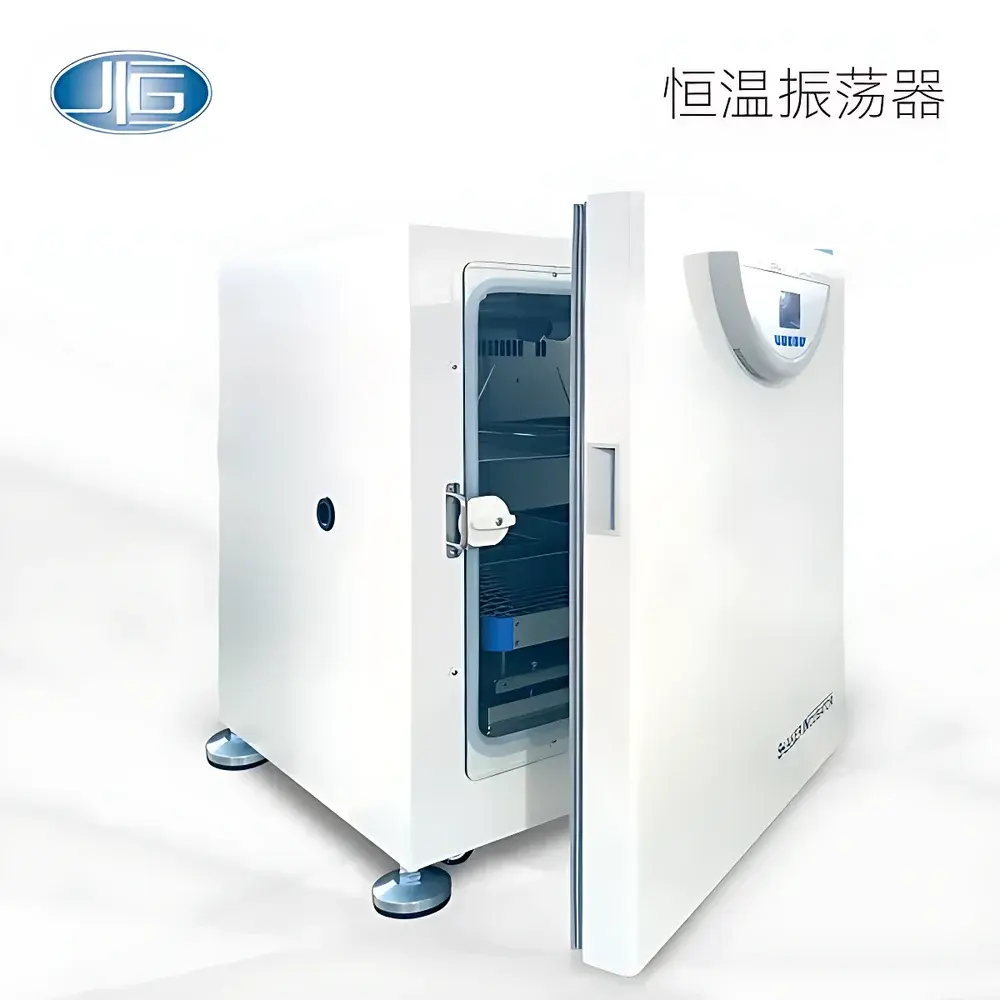
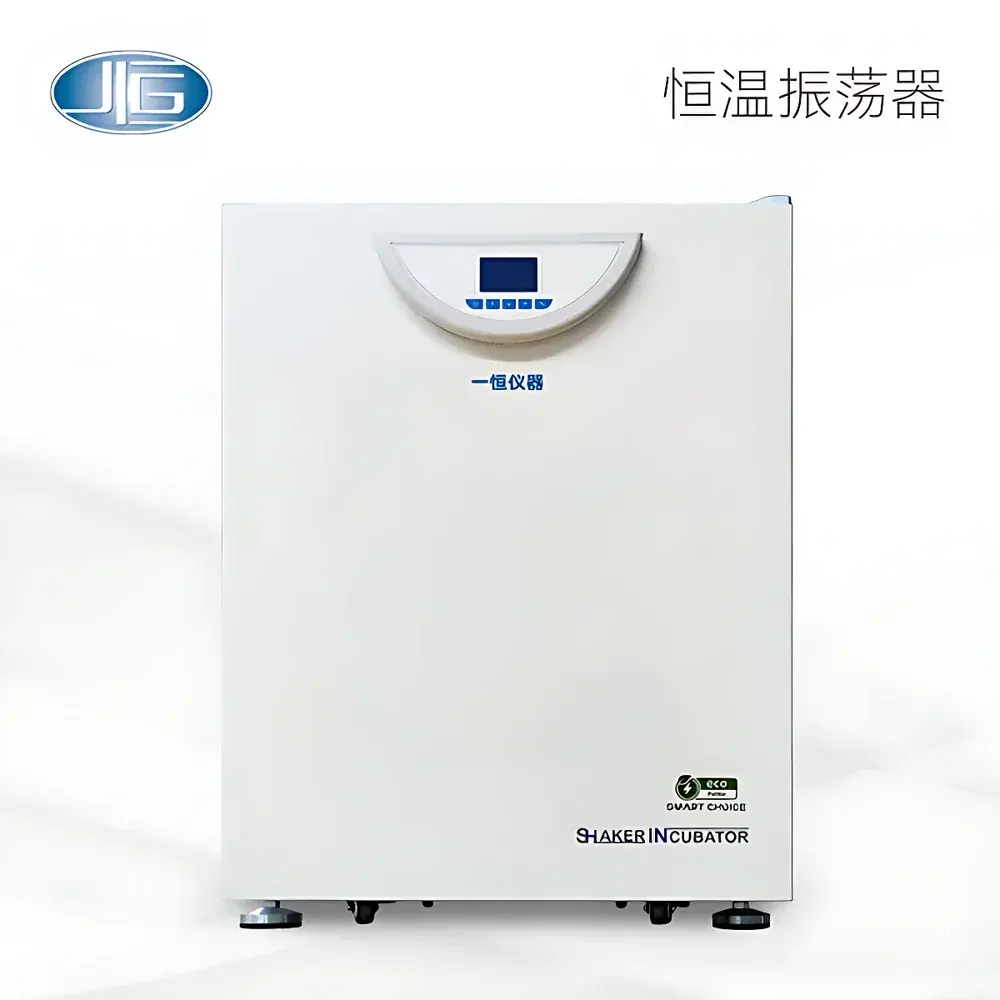
YIHENG THZ-98AB Dual-Shelf Air-Bath Incubator Shaker with LCD Interface
| Brand | YIHENG |
|---|---|
| Origin | Shanghai, China |
| Manufacturer Type | OEM Manufacturer |
| Region of Origin | Domestic (China) |
| Model | THZ-98AB (Dual-Shelf) |
| Instrument Type | Air-Bath Constant-Temperature Shaker / Incubator Shaker |
| Timer Range | 0–5999 min |
| Oscillation Frequency | 40–300 rpm |
| Oscillation Amplitude | 20 mm |
| Temperature Control Range | RT+5°C to 65°C |
| Shelf Quantity | 2 shelves |
Overview
The YIHENG THZ-98AB Dual-Shelf Air-Bath Incubator Shaker is an integrated laboratory platform engineered for precision cell culture, microbial growth, enzyme assays, and biochemical reaction monitoring under controlled temperature and agitation conditions. It operates on the principle of forced-air convection heating combined with orbital shaking—providing uniform thermal distribution across dual independent shelves while maintaining mechanical stability at variable rotational speeds. Unlike conventional shakers or standalone incubators, this unit bridges functional gaps by enabling seamless transition between agitation and static incubation modes without sample relocation. Its air-bath architecture eliminates direct liquid contact with heating elements, minimizing thermal gradients and condensation risks—critical for long-term suspension cultures and sensitive recombinant protein expression workflows. Designed for GLP-compliant environments, the system supports traceable operation through programmable logic and non-volatile parameter retention.
Key Features
- Dual-shelf configuration (2 × stainless steel platforms) enables parallel processing of heterogeneous sample sets—ideal for comparative studies or multi-condition screening.
- LCD graphical interface with menu-driven navigation supports intuitive setup of temperature setpoints, oscillation speed, amplitude, and timer duration—no external software required for basic operation.
- Microprocessor-based PID control ensures ±0.3°C temperature accuracy and ±2 rpm speed regulation across the full operating range (40–300 rpm), with automatic compensation for ambient load fluctuations.
- Energy-efficient DC motor drive delivers high starting torque, wide-speed linearity, and zero-maintenance continuous-duty performance—validated for uninterrupted operation over 720 hours.
- Full 304 stainless steel interior—including shelves, chamber walls, and door liner—resists corrosion from sterilants, solvents, and biological residues; compatible with autoclave-safe accessories.
- Integrated safety architecture includes door-interlocked shutdown (halts heating, airflow, and oscillation upon opening), independent overtemperature cutoff (adjustable limit up to 70°C), and electronic soft-start circuitry to prevent splashing during acceleration.
- 25 mm access port on left chamber wall permits sterile cable routing for external sensors, gas lines, or pH/DO probes—enabling integration into advanced bioprocess workflows.
Sample Compatibility & Compliance
The THZ-98AB accommodates standard microbiological vessels including Erlenmeyer flasks (50–2000 mL), test tubes, deep-well plates, and custom bioreactor bags mounted via optional clamps or universal platforms. Its uniform airflow pattern (achieved via rear-mounted centrifugal fan with auto-throttling logic) prevents localized evaporation in multi-well formats—a key requirement for high-throughput assay reproducibility. The system complies with IEC 61010-1:2010 safety standards for laboratory equipment and meets electromagnetic compatibility (EMC) Class B requirements per EN 61326-1. While not certified for ISO 5 cleanroom use, its sealed chamber design and optional UV germicidal lamp (254 nm, 15 W) support aseptic practices aligned with USP environmental monitoring guidelines.
Software & Data Management
The base unit operates autonomously via embedded firmware with non-volatile memory—retaining user-defined parameters (temperature, rpm, time) during power interruption and resuming pre-failure settings upon restoration. Optional RS-485 serial interface (Modbus RTU protocol) enables integration with SCADA systems or centralized lab management platforms for remote monitoring and alarm logging. USB host port supports direct data export to FAT32-formatted USB drives, recording timestamped temperature and speed profiles at 10-second intervals. When paired with YIHENG’s optional PC software suite, users can generate audit-ready reports compliant with FDA 21 CFR Part 11 requirements—including electronic signatures, change history, and user-access logs.
Applications
- Mammalian and insect cell suspension culture requiring precise O2 transfer and shear-sensitive handling.
- Recombinant protein expression in E. coli and yeast strains where temperature ramping and agitation synchronization improve yield consistency.
- Antibiotic susceptibility testing (AST) and minimum inhibitory concentration (MIC) determination using broth microdilution methods.
- Enzyme kinetics studies involving thermostable or cold-adapted biocatalysts across defined thermal gradients.
- Environmental microbiology applications including wastewater biofilm development and soil slurry enrichment under aerobic agitation.
- Pre-analytical sample homogenization prior to HPLC, GC-MS, or NGS library preparation protocols.
FAQ
Does the THZ-98AB support multi-segment programming?
Yes—optional firmware upgrade enables up to 9 programmable segments with independent temperature, speed, and time settings per segment, allowing complex ramp-and-hold protocols for differentiation studies or adaptive stress response assays.
Can the unit maintain sterility during extended runs?
While not a Class II biosafety cabinet, the sealed chamber, optional UV lamp, and stainless-steel surfaces support routine decontamination cycles; users must implement supplemental laminar flow or glovebox transfer for strict axenic workflows.
Is calibration documentation provided?
Factory calibration certificates (temperature and speed) are included; field recalibration is supported via front-panel adjustment using NIST-traceable reference probes.
What is the maximum flask loading capacity per shelf?
With standard universal clamps: up to eight 1 L flasks or sixteen 500 mL flasks—load distribution must remain balanced within ±10% mass variance to ensure mechanical stability at >200 rpm.
How is heat dissipation managed during continuous operation?
The unit employs low-thermal-resistance aluminum finned heat exchangers and variable-speed fan control—surface temperature rise remains below 35°C above ambient even at 65°C setpoint and 300 rpm, minimizing lab HVAC load.





