
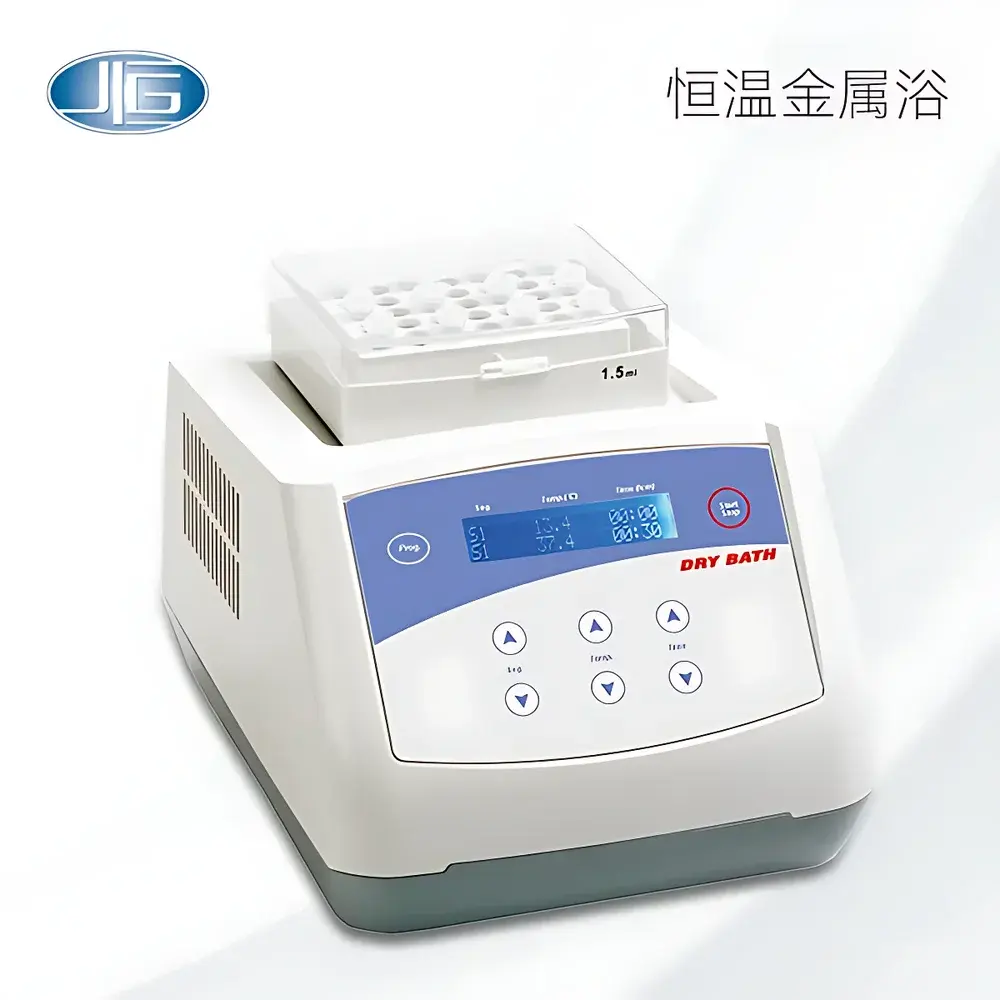
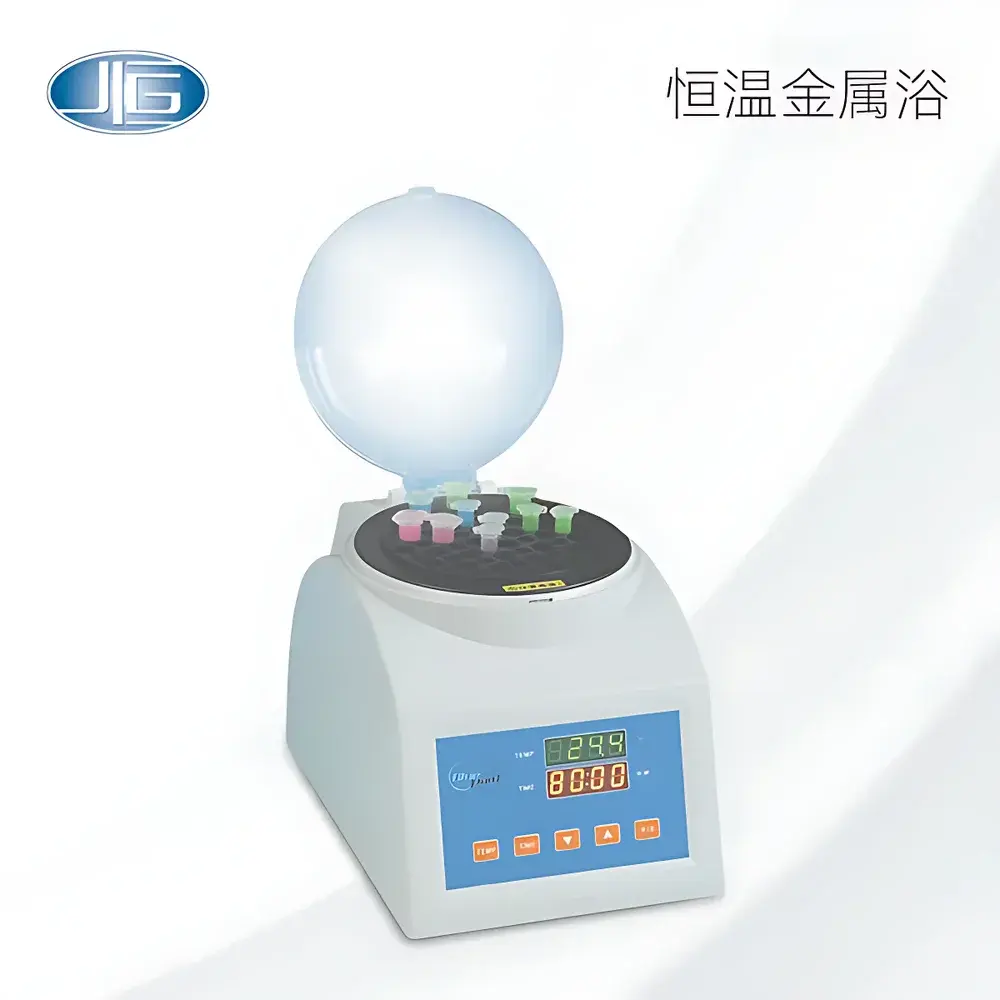
Yiheng TU10/TU100/TU100C Precision Metal Block Thermostat
| Brand | Yiheng |
|---|---|
| Origin | Shanghai, China |
| Manufacturer Type | Direct Manufacturer |
| Region of Origin | Domestic (China) |
| Model | TU10 (Heating-Only), TU100 (Heating-Only), TU100C (Heating & Cooling) |
| Temperature Range | RT+5°C to 100°C (TU10/TU100) |
| Temperature Accuracy | ≤ ±0.5°C |
| Display | Dual LED (Real-Time Temp + Timer/Countdown) |
| Safety Features | Over-Temperature Protection, Auto Fault Detection, Audible Alarm, Transparent Lid Interlock |
| Module Compatibility | Interchangeable Aluminum Blocks (B-module standard for TU10 |
| Cooling Method | Integrated Fan-Assisted Active Cooling (TU100C only) |
| Calibration | User-Accessible Offset Adjustment |
Overview
The Yiheng TU10, TU100, and TU100C series are precision metal block thermostats engineered for stable, contamination-free thermal control of small-volume samples in molecular biology, clinical diagnostics, pharmaceutical QC, and analytical chemistry laboratories. Unlike water baths, these instruments utilize solid aluminum heating blocks—machined to precise tolerances—to deliver rapid thermal response, minimal temperature gradient across wells, and zero risk of cross-contamination or evaporation. The core operating principle relies on Peltier-based thermoelectric elements (TU100C) or resistive heating with forced-air cooling (TU10/TU100), enabling accurate setpoint maintenance within ±0.5°C across the full operational range. The TU100C variant extends functionality with active refrigeration, supporting protocols requiring sub-ambient incubation—such as enzyme inactivation, cold-sensitive reagent storage, or controlled thawing—without external chillers or ice baths.
Key Features
- Microprocessor-Controlled Thermal Regulation: PID algorithm ensures minimal overshoot and high reproducibility; dual LED display simultaneously shows real-time block temperature and countdown timer (TU100/TU100C) or elapsed time (TU10).
- Modular Aluminum Block Architecture: Standard B-module (TU10) and E-module (TU100/TU100C) support common tube formats including 0.2 mL, 0.5 mL, 1.5 mL, and 2.0 mL microcentrifuge tubes; blocks are removable for autoclaving, chemical disinfection, or replacement without tools.
- Integrated Safety System: Hardware-level over-temperature cutoff, lid-open detection (via transparent polycarbonate cover interlock), and automatic fault diagnosis with audible alarm and on-screen error code reporting.
- User Calibration Capability: Field-adjustable temperature offset compensation allows traceable alignment against NIST-traceable reference thermometers—critical for GLP-compliant workflows.
- Thermal Uniformity Optimization: Optimized finned heat-sink design and low-noise DC fan ensure rapid equilibration (<15 min from 25°C to 95°C) and consistent well-to-well deviation < ±0.3°C at 37°C (measured per ASTM E2209).
Sample Compatibility & Compliance
The Yiheng metal bath series accommodates standard laboratory consumables without adapter requirements. Modules are compatible with PCR tubes, strip tubes, deep-well plates (96-well format supported via optional E-module variants), and cryovials. All units comply with IEC 61010-1:2010 for electrical safety in laboratory equipment and meet EMC directive 2014/30/EU. The TU100C’s refrigeration circuit is sealed and CFC-free, conforming to EU Regulation (EC) No 1005/2009. For regulated environments, the devices support audit-ready operation when paired with validated calibration logs and temperature mapping reports—fully compatible with FDA 21 CFR Part 11 data integrity requirements when integrated with compliant LIMS or ELN platforms.
Software & Data Management
While standalone operation requires no software, the TU100 and TU100C models feature RS-232 serial interface (optional USB-to-serial adapter) for external logging and remote parameter control. Third-party LabVIEW drivers and Python-compatible ASCII command sets are available under Yiheng’s Instrument Control Library (v2.1+). All temperature and timer events—including alarm triggers, lid status changes, and power cycles—are timestamped and storable in CSV format. Audit trails include operator ID fields (when integrated with networked authentication systems), satisfying ISO/IEC 17025 clause 7.7 and USP analytical instrument qualification (AIQ) documentation standards.
Applications
- Enzyme reaction incubation (restriction digests, ligations, phosphorylations)
- Cell culture sample warming pre-transfection or pre-plating
- Standard curve preparation in ELISA and qPCR workflows
- Controlled denaturation and renaturation studies of nucleic acids and proteins
- Cold-chain validation support: stability testing of reagents at –10°C, 4°C, 25°C, and 37°C
- QC release testing for sterile filtration validation (e.g., membrane wetting temperature verification)
FAQ
What is the difference between the TU10, TU100, and TU100C models?
The TU10 is a heating-only unit (RT+5°C to 100°C) with B-module standard configuration. The TU100 adds countdown timer functionality and E-module compatibility but remains heating-only. The TU100C integrates thermoelectric cooling, enabling full-range operation from –10°C to 100°C.
Can I use non-Yiheng modules with these units?
Yes—modules adhering to DIN 12880 mounting dimensions and thermal mass specifications (≤1.2 kg aluminum, ≥15 mm base thickness) may be mechanically and thermally compatible; however, Yiheng does not validate third-party modules for accuracy or safety certification.
Is the temperature accuracy verified at all setpoints?
Calibration is performed at three points (25°C, 50°C, and 95°C) during factory QA per ISO/IEC 17025; users may perform intermediate point verification using a calibrated PT100 probe inserted into a dedicated well.
Does the transparent lid affect thermal performance?
No—the polycarbonate lid reduces ambient air convection loss by >40% versus open-block operation while maintaining visual monitoring; thermal uniformity testing confirms <0.1°C impact on mean block temperature at 70°C.
How often should I recalibrate the unit?
Annual recalibration is recommended for GxP environments; more frequent verification (e.g., daily pre-use checks with reference thermometer) is required when used in critical quality control steps per ASTM E2554 guidance.



