
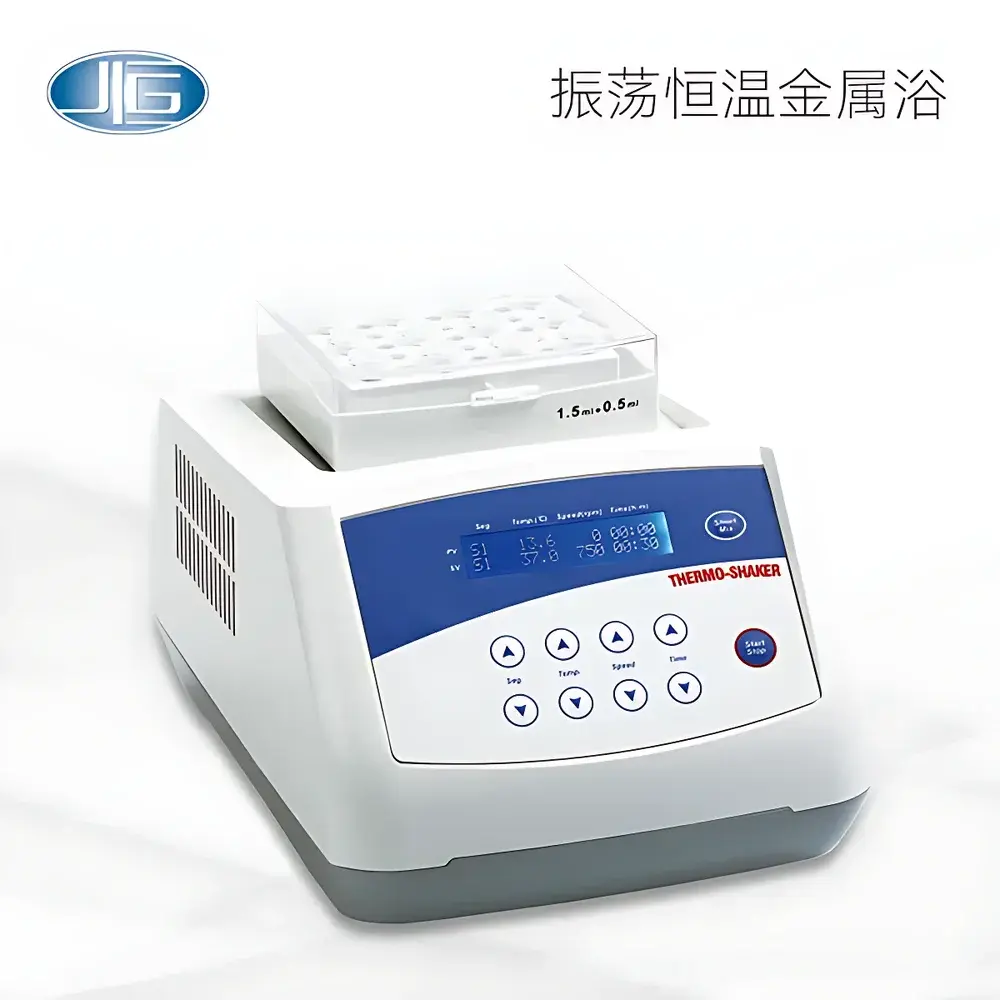
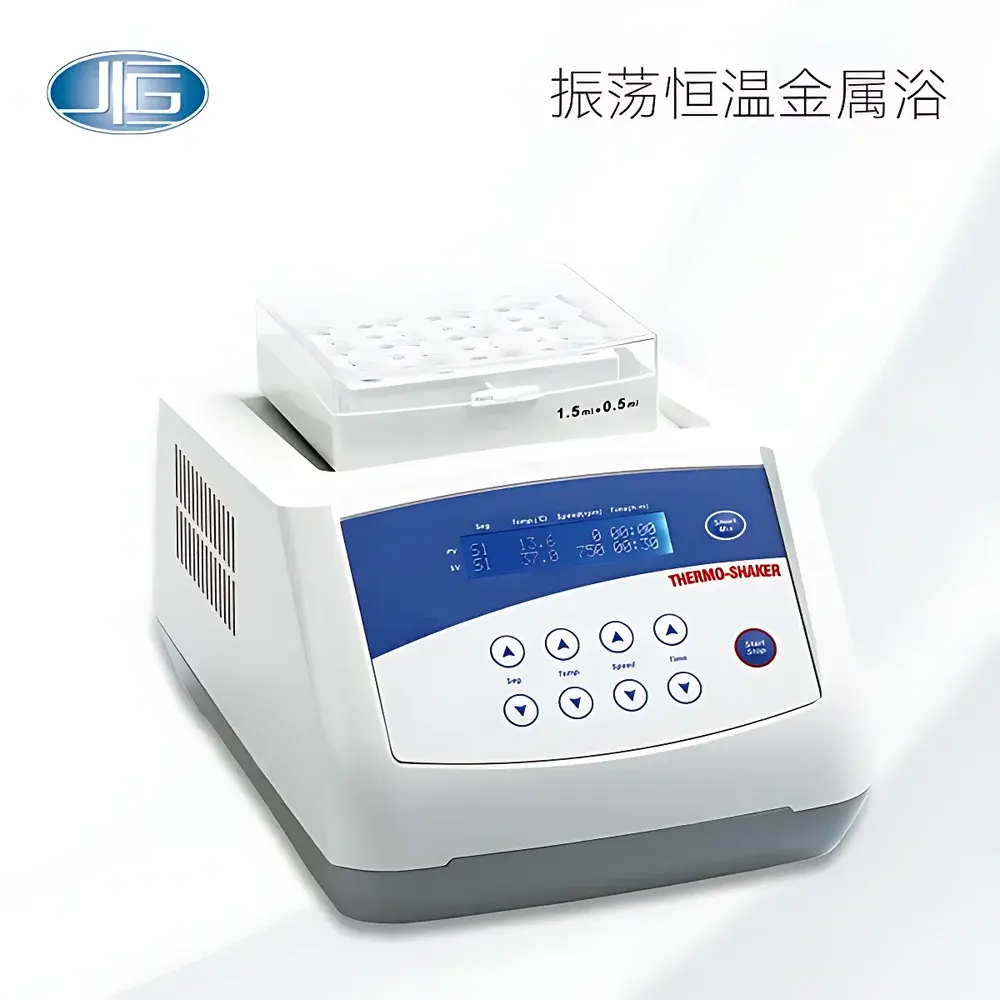
YIHENG TUS-200P Programmable Oscillating Metal Block Thermostat
| Brand | YIHENG |
|---|---|
| Origin | Shanghai, China |
| Manufacturer Type | Direct Manufacturer |
| Country of Origin | China |
| Model | YIHENG TUS-200P (Standard with E-Module) |
| Temperature Range | RT+5°C to 100°C |
| Temperature Accuracy | ±0.1°C |
| External Dimensions | 300 × 220 × 170 mm |
| Net Weight | 5 kg |
Overview
The YIHENG TUS-200P is a precision-engineered oscillating metal block thermostat designed for consistent thermal control and gentle mechanical agitation in molecular biology, clinical diagnostics, and analytical sample preparation workflows. Unlike water baths or dry-block heaters lacking motion control, the TUS-200P integrates Peltier-assisted heating with digitally regulated orbital oscillation—enabling simultaneous temperature stabilization and uniform mixing within sealed tubes or vials. Its solid aluminum heating block ensures rapid thermal equilibration, minimal gradient deviation across wells (<0.3°C at 37°C), and chemical resistance to common reagents including ethanol, DMSO, and dilute acids. The device operates on a closed-loop feedback system using high-stability PT100 sensors and PID-controlled power delivery, delivering stable setpoint maintenance under dynamic load conditions (e.g., repeated tube insertion/removal or ambient fluctuations). It is engineered for routine use in ISO 17025-accredited labs, GLP-compliant QC environments, and academic core facilities requiring traceable, repeatable incubation protocols.
Key Features
- High-resolution LCD interface with intuitive menu navigation—displays real-time temperature, setpoint, oscillation speed (rpm), remaining timer, and system status simultaneously.
- Auto-recovery function: resumes pre-interruption settings—including temperature, rpm, and timer—following AC power loss, minimizing protocol disruption and ensuring data continuity.
- Precision microprocessor control ensures temperature linearity ≤±0.1°C across the full operating range (RT+5°C to 100°C) and oscillation speed stability ≤±2% of set value.
- Programmable timer (0–100 hours) with audible end-of-cycle alert and automatic shutdown; countdown display updates every 10 seconds for precise endpoint tracking.
- Modular interchangeable block system: standard E-module accommodates 0.2 mL, 0.5 mL, 1.5 mL, and 2.0 mL microcentrifuge tubes; additional modules (e.g., PCR strip, 15 mL conical, 50 mL Falcon) available as accessories or custom-fabricated per user specifications.
- Instant oscillation activation via momentary “pulse” button—ideal for brief mixing before centrifugation or pipetting without altering active program parameters.
- Brushless DC motor drive eliminates carbon brush wear, reduces electromagnetic interference, and supports continuous operation >20,000 hours without lubrication or service intervention.
Sample Compatibility & Compliance
The TUS-200P accepts standard laboratory consumables including polypropylene, polycarbonate, and glass tubes up to 50 mL capacity. Its heated aluminum block surface meets IEC 61010-1 safety requirements for laboratory equipment and complies with RoHS Directive 2011/65/EU for hazardous substance restrictions. While not certified for medical device use under ISO 13485, its temperature accuracy and repeatability align with ASTM E2252-20 (Standard Specification for Laboratory Incubators) and support method validation under USP Analytical Instrument Qualification. Data integrity is preserved through non-volatile memory storage of up to 10 user-defined protocols, each with timestamped execution logs accessible via front-panel review.
Software & Data Management
The TUS-200P operates as a standalone instrument without proprietary software dependency. All configuration, execution, and audit trail functions are managed locally via the embedded controller. Protocol parameters—including temperature setpoint, oscillation speed (200–1,200 rpm), duration, and ramp rate—are stored in EEPROM with write-protection against accidental overwrite. System event logs (e.g., power cycle timestamps, temperature deviation alerts, timer completion) persist across power cycles and can be reviewed directly on-screen. For integration into LIMS or electronic lab notebooks (ELN), users may manually record protocol IDs and execution metadata; optional RS-232 serial output (available on request) enables basic external logging when paired with terminal emulation software compliant with ANSI X3.64 standards.
Applications
- Enzymatic reactions requiring strict thermal control and homogeneous mixing (e.g., restriction digests, ligations, phosphorylations).
- Cell culture sample thawing and resuspension with minimized thermal shock and shear stress.
- Antibody labeling, ELISA plate coating, and antigen-antibody incubations where uniform agitation prevents sedimentation and improves binding kinetics.
- Nucleic acid extraction workflows involving proteinase K digestion or bead-beating pre-incubation steps.
- Calibration standard preparation for HPLC, GC, or spectrophotometric assays where temperature-dependent solubility or stability must be tightly controlled.
- QC testing of temperature-sensitive reagents (e.g., polymerases, reverse transcriptases) across multiple lot releases.
FAQ
What is the maximum recommended oscillation speed for 1.5 mL microcentrifuge tubes?
For optimal tube retention and minimal condensation displacement, the recommended upper limit is 1,000 rpm when using standard 1.5 mL PP tubes with snap-cap closures.
Can the TUS-200P be used for long-term incubation at 4°C?
No—the minimum operating temperature is RT+5°C; it does not provide active cooling and is unsuitable for sub-ambient applications.
Is the E-module compatible with 0.2 mL PCR tubes in 8-strip format?
Yes—the E-module includes dedicated grooves for both individual 0.2 mL tubes and rigid 8-tube strips, ensuring secure positioning during oscillation.
Does the device support FDA 21 CFR Part 11 compliance?
No—while it maintains local audit trails, it lacks electronic signature capability, role-based access control, or encrypted data export required for Part 11 adherence.
How often should calibration verification be performed?
Per ISO/IEC 17025 guidance, verify temperature accuracy annually using an NIST-traceable probe; additionally, perform daily checks with a calibrated reference thermometer before critical assays.



