
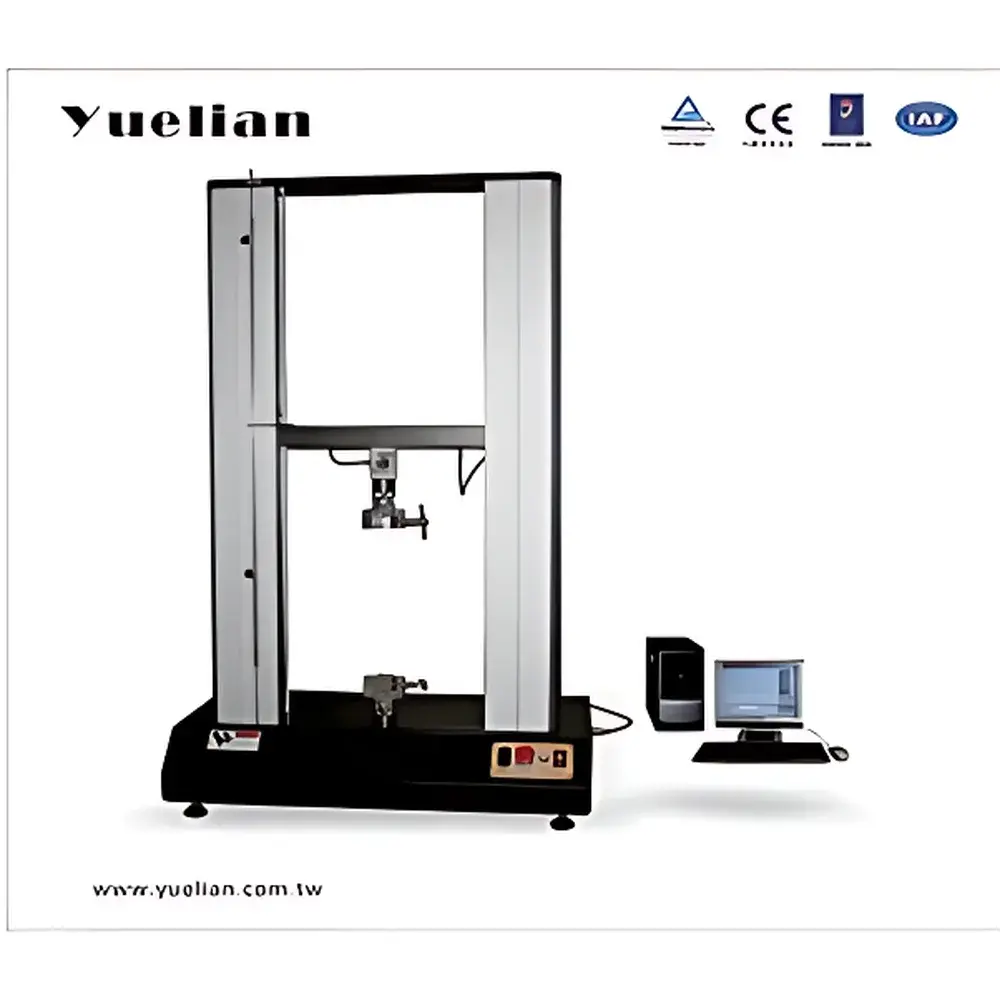
YL-1123S Yuelian Servo-Controlled Universal Testing Machine (2 Ton Capacity)
| Brand | Yuelian |
|---|---|
| Origin | Guangdong, China |
| Model | YL-1123S |
| Instrument Type | Electromechanical Universal Testing Machine |
| Load Capacity Options | 10 N to 20 kN (dual-range configurable) |
| Force Resolution | 1/500,000 full scale |
| Force Accuracy | ±0.3% of reading |
| Crosshead Travel | 700 mm |
| Test Width | 420 mm |
| Speed Range | 0.01–1000 mm/min (programmable) |
| Displacement Resolution | 1/500,000 full scale |
| Control Interface | PC-based with USB connectivity |
| Power Supply | 220 V, 50/60 Hz, 10 A |
| Motor Type | AC servo motor with precision ball screw and synchronous belt drive |
| Dimensions (W×D×H) | 72 × 52 × 130 cm |
| Weight | ~115 kg |
| Compliant Standards | ISO 7500-1, ASTM E4, EN 10002-1, GB/T 228.1, GB/T 2792, ASTM D3330, GB/T 7124-2008, JJG 475 |
Overview
The YL-1123S Yuelian Servo-Controlled Universal Testing Machine is a precision-engineered electromechanical system designed for static mechanical property evaluation of solid materials across research, quality assurance, and production environments. Operating on the principle of controlled axial force application via high-fidelity servo actuation, it delivers repeatable tensile, compression, flexural, shear, peel, tear, and adhesion testing in accordance with internationally recognized mechanical testing protocols. Its modular load frame architecture—featuring a rigid cast-iron base, dual-column uprights, and preloaded ball-screw transmission—ensures minimal deflection and high lateral stiffness, critical for maintaining measurement integrity during high-load or low-force micro-testing scenarios. The machine supports both single- and dual-capacity sensor configurations, enabling seamless transition between high-resolution sub-newton measurements (e.g., thin film peel strength) and robust kilonewton-level structural validation (e.g., metal tensile yield assessment), all within a single platform.
Key Features
- AC servo motor drive with closed-loop position and speed control, delivering smooth motion profiles and exceptional repeatability across the full speed range (0.01–1000 mm/min)
- Precision-ground ball screw assembly coupled with synchronous timing belts for zero backlash and long-term mechanical stability
- Force transducer resolution of 1 part in 500,000 full scale and certified accuracy of ±0.3% of reading per ISO 7500-1 Class 0.5
- Displacement encoder resolution matching force resolution, ensuring synchronized load–displacement data acquisition
- PC-based control interface with USB 2.0 connectivity, supporting Windows OS and offering real-time graphing, multi-curve overlay, and customizable test method templates
- Automated safety logic including overload cutoff, emergency stop circuitry, specimen rupture detection, programmable upper/lower travel limits, and auto-return-to-initial-position functionality
- Modular fixture mounting system compatible with standardized wedge, pneumatic, hydraulic, and custom-designed grips per ASTM E8/E9/E292 requirements
Sample Compatibility & Compliance
The YL-1123S accommodates specimens ranging from ultra-thin polymer films (≥10 µm thickness) to structural metallic coupons (up to 20 mm thickness and 420 mm width). It supports standardized geometries defined in ASTM D882 (thin plastics), ASTM D638 (tensile bars), ASTM D790 (flexural testing), ASTM D903 (peel adhesion), ASTM D1876 (T-peel), ISO 11339 (adhesive bond strength), and GB/T 7124 (adhesives shear strength). All hardware and firmware comply with metrological traceability requirements under JJG 475–2008 (Chinese national verification regulation for universal testing machines) and meet mechanical accuracy classifications per ISO 7500-1:2018 (Class 0.5). Data audit trails, user access levels, and electronic signature support align with GLP and basic 21 CFR Part 11 readiness when deployed with validated software configuration.
Software & Data Management
The embedded test control software operates natively on Windows platforms and integrates seamlessly with MS Access relational databases for structured storage of raw load–displacement arrays, metadata (operator ID, environmental conditions, calibration dates), and derived parameters (modulus, yield point, elongation at break, peak peel force, energy to fracture). It computes over 20 standardized mechanical indices—including Young’s modulus, secant modulus, offset yield strength (0.2%), ultimate tensile strength, fracture toughness proxy (area under curve), and average peel force per ASTM D3330 Annex A. Graphical tools support derivative analysis (e.g., strain rate sensitivity), curve smoothing (Savitzky–Golay), and export to CSV, PDF, and XML formats. Optional API modules allow integration into LIMS or MES environments via TCP/IP or OPC UA protocols.
Applications
This system serves as a foundational instrument in polymer R&D labs evaluating thermoplastic melt strength and elastomer hysteresis; in automotive Tier-1 supplier QA departments verifying gasket compressive set and adhesive joint durability; in packaging engineering validating seal integrity of laminated pouches per ASTM F88; in electronics manufacturing assessing solder joint shear resistance and flexible printed circuit peel strength; and in academic mechanics laboratories conducting constitutive modeling of composite laminates. Its adaptability extends to ISO 179 (Charpy impact pre-test conditioning), GB/T 15598 (rubber hardness correlation), and HGT 2-163 (synthetic rubber tensile fatigue protocols), making it suitable for cross-industry physical property benchmarking.
FAQ
What standards does the YL-1123S comply with for force calibration and verification?
It meets ISO 7500-1:2018 Class 0.5 requirements for static calibration, and its verification procedures follow JJG 475–2008 and ASTM E4–22 guidelines.
Can the system perform peel and adhesion tests on pressure-sensitive tapes?
Yes—equipped with 90° and 180° peel fixtures compliant with ASTM D3330, GB/T 7124-2008, and ISO 8510-2, it delivers traceable peel force quantification with automatic detachment detection.
Is the software compatible with modern Windows versions and networked lab environments?
The current release supports Windows 10/11 (64-bit), includes SQL Server Express compatibility, and offers optional LIMS/MES integration via standardized industrial communication protocols.
What maintenance intervals are recommended for long-term accuracy retention?
Annual force transducer recalibration against NIST-traceable deadweight standards is advised; mechanical inspection (ball screw lubrication, belt tension, guide rail cleanliness) every 6 months ensures optimal kinematic fidelity.
Does the machine support dual-range load cells for high-resolution low-force and high-capacity testing?
Yes—its dual-capacity configuration option enables automatic sensor switching between ranges (e.g., 100 N / 20 kN), preserving resolution across orders-of-magnitude force differences without manual intervention.



