
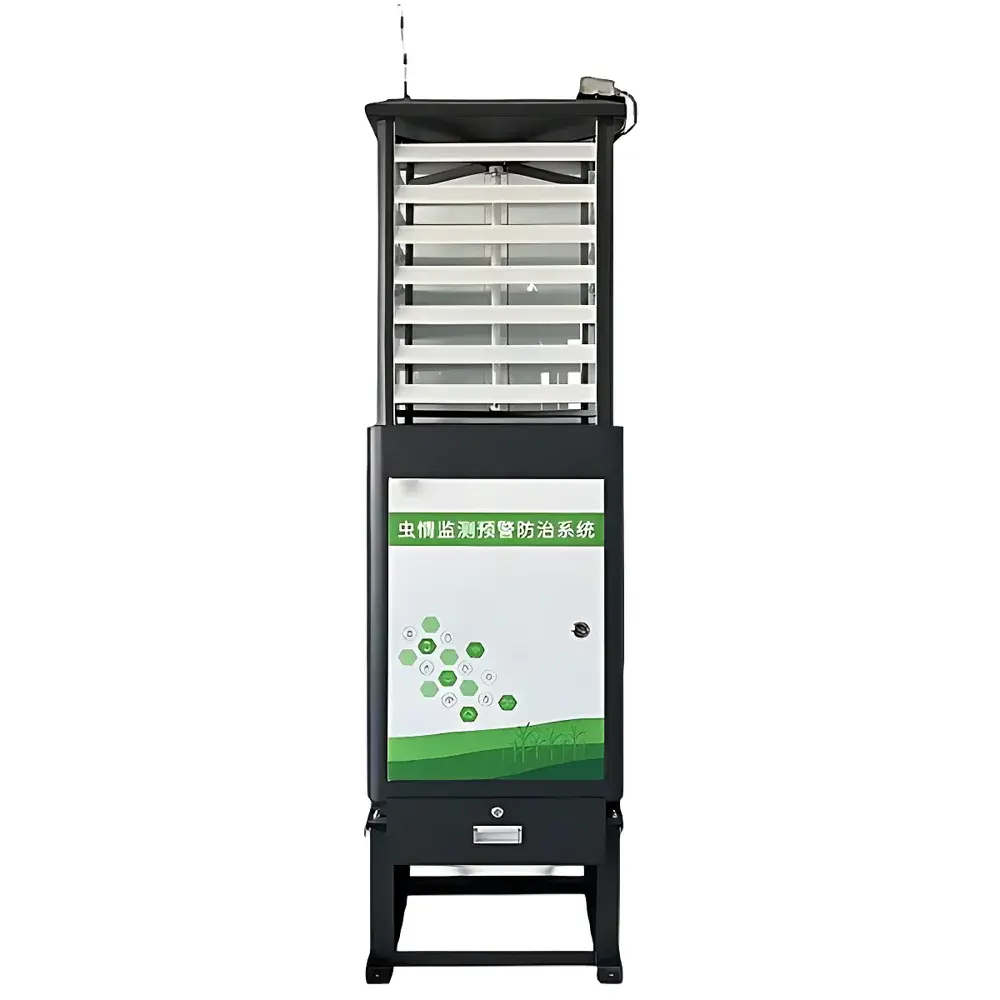
YL-CJQ Insect Monitoring and Early-Warning System
| Brand | Azure Cloud & Wind Confluence |
|---|---|
| Origin | Jiangsu, China |
| Manufacturer Type | Authorized Distributor |
| Country of Manufacture | China |
| Model | YL-CJQ |
| Instrument Category | Specialized Entomological Weather Station |
| Price | USD 700 (FOB Jiangsu) |
Overview
The YL-CJQ Insect Monitoring and Early-Warning System is a field-deployable, solar-powered entomological surveillance instrument engineered for automated detection, capture, imaging, and preliminary classification of flying insect populations in agricultural, forestry, and ecological monitoring contexts. It operates on the principle of light-attractant trapping combined with high-resolution time-lapse imaging and embedded image acquisition logic. The system integrates a UV-A light source (365 nm peak emission), a vertical funnel trap with non-stick collection surface, and a programmable CMOS imaging module (5 MP resolution, auto-white-balance, IR-cut filter) that captures top-down images at user-defined intervals (1–24 h). Data are timestamped, geotagged (via optional GNSS module), and stored locally on industrial-grade microSD card (up to 128 GB) while supporting remote retrieval via 4G LTE Cat-1 or LoRaWAN uplink. Designed for unattended operation across seasonal temperature ranges (−20 °C to +60 °C) and IP65-rated environmental resilience, the YL-CJQ serves as a foundational node in integrated pest management (IPM) networks and national agricultural biosecurity infrastructure.
Key Features
- Solar-rechargeable power architecture with 20 Ah LiFePO₄ battery backup, enabling >180 days of continuous operation without maintenance under typical insolation conditions
- Modular optical trap design compliant with FAO Plant Protection Bulletin No. 17 (2021) guidelines for standardized insect light-trap geometry and spectral output
- Onboard image preprocessing: automatic background subtraction, contrast normalization, and binary segmentation to isolate insect silhouettes prior to storage
- Configurable sampling logic: supports event-triggered capture (e.g., motion-detection via PIR sensor integration) or fixed-interval scheduling
- Secure firmware update over-the-air (FOTA) with SHA-256 signature verification and rollback protection
- RS485 Modbus RTU interface for integration with third-party SCADA systems or local weather station hubs (e.g., Davis Vantage Pro2, Campbell CR1000)
Sample Compatibility & Compliance
The YL-CJQ is validated for monitoring diurnal and crepuscular flying insects including Lepidoptera (moths), Coleoptera (beetles), Diptera (flies), and Hemiptera (aphids, leafhoppers) within canopy heights up to 3 m. Its trap entrance diameter (120 mm) and internal funnel angle (45°) align with ISO 22973:2022 “Field methods for sampling flying insects using light traps.” Units are CE-marked per EN 61326-1:2013 (EMC for laboratory equipment) and RoHS 2015/863/EU compliant. Firmware implements audit-log functionality meeting GLP-aligned data integrity requirements: all image metadata (exposure time, gain, lens focus status, ambient lux, internal temperature) are cryptographically hashed and appended to each file header.
Software & Data Management
The system ships with Azure Cloud & Wind Confluence’s EntoView™ Desktop Suite (v3.2+, Windows/macOS/Linux), providing lossless image review, manual annotation tools (polygon ROI, species tagging), and batch export in TIFF/PNG/CSV formats. Raw image datasets support interoperability with open-source computer vision pipelines (e.g., TensorFlow Lite models trained on IPM-DB v2.0). For enterprise deployments, optional cloud subscription includes RESTful API access, role-based user permissions, and 21 CFR Part 11–compliant electronic signatures for QA/QC workflows. All stored images retain EXIF-compliant metadata fields per RFC 2397 and are archived in immutable object storage with versioning enabled.
Applications
- Regional pest phenology mapping: correlating trap catch dynamics with degree-day accumulation models for Helicoverpa armigera, Plutella xylostella, and other migratory lepidopteran pests
- Early detection of invasive species incursions—integrated into China’s National Agricultural Biosecurity Surveillance Network (NABSN)
- Validation of drone-based multispectral crop stress indicators against ground-truth entomological pressure indices
- Long-term ecological trend analysis in protected areas under IUCN Category IV management plans
- Supporting ISO 15189-accredited plant quarantine laboratories in generating traceable, auditable insect occurrence records
FAQ
Does the YL-CJQ provide automatic species identification?
No. It delivers high-fidelity imagery and structured metadata suitable for downstream AI classification; real-time ID requires integration with external inference engines.
Can the device operate without cellular connectivity?
Yes. All core functions—including trapping, imaging, timestamping, and local storage—are fully autonomous. Connectivity is optional for remote data retrieval and configuration updates.
What calibration documentation is supplied?
Each unit ships with a factory-verified UV-A irradiance certificate (measured at trap aperture using NIST-traceable spectroradiometer), plus temperature/humidity sensor calibration report per ISO/IEC 17025:2017.
Is firmware open for customization by end users?
Firmware binaries are proprietary, but the device exposes a documented UART command set and Modbus register map for OEM-level integration and script-driven control.
How is data security handled during wireless transmission?
4G LTE traffic is encrypted via TLS 1.2+; LoRaWAN payloads use AES-128 encryption at the MAC layer with device-specific session keys managed by the network server.







