
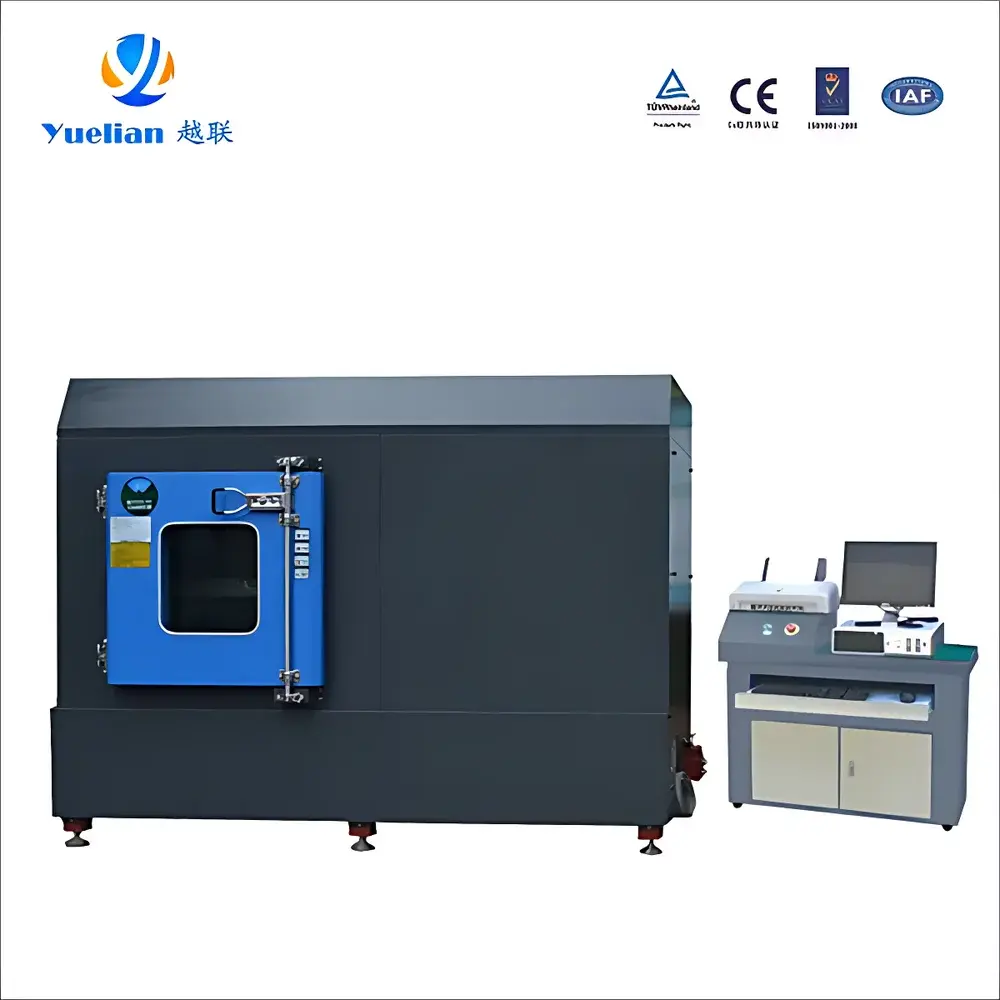
YL-JY-2T Battery Crush Test Machine
| Key | Brand: Yuelian |
|---|---|
| Origin | Guangdong, China |
| Model | YL-JY-2T |
| Max. Crushing Force | 20 kN (2 metric tons) |
| Sample Chamber Dimensions | W300 × D300 mm |
| Stroke Range | 0–300 mm |
| Crushing Speed | 1–10 mm/s (adjustable) |
| Force Accuracy | ±0.5% of reading |
| Force Resolution | 1/500,000 FS |
| Displacement Resolution | 0.01 mm |
| Data Acquisition Rate | ≥30 Hz |
| Voltage Measurement Range | 0–36 V (±0.1% FS) |
| Temperature Measurement Range | 0–600 °C (±1 °C) |
| Control System | Servo Motor + PC-Based Software |
| Compliance | Designed for UN 38.3, GB/T 31485, IEC 62133, ISO 12405, and QC/T 743 test protocols |
Overview
The YL-JY-2T Battery Crush Test Machine is an engineered safety validation system designed to perform controlled mechanical compression testing on lithium-ion and other rechargeable battery cells and modules in accordance with international regulatory standards. It operates on the principle of quasi-static uniaxial compression using a precision servo-driven actuator, applying calibrated force perpendicular to electrode planes or along vehicle-relevant load paths. The system replicates worst-case mechanical intrusion scenarios—such as crash-induced deformation or mounting fixture failure—to assess thermal runaway initiation, voltage collapse, electrolyte leakage, fire propagation, and structural integrity loss. Its architecture supports both single-cell and module-level evaluation under defined displacement rate, force threshold, and deformation limit conditions per GB/T 31485–2015, UN Manual of Tests and Criteria Part III, Subsection 38.3.5, and ISO 12405–4:2018.
Key Features
- Robust monolithic frame constructed from high-tensile cold-rolled steel with dual-tone gray-and-blue epoxy coating for corrosion resistance and structural rigidity.
- Explosion-resistant observation window (350 × 400 mm) composed of laminated tempered glass with integrated LED illumination for real-time visual monitoring during hazardous events.
- Dual-mode crushing configuration: vertical orientation optimized for cell-level tests; optional horizontal adaptation available for large-format modules (customizable per YL-JY-10T/20T/50T variants).
- High-fidelity closed-loop control system featuring servo motor actuation, real-time PID feedback, and synchronized multi-channel data acquisition at ≥30 samples per second.
- Integrated environmental safety subsystems including forced-air exhaust ducting, automatic pressure-relief venting, and emergency stop circuitry compliant with IEC 60204-1.
- Modular tooling interface supporting interchangeable semi-cylindrical crush platens (R = 75 mm, L > sample width), enabling standardized contact geometry per ISO 12405 and QC/T 743.
Sample Compatibility & Compliance
The YL-JY-2T accommodates prismatic, cylindrical, and pouch-type lithium-ion cells up to 300 mm × 300 mm footprint. Its programmable stroke range (0–300 mm) and adjustable speed (1–10 mm/s) allow precise replication of specified deformation rates per GB/T 31485 Section 6.1.3 (cell) and 6.1.4 (module). The system meets functional requirements for UN 38.3 Clause 38.3.5 (crush test), IEC 62133–2:2017 Annex A.7, and ISO 12405–4 Clause 7.3. All hardware and software components are traceable to NIST-calibrated reference standards. Data logging includes audit-trail metadata (operator ID, timestamp, test sequence, calibration status) to support GLP/GMP documentation workflows and FDA 21 CFR Part 11 readiness when paired with validated software configurations.
Software & Data Management
The proprietary PC-based control suite provides synchronized acquisition of five-parameter time-series data: compressive force (kN), displacement (mm), terminal voltage (V), surface temperature (°C), and elapsed time (s). Real-time overlay plotting enables immediate correlation between mechanical input and electrochemical/thermal response. Export formats include CSV, XLSX, and PDF reports with embedded metadata and user-defined pass/fail criteria. Raw binary files are stored with checksum verification for long-term archival. Optional firmware upgrades support integration with LIMS platforms via TCP/IP or Modbus RTU protocols. Software validation documentation (IQ/OQ/PQ templates) is available upon request for regulated laboratory environments.
Applications
- Pre-certification safety validation for EV battery cells prior to UN 38.3 submission.
- R&D-stage failure mode analysis under controlled crush loading to inform cell packaging design and module housing reinforcement strategies.
- Quality assurance screening in battery manufacturing lines to detect internal defects (e.g., separator misalignment, electrode delamination) that manifest only under mechanical stress.
- Comparative evaluation of thermal barrier materials, flame-retardant electrolytes, and current collector coatings under coupled mechanical–electrochemical stress.
- Supporting root cause investigation following field incidents involving mechanical impact damage to traction battery systems.
FAQ
What standards does the YL-JY-2T explicitly support?
It is configured to execute test procedures aligned with GB/T 31485–2015, UN Manual of Tests and Criteria 38.3.5, IEC 62133–2:2017 Annex A.7, ISO 12405–4:2018 Clause 7.3, and QC/T 743–2006.
Can the system record voltage and temperature simultaneously with force/displacement data?
Yes—five-channel synchronized acquisition is standard, with voltage (0–36 V, ±0.1% FS) and thermocouple-based temperature (0–600 °C, ±1 °C) captured at ≥30 Hz alongside mechanical parameters.
Is the crush platen geometry customizable beyond the standard R75 mm semi-cylinder?
Yes—custom platen profiles (flat, wedge, segmented) can be fabricated and integrated via the modular mounting interface; lead time and qualification testing apply.
Does the system include calibration certification?
Each unit ships with factory calibration certificates for load cell and displacement transducer, traceable to national metrology institutes; annual recalibration services are available.
What safety interlocks prevent unintended operation during hazardous events?
Hardware-enforced dual-channel E-stop, pressure-relief valve activation at preset chamber overpressure, and automatic power cutoff upon door breach or thermal sensor fault.



