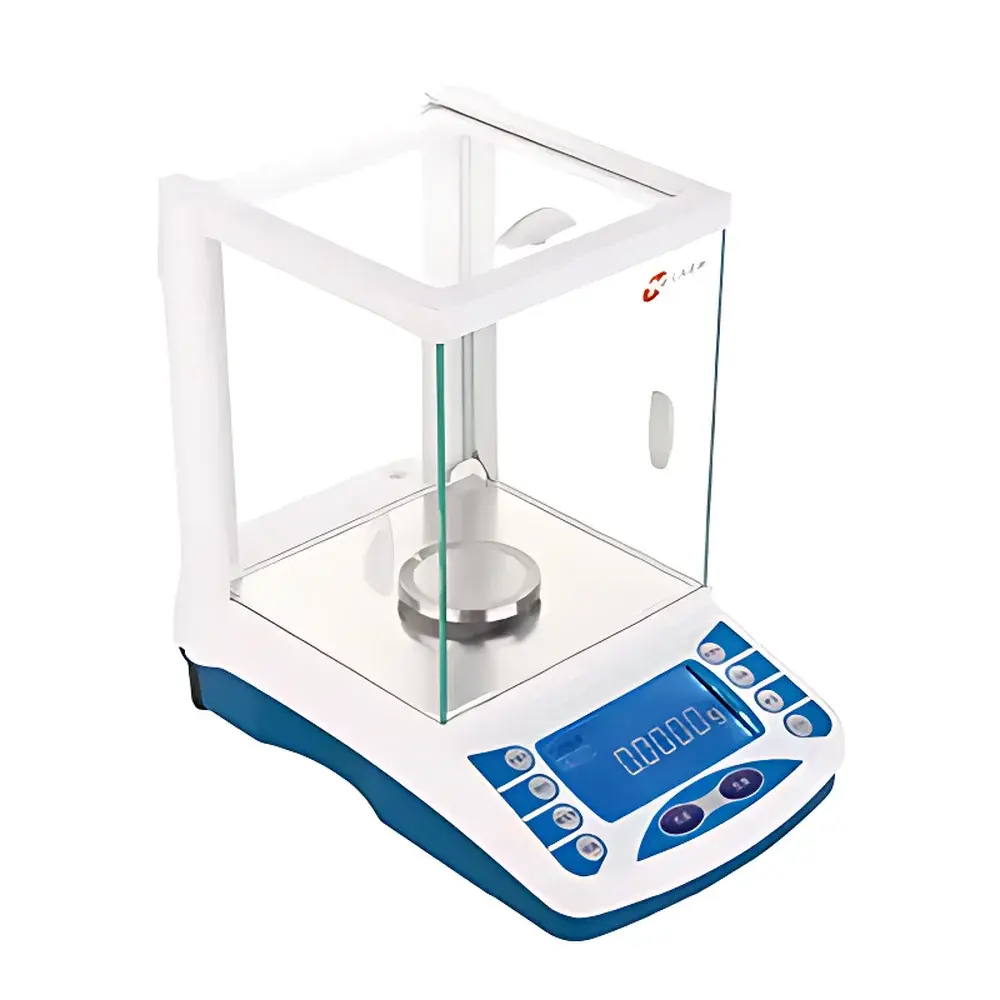
Yoke FA2204B Analytical Balance
| Brand | Yoke |
|---|---|
| Origin | Shanghai, China |
| Manufacturer Type | Direct Manufacturer |
| Instrument Type | Analytical Balance |
| Maximum Capacity | 220 g |
| Readability | 0.1 mg |
| Repeatability | 0.1 mg |
| Calibration Method | External Calibration |
| Pan Diameter | 80 mm |
| Working Height Under Draft Shield | 240 mm |
| Dimensions (W×D×H) | 350 × 215 × 340 mm |
| Net Weight | 7.5 kg |
| Power Supply | 220 V AC, 50 Hz |
| Display | Backlit LCD (120 × 55 mm) |
| Interface | RS232 standard port |
| Unit Options | g, oz, ct |
| Compliance | Patented design (CN ZL201020562335.X) |
Overview
The Yoke FA2204B Analytical Balance is a high-precision mass measurement instrument engineered for routine and regulated laboratory environments requiring consistent sub-milligram resolution. Operating on electromagnetic force compensation (EMFC) principle, it delivers stable and traceable measurements across its full 0–220 g capacity range with a readability of 0.1 mg (100 µg). Designed to meet the functional requirements of ISO/IEC 17025-accredited testing laboratories, pharmaceutical QC units, and academic research facilities, the FA2204B integrates metrological rigor with ergonomic usability. Its EMFC transducer—enhanced by sensor firmware technology developed in collaboration with STL Institute (Germany)—supports multi-point linearization, minimizing nonlinearity errors across the weighing range and improving long-term stability under variable thermal and mechanical conditions.
Key Features
- Backlit LCD display (120 × 55 mm) with high-contrast alphanumeric rendering for clear visibility under varied ambient lighting, including low-illumination lab settings.
- Four-sided electrostatically shielded glass draft shield with conductive anti-static coating—reduces charge-induced drift and improves measurement reproducibility in low-humidity or static-prone environments.
- External calibration capability using certified weights (e.g., Class E2 or better), enabling user-performed verification and adjustment in accordance with internal SOPs or external audit requirements (e.g., GLP, GMP).
- RS232 serial interface compliant with ANSI/TIA/EIA-232-F standards, supporting direct connection to label printers, PCs, or LIMS systems without additional protocol converters.
- Three-unit weighing mode: grams (g), troy ounces (oz t), and carats (ct), configurable via front-panel keys—ideal for applications spanning materials science, gemology, and formulation development.
- Mechanically robust housing with optimized weight distribution (7.5 kg net mass) and vibration-damping base geometry to mitigate floor-borne disturbances in shared laboratory spaces.
Sample Compatibility & Compliance
The FA2204B accommodates standard analytical sample containers—including weighing boats, crucibles, and volumetric flasks—within its 80 mm diameter stainless-steel pan and 240 mm vertical working clearance beneath the draft shield. Its design conforms to fundamental requirements outlined in USP “Weights and Balances” and ASTM E898–22 “Standard Guide for Selection and Use of Laboratory Balances”. While not pre-certified for FDA 21 CFR Part 11 compliance, the balance supports audit-ready workflows when integrated with validated third-party data capture software that implements electronic signatures, change tracking, and secure archiving. The patented mechanical and firmware architecture (ZL201020562335.X) ensures structural integrity and signal fidelity during repeated daily use under ISO Class 5 or cleaner environments.
Software & Data Management
Data output via RS232 follows standard ASCII-based weighing protocols (e.g., “S” command for stable weight transmission), compatible with common laboratory software such as LabX (Mettler Toledo), WinWedge (TAL Technologies), and custom Python/Node-RED scripts using pySerial or similar libraries. No proprietary driver installation is required. Timestamped weight logs can be exported in CSV or TXT format for integration into ELN platforms or statistical process control (SPC) tools. For regulated environments, users are advised to validate the end-to-end data chain—including cable integrity, baud rate consistency (default: 9600 bps, 8N1), and receiving application parsing logic—as part of their computerized system validation (CSV) protocol.
Applications
- Pharmaceutical dosage form development: precise active pharmaceutical ingredient (API) dispensing and excipient blending at ≤0.1 mg tolerance levels.
- Chemical synthesis: stoichiometric reagent weighing and yield calculation in organic and inorganic reaction workflows.
- Materials characterization: determination of moisture content (via loss-on-drying), ash residue, or catalyst loading ratios.
- Reference standard preparation: gravimetric dilution of certified reference materials (CRMs) per ISO Guide 35 and EURACHEM/CITAC guidelines.
- Education and training: hands-on instruction in metrology fundamentals, uncertainty budgeting (GUM-compliant), and calibration hierarchy concepts.
FAQ
What calibration weights are recommended for external calibration?
Class E2 stainless-steel weights (certified to OIML R111) are recommended for full-range verification; single-point calibration at 100 g or 200 g may use Class F1 weights where risk assessment permits.
Is internal calibration available on this model?
No—the FA2204B relies exclusively on external calibration; no motorized internal weight or auto-calibration mechanism is integrated.
Can the balance operate on DC power or battery backup?
No—it requires continuous 220 V AC, 50 Hz mains supply; no built-in UPS or battery option is provided.
Does the RS232 interface support Modbus RTU or other industrial protocols?
No—it transmits raw ASCII weight strings only; protocol translation must be handled externally via middleware or PLC-level configuration.
How often should repeatability verification be performed?
Per ISO 17025 and internal quality procedures, repeatability checks using a 100 g test weight should be conducted at start-up, after relocation, and at least once per shift in high-throughput QC labs.