
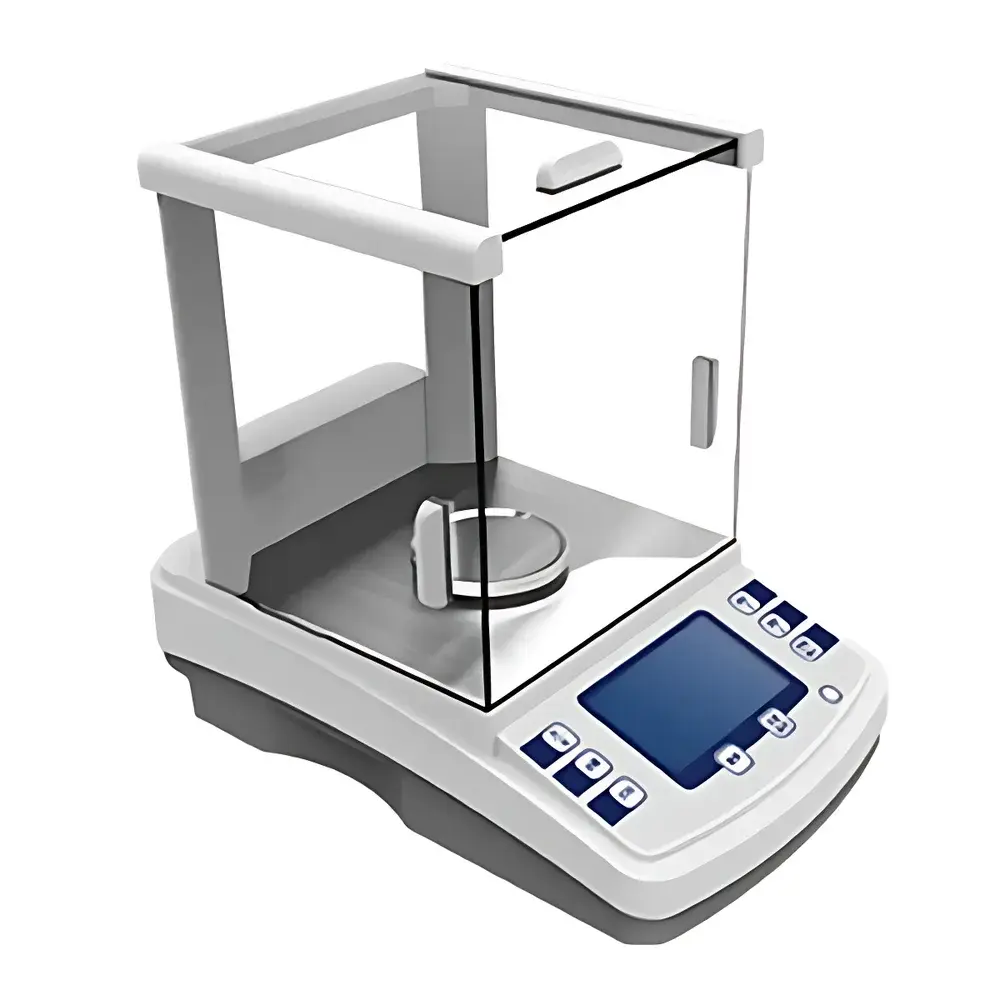
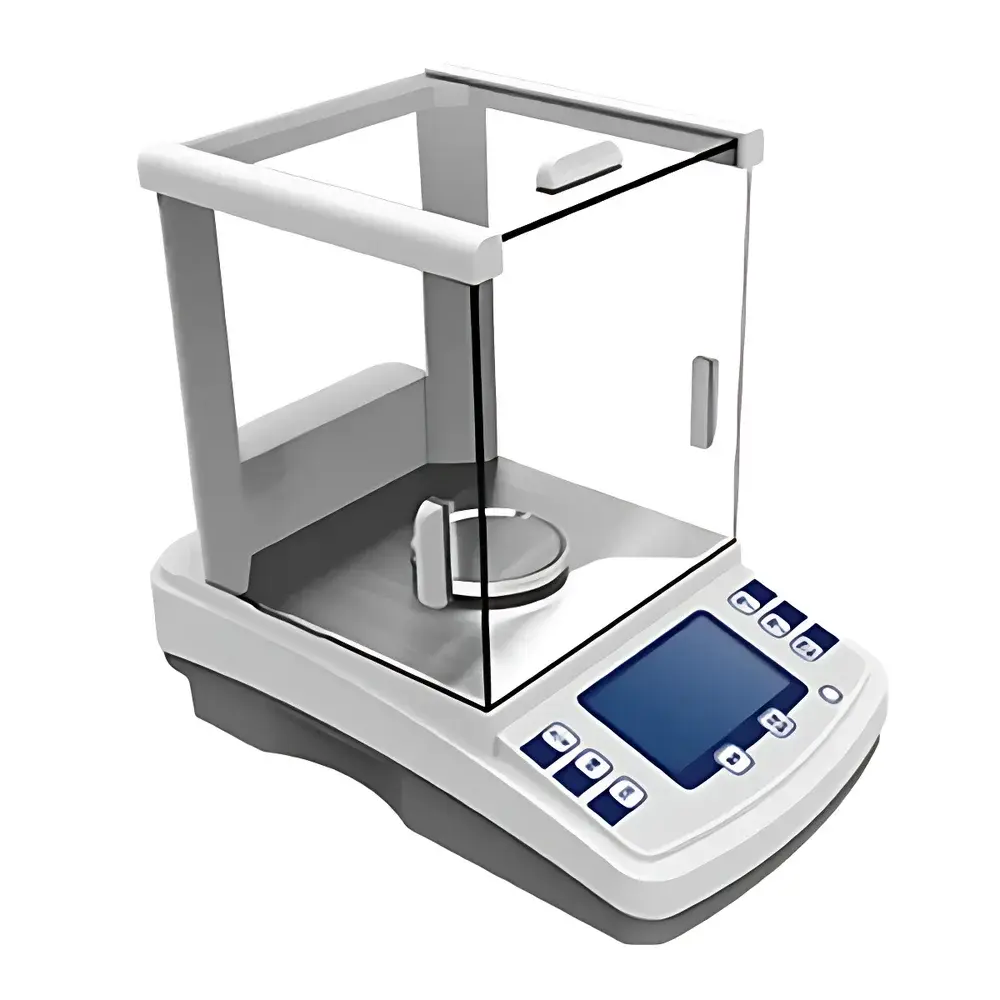
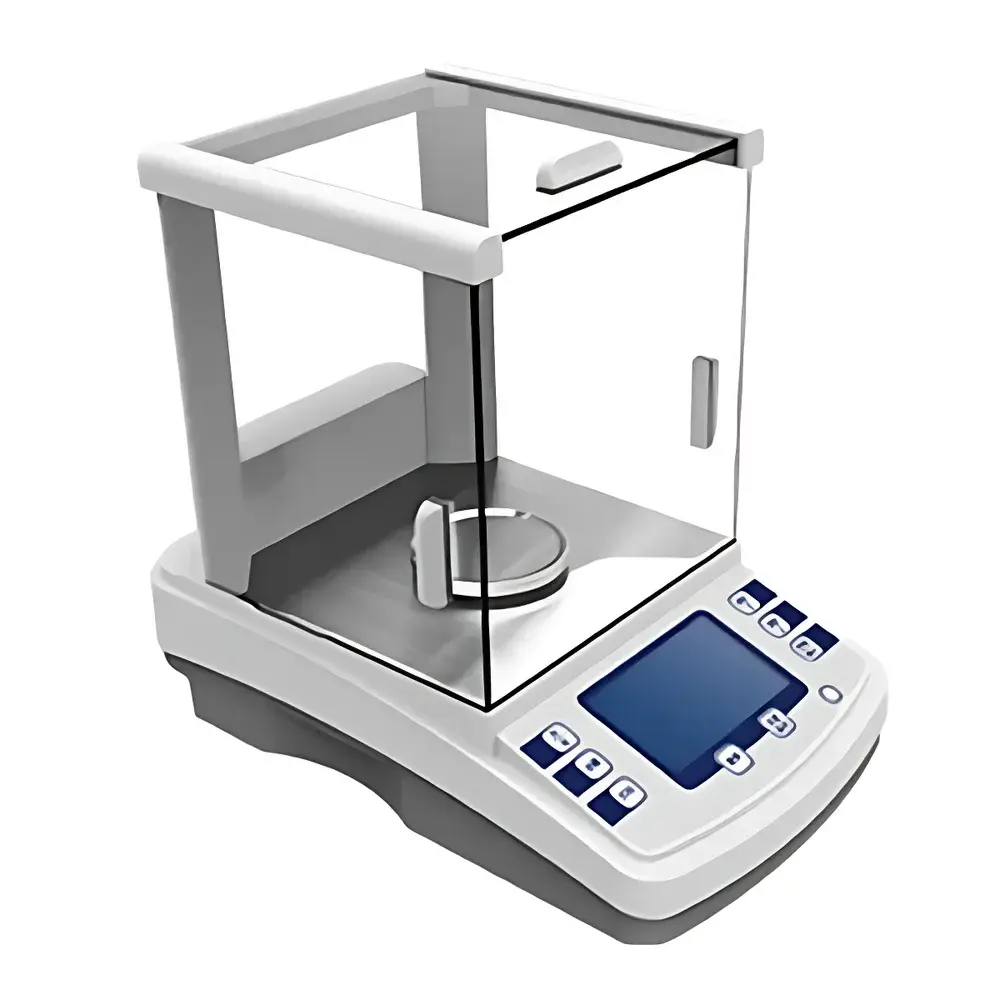
Yoke GL2204C Analytical Balance (0.1 mg readability, Internal/External Calibration)
| Brand | Yoke |
|---|---|
| Origin | Shanghai, China |
| Model | GL2204C |
| Capacity | 0–220 g |
| Readability | 0.1 mg |
| Stabilization Time | ≤4 s |
| Pan Size | 80 mm diameter |
| Net Weight | 7.5 kg |
| Dimensions (W×D×H) | 355×220×325 mm |
| Working Height Under Draft Shield | 220 mm |
| Calibration | Internal and External |
| Power Supply | DC 12 V / 1 A |
| Accuracy Class | Class I (according to OIML R76) |
| Display | 120×55 mm backlit LCD |
| Interface | RS232 standard port |
| Units | g, oz, ct |
| Environmental Protection | Four-sided electrostatically coated glass draft shield |
Overview
The Yoke GL2204C is a Class I analytical balance engineered for precision mass measurement in regulated laboratory environments, including quality control (QC), pharmaceutical formulation, academic research, and materials science applications. It operates on electromagnetic force compensation (EMFC) principle — the industry-standard transduction method for high-resolution analytical balances — delivering reproducible results at 0.1 mg readability across its 220 g capacity range. Designed to meet the metrological requirements of OIML R76 and ISO/IEC 17025, the GL2204C integrates internal calibration with motor-driven weight deployment, enabling automated drift compensation without manual intervention. Its robust mechanical architecture minimizes sensitivity to ambient vibration and thermal gradients, while the sealed electromagnetic sensor module — enhanced by firmware algorithms developed in collaboration with STL Institute (Germany) — ensures long-term signal stability and reduced zero drift over extended operation cycles.
Key Features
- High-contrast 120 × 55 mm backlit monochrome LCD display with intuitive icon-based navigation and real-time status indicators (e.g., calibration mode, overload, draft shield status)
- Four-sided draft shield constructed from electrostatically coated tempered glass, providing full 360° visual access while suppressing electrostatic interference and air turbulence — critical for low-mass measurements below 10 mg
- Dual-mode calibration system: fully automated internal calibration (with temperature-triggered recalibration) and traceable external calibration using certified weights compliant with ISO 9001 and ISO/IEC 17025 procedures
- RS232 serial interface supporting bidirectional communication with PCs, label printers, and LIMS systems; compatible with standard terminal emulation protocols (e.g., VT100) for raw data export without proprietary software dependency
- Multi-unit weighing functionality: seamless switching between grams (g), troy ounces (oz t), and carats (ct), with programmable decimal place selection per unit
- Class I accuracy certification per OIML R76-1:2017, verified under controlled environmental conditions (20 ± 2 °C, RH ≤ 65 %, no drafts or magnetic fields)
Sample Compatibility & Compliance
The GL2204C accommodates standard analytical sample containers (e.g., weighing boats, crucibles, vials) up to 80 mm in diameter on its stainless-steel pan. Its 220 mm working height beneath the draft shield allows compatibility with tall glassware and custom fixtures used in gravimetric titration or loss-on-drying workflows. The instrument conforms to electromagnetic compatibility (EMC) standards IEC 61326-1 and safety standard IEC 61010-1. For regulated industries, it supports audit-ready documentation through timestamped calibration logs, user-accessible calibration history, and optional GLP/GMP-compliant data export (CSV/TXT) with operator ID tagging when integrated into validated networked environments.
Software & Data Management
No proprietary software is required for basic operation or data transfer. Raw measurement output follows NIST-traceable ASCII format via RS232, enabling direct ingestion into Excel, LabArchives, or ELN platforms. Optional Yoke DataBridge utility (Windows-compatible) provides configurable auto-export, statistical summary generation (mean, SD, CV%), and PDF report templating aligned with ISO/IEC 17025 reporting clauses. All calibration events — including date, time, technician ID, reference weight value, and deviation — are stored in non-volatile memory with read-only access to prevent tampering, satisfying FDA 21 CFR Part 11 requirements when paired with appropriate system controls.
Applications
- Pharmaceutical QC: assay uniformity testing, active pharmaceutical ingredient (API) quantification, and excipient blending verification per USP & EP monographs
- Materials characterization: powder density determination, catalyst loading validation, and thin-film mass deposition analysis
- Environmental testing: filter weighing for particulate matter (PM₂.₅/PM₁₀) analysis in accordance with EPA Method IO-3.2
- Academic research: stoichiometric reagent preparation, polymer synthesis yield calculation, and isotopic tracer mass tracking
- Reference standard maintenance: periodic verification of certified reference materials (CRMs) in metrology labs accredited to ISO/IEC 17025
FAQ
What is the recommended environmental class for optimal performance of the GL2204C?
The balance achieves specified repeatability and linearity in environments meeting ISO 27668-1:2016 Class II (temperature stability ±1 °C/h, humidity 40–60 % RH, vibration < 0.5 µm peak-to-peak at 10–100 Hz).
Does the GL2204C support GLP-compliant electronic records?
Yes — when connected to a validated computer system with user authentication and audit trail enabled, all calibration and weighing events can be archived with immutable timestamps and operator identification.
Can the draft shield be removed for large-sample weighing?
No — the four-sided electrostatic shield is integral to metrological performance; removal invalidates calibration and violates OIML R76 operational conditions.
Is the internal calibration weight traceable to national standards?
The internal mass is factory-adjusted against NIST-traceable reference standards; full traceability documentation is provided with each instrument’s Certificate of Conformance.
What maintenance intervals are recommended for routine verification?
Daily zero check, weekly repeatability test (using 100 g test weight), and semi-annual full calibration with external standards — per ISO/IEC 17025 Clause 6.4.10 and manufacturer’s Maintenance Schedule GL2204C-MS-2023.



