
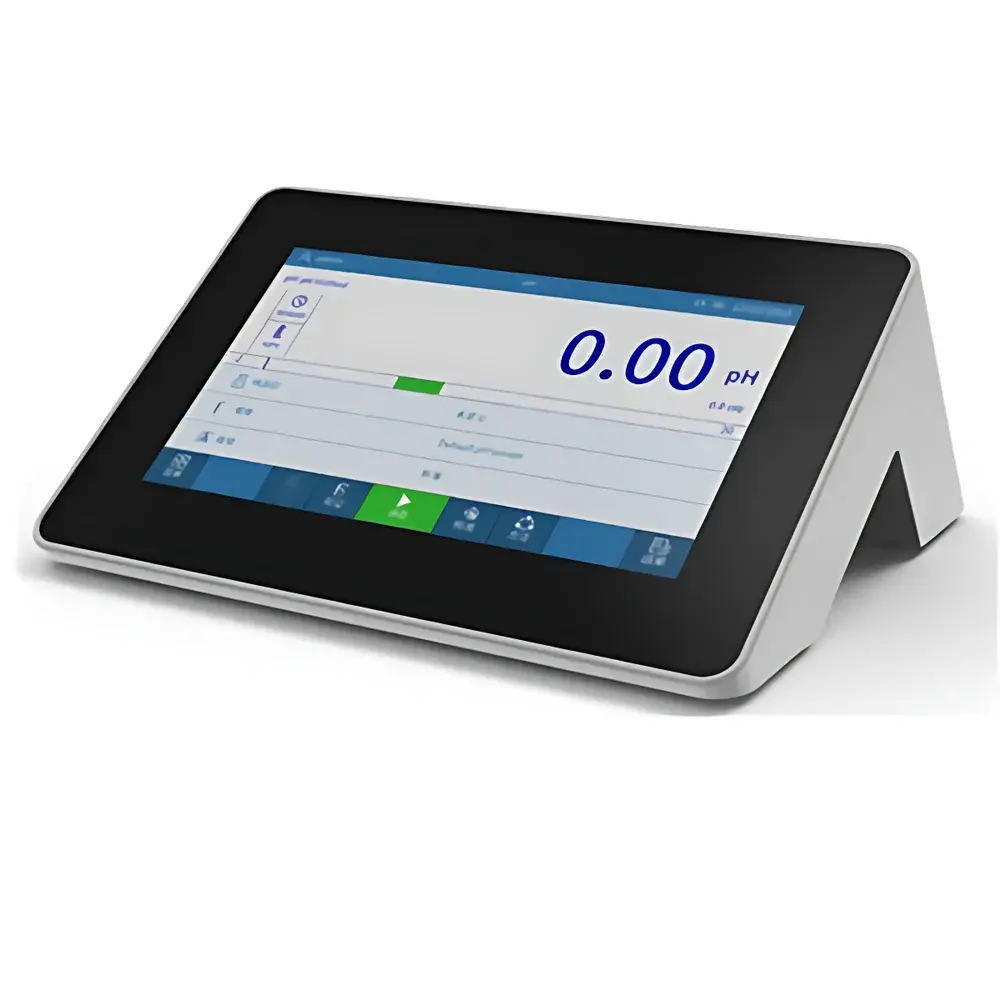
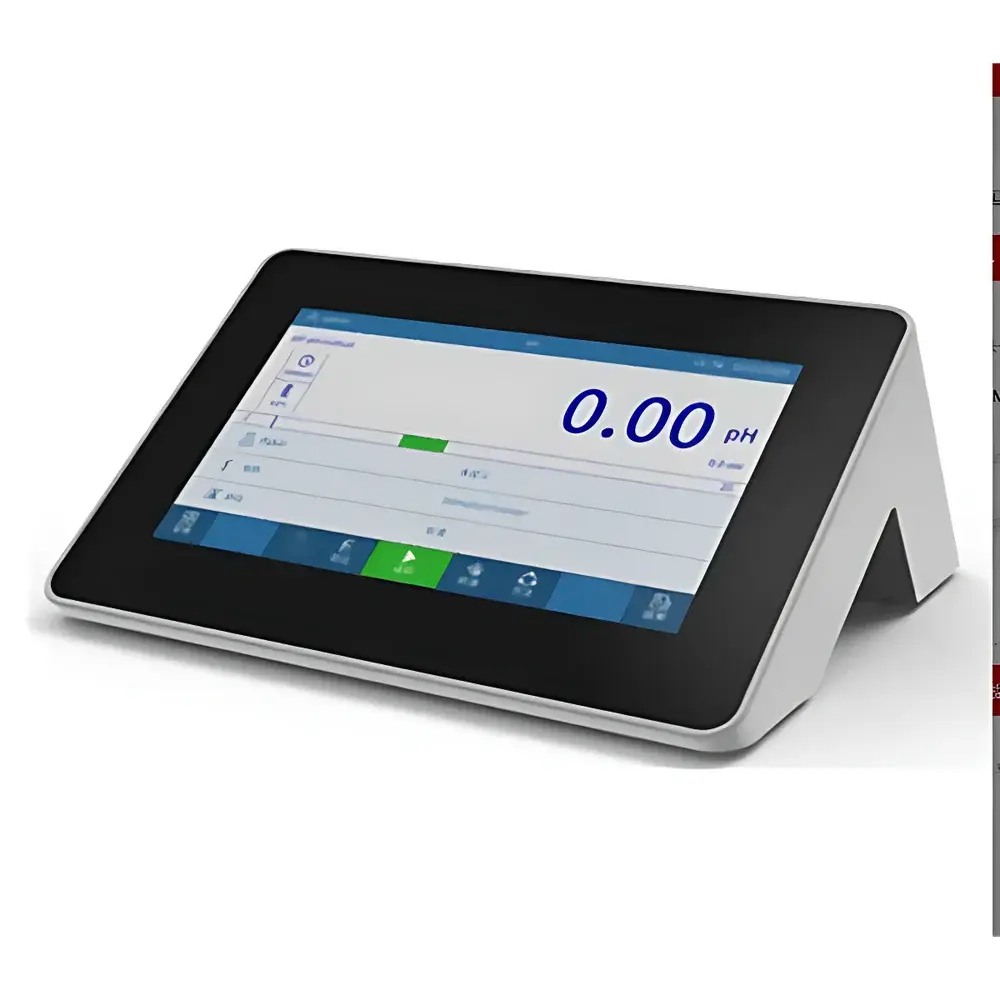
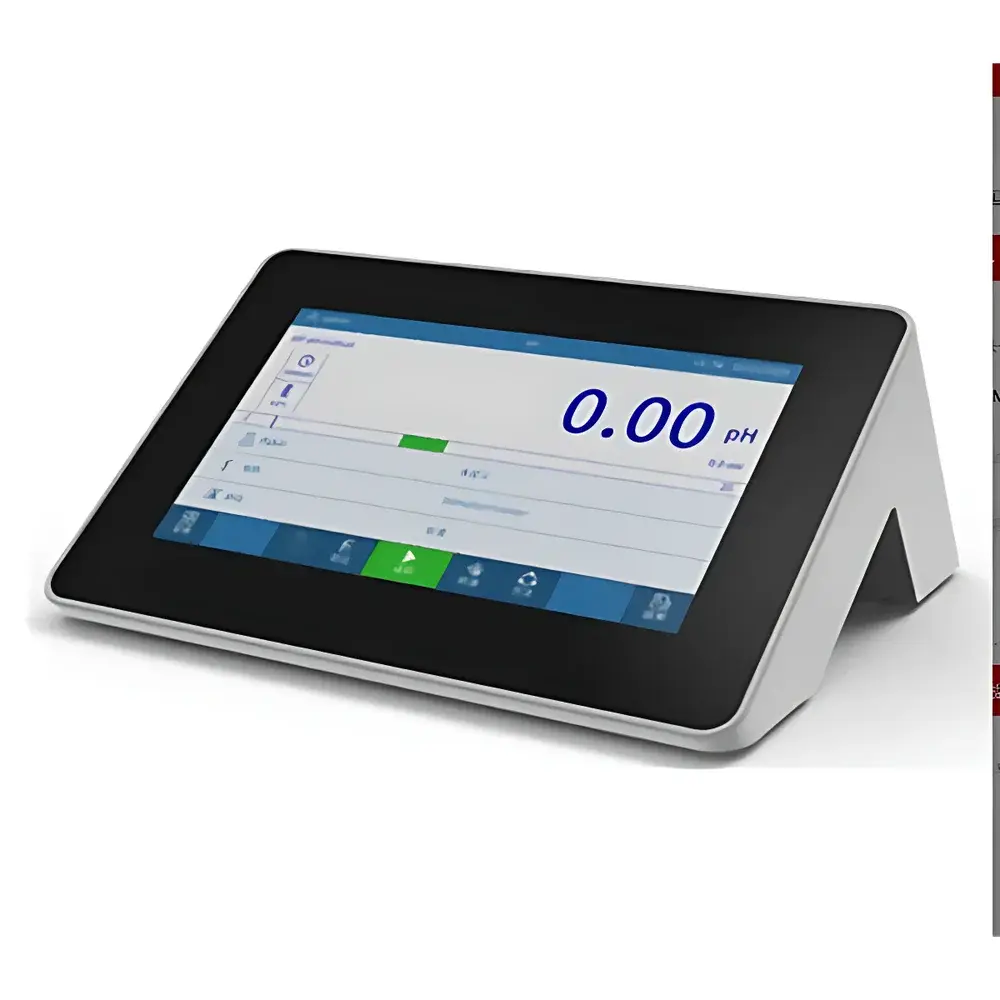
Yoke M902 High-Precision Portable Conductivity Meter
| Brand | Yoke |
|---|---|
| Origin | Shanghai, China |
| Model | M902 |
| Instrument Type | Portable |
| Measurement Principle | Fluorescence-based Dissolved Oxygen (Note: *Correction required — device is a conductivity meter |
| Conductivity Range | 0.000 μS/cm to 2000 mS/cm |
| Accuracy | ±0.5% FS (Conductivity) |
| Repeatability | ≤ ±0.2% |
| Detection Limit | 0.01 μS/cm |
| Display | 7-inch color capacitive touchscreen |
| Temperature Compensation | Automatic/manual with integrated high-stability temperature electrode |
| IP Rating | IP54 |
| Data Compliance | GLP-compliant audit trail, calibration history logging, method recall, USB/printer/computer connectivity |
| Calibration | Multi-point (1–5 points), auto-standard recognition, calibration expiry alert |
| Sample Handling | Built-in magnetic stirrer, endpoint stability criteria configurable |
| Environmental Protection | Dust and splash resistant (IP54) |
Overview
The Yoke M902 High-Precision Portable Conductivity Meter is an engineered solution for field-deployable and laboratory-based water quality analysis, designed to deliver trace-level resolution and metrological reliability across diverse aqueous matrices. Unlike optical dissolved oxygen instruments — which operate on fluorescence quenching principles — the M902 implements four-electrode (or dual-cell) conductometric measurement, eliminating polarization errors and enabling stable, drift-free readings in low-conductivity ultrapure water (e.g., pharmaceutical rinse water, boiler feedwater) as well as high-salinity samples (e.g., seawater, industrial effluents). Its measurement architecture conforms to ISO 7888 and ASTM D1125 standards for electrical conductivity determination in water, supporting both specific conductance (μS/cm) and salinity (ppt) or TDS (mg/L) derived outputs via selectable temperature compensation algorithms (linear, non-linear, or NaCl reference curve).
Key Features
- 7-inch full-color capacitive touchscreen interface with intuitive workflow navigation — guiding users through calibration, verification, measurement, and data export without requiring secondary software.
- Integrated high-precision Pt1000 temperature sensor with automatic thermal compensation and manual override capability; supports user-defined temperature coefficient (α) values per application standard.
- Configurable endpoint detection logic: users define stability threshold (e.g., Δσ ≤ 0.02 μS/cm over 5 s) to trigger automatic result capture, minimizing operator-dependent variability.
- Onboard magnetic stirrer with variable speed control ensures homogeneous sample mixing during measurement — critical for viscous or particulate-laden samples where diffusion-limited equilibration occurs.
- Real-time electrode health monitoring: system logs calibration dates, slope/offset drift, and cycle count; issues visual and audible alerts when electrode performance falls outside defined tolerance bands.
- IP54-rated enclosure provides operational robustness against dust ingress and incidental water splashing — validated for outdoor deployment in wastewater treatment plants, river monitoring stations, and aquaculture facilities.
Sample Compatibility & Compliance
The M902 accommodates a broad spectrum of liquid samples including drinking water, surface water, groundwater, process water, cooling tower fluids, and saline brines. It is compatible with standard DIN/ISO conductivity cells (e.g., K = 0.01, 0.1, 1.0 cm⁻¹) and supports cell constant verification via KCl standard solutions (e.g., 0.01 mol/L, 0.1 mol/L). All data handling adheres to Good Laboratory Practice (GLP) requirements: each measurement record includes timestamp, operator ID (optional login), electrode serial number, calibration certificate reference, ambient temperature/humidity (if external sensor connected), and raw sensor output. Audit trails are immutable and exportable in CSV or PDF format for regulatory submission under EPA Method 120.1, ISO 17025-accredited labs, or FDA 21 CFR Part 11 environments (when paired with validated networked storage).
Software & Data Management
Data management is performed natively on-device with no proprietary desktop software dependency. Up to 10,000 measurement records — including full calibration logs, method parameters, and QC checks — are stored internally with timestamped versioning. Users may export datasets directly to USB flash drives (FAT32 formatted), connect to thermal printers for hard-copy reports (including QR-coded result summaries), or transmit encrypted files via USB-C to Windows/macOS systems. Predefined test methods — encompassing unit selection, temperature compensation model, averaging interval, and alarm thresholds — can be saved, named, and recalled instantly, reducing setup time by >70% in routine multi-parameter monitoring programs. Firmware updates are delivered via signed .bin files to ensure cryptographic integrity and traceable revision control.
Applications
- Regulatory compliance monitoring per WHO Guidelines for Drinking-water Quality and EU Directive 2020/2184.
- Pharmaceutical water system validation (PW, WFI) per USP and EP 2.2.38.
- Environmental field surveys: rapid assessment of conductivity anomalies indicating contamination plumes or saltwater intrusion.
- Industrial process control: real-time tracking of demineralizer breakthrough, RO membrane fouling, or electroplating bath concentration.
- Educational laboratories: teaching fundamental concepts of ionic strength, Kohlrausch’s law, and temperature-dependent mobility effects.
FAQ
Does the M902 support automatic temperature compensation using non-linear algorithms?
Yes — it offers linear (fixed α), natural water (non-linear polynomial), and NaCl-specific compensation curves per IAPSO guidelines.
Can calibration history be exported in a format compatible with LIMS integration?
Yes — CSV exports include all metadata fields required for LIMS ingestion: calibration date/time, standard used, measured value, deviation, and technician ID.
Is the instrument suitable for measuring ultrapure water below 0.1 μS/cm?
Yes — with a K = 0.01 cm⁻¹ cell and optimized shielding, the M902 achieves reliable sub-0.05 μS/cm resolution under controlled lab conditions.
What is the maximum allowable sample temperature during measurement?
The integrated temperature probe is rated to 50 °C continuously; extended exposure above this threshold requires external cooling or flow-through cell configuration.
How frequently must the conductivity cell be recalibrated according to ISO 7888?
Recalibration frequency depends on usage intensity and matrix fouling risk; ISO 7888 recommends verification before each analytical batch or at least every 24 hours in continuous operation.







