
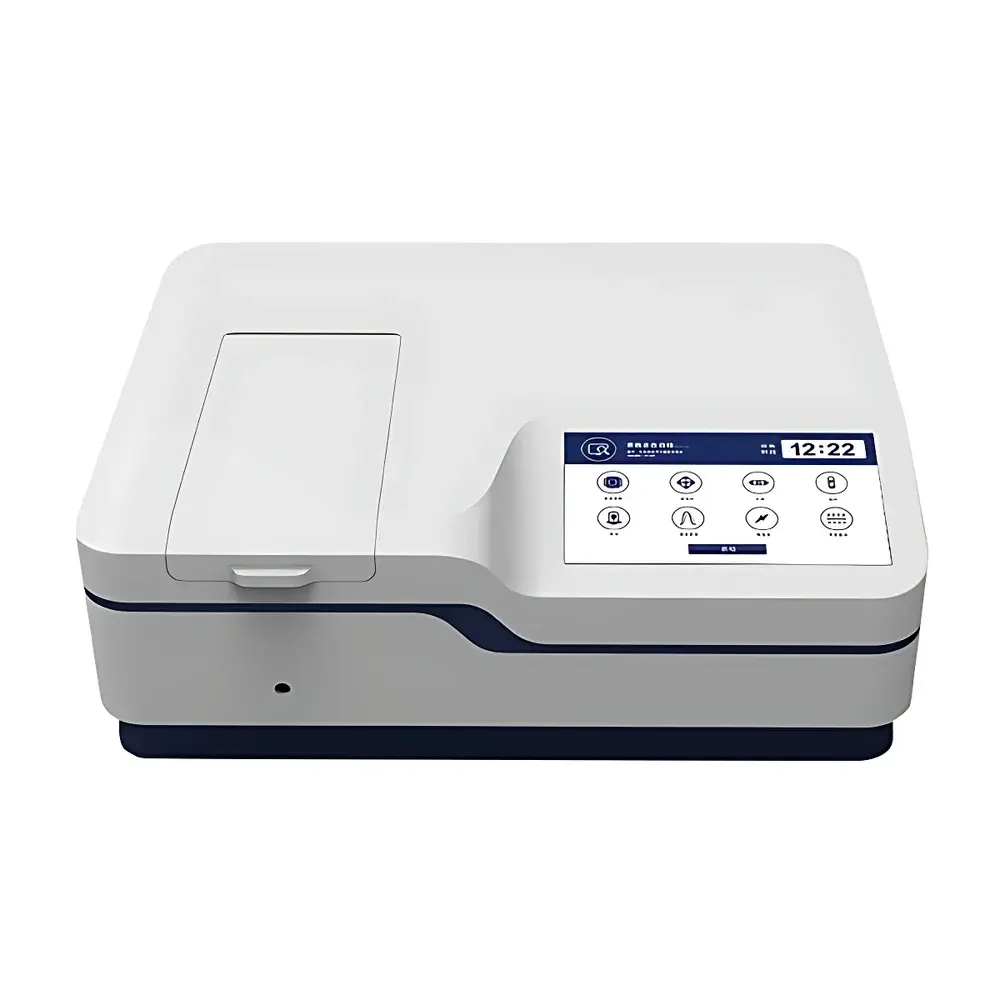
Yoke T3202 Dual-Beam Ultraviolet-Visible Spectrophotometer
| Brand | Yoke |
|---|---|
| Origin | Shanghai, China |
| Manufacturer Type | Direct Manufacturer |
| Model | T3202 |
| Optical System | Dual-Beam |
| Detector | Photodiode Array (PDA) |
| Wavelength Range | 190–1100 nm |
| Wavelength Accuracy | ±0.3 nm (full range), ±0.1 nm at 656.1 nm |
| Spectral Bandwidth | 2 nm |
| Stray Light | ≤0.05% at 220 nm |
| Transmittance Accuracy | ±0.3% T |
| Wavelength Repeatability | ±0.1 nm |
| Display | 10.1-inch color capacitive touchscreen (1024 × 600) |
| Internal Storage | 8 GB |
| Data Interfaces | RS-232C, USB Device (for PC connection), USB Host (for flash drive) |
| Onboard Data Capacity | 5,000 absorbance readings or 500 calibration curves |
| Supported Output Formats | *.csv, *.qua, *.txt, *.bmp |
| Self-Diagnostic Function | Yes |
| Optical Design | Suspended optical bench with reinforced aluminum baseplate |
Overview
The Yoke T3202 Dual-Beam Ultraviolet-Visible Spectrophotometer is an analytical instrument engineered for precision quantitative and qualitative analysis across the 190–1100 nm spectral region. It operates on the dual-beam optical principle—splitting the light path into sample and reference channels—to continuously compensate for source intensity drift, lamp aging, and environmental fluctuations. This architecture ensures high photometric stability and reproducibility without requiring frequent manual baseline correction. The system employs a Czerny-Turner monochromator with imported deuterium and tungsten-halogen lamps, delivering uniform spectral irradiance across both UV and visible domains. Its photodiode array (PDA) detector enables rapid full-spectrum acquisition with no moving parts in the detection stage, minimizing mechanical wear and enhancing long-term measurement consistency. Designed for routine laboratory use under ISO/IEC 17025-aligned environments, the T3202 meets foundational performance criteria referenced in ASTM E275, ISO 6223, and USP for spectrophotometric instrumentation validation.
Key Features
- 10.1-inch high-resolution capacitive touchscreen (1024 × 600) enabling direct instrument control, real-time spectrum visualization, and interactive method editing—no external PC required for basic operation.
- Dual-beam CT monochromator architecture with suspended optical bench and reinforced aluminum baseplate to mitigate vibration-induced wavelength shift and thermal deformation.
- Optoelectronic isolation design: physically segregated optical and electronic compartments reduce electromagnetic interference and improve signal-to-noise ratio.
- Patented photodetection module (CN ZL 2010 2 0562320.3) optimized for low-noise analog signal conversion and enhanced dynamic range.
- Onboard storage capacity of 8 GB supports up to 5,000 single-point measurements or 500 multi-point calibration curves, with automatic timestamping and user-defined ID tagging.
- Integrated self-diagnostic firmware performs automated optical alignment verification, lamp status assessment, and detector response validation prior to each measurement cycle.
- Multiple data export options: direct saving to USB flash drives in native *.csv, *.qua (Yoke format), *.txt, and *.bmp formats—compatible with Microsoft Excel and standard image viewers without proprietary software.
Sample Compatibility & Compliance
The T3202 accommodates standard 10 mm pathlength cuvettes (quartz, glass, or plastic), as well as optional 8-position rotating automatic cell changer (patent-pending alignment mechanism ensuring beam centering accuracy within ±0.05 mm). It supports liquid, solution-phase, and transparent solid samples compatible with UV-Vis absorption spectroscopy protocols. Instrument compliance aligns with general requirements for analytical instrumentation under GLP and GMP frameworks: audit-trail-capable data logging (user ID, timestamp, method name, raw absorbance values), secure password-protected access levels, and non-modifiable raw data files stored in immutable binary format. While not pre-certified to FDA 21 CFR Part 11, its architecture supports implementation of electronic signature workflows and data integrity controls when deployed within validated laboratory information management systems (LIMS).
Software & Data Management
The embedded operating system—built on ARM12 architecture—executes all core spectroscopic functions locally, including baseline correction, peak integration, derivative spectra generation, and multi-component quantitation via simultaneous equation solving. Data files include metadata headers specifying instrument serial number, lamp hours, calibration date, and operator ID. USB Host interface permits plug-and-play connectivity with industry-standard flash drives; no driver installation required. RS-232C port enables integration with legacy printers or centralized data acquisition servers. Optional PC-based YokeSpectra software (v3.2+) extends functionality to kinetic scan analysis, DNA/protein A260/A280 ratio reporting, and customizable report templates compliant with ISO/IEC 17025 documentation standards.
Applications
The T3202 serves as a primary analytical tool in quality control laboratories conducting routine assays per pharmacopeial methods (e.g., USP , EP 2.2.25), environmental monitoring (EPA Method 450.1 for nitrate/nitrite), food safety testing (AOAC 973.43 for total phenolics), and academic research in photochemistry and enzyme kinetics. Its 2 nm spectral bandwidth and ≤0.05% stray light specification support accurate quantification of highly absorbing or turbid samples—including biological macromolecules, transition metal complexes, and nanoparticle suspensions—without significant deviation from Beer-Lambert law linearity. The instrument is routinely deployed for concentration determination, purity assessment, equilibrium constant calculation, and spectral library matching in teaching and industrial settings.
FAQ
Does the T3202 support variable slit widths?
No—the standard T3202 model features a fixed 2 nm spectral bandwidth. A variant (T3202S) offers adjustable slit widths (0.5, 1, 2, 4, 5 nm), but this configuration is not included in the base T3202 specification.
Is the instrument compatible with third-party LIMS or ELN platforms?
Yes—via RS-232C or USB virtual COM port emulation, the T3202 can transmit ASCII-formatted absorbance data streams for ingestion into laboratory informatics systems supporting ASTM E1384 or HL7-compatible interfaces.
What maintenance procedures are recommended for long-term optical stability?
Biannual verification of wavelength accuracy using NIST-traceable holmium oxide and didymium filters is advised. Lamp replacement intervals are approximately 1,000 hours for deuterium and 2,000 hours for tungsten-halogen sources, monitored automatically by the onboard diagnostics module.
Can the touchscreen interface be locked during unattended operation?
Yes—administrative mode allows configuration of screen lock timeout, disabled touch zones, and restricted access to calibration menus to prevent accidental parameter modification.
Is the 8 GB internal memory user-accessible for file management?
Yes—through the USB Host interface, users may browse, copy, rename, or delete files directly on the instrument’s file system using standard FAT32-formatted USB drives.
Related Products






