
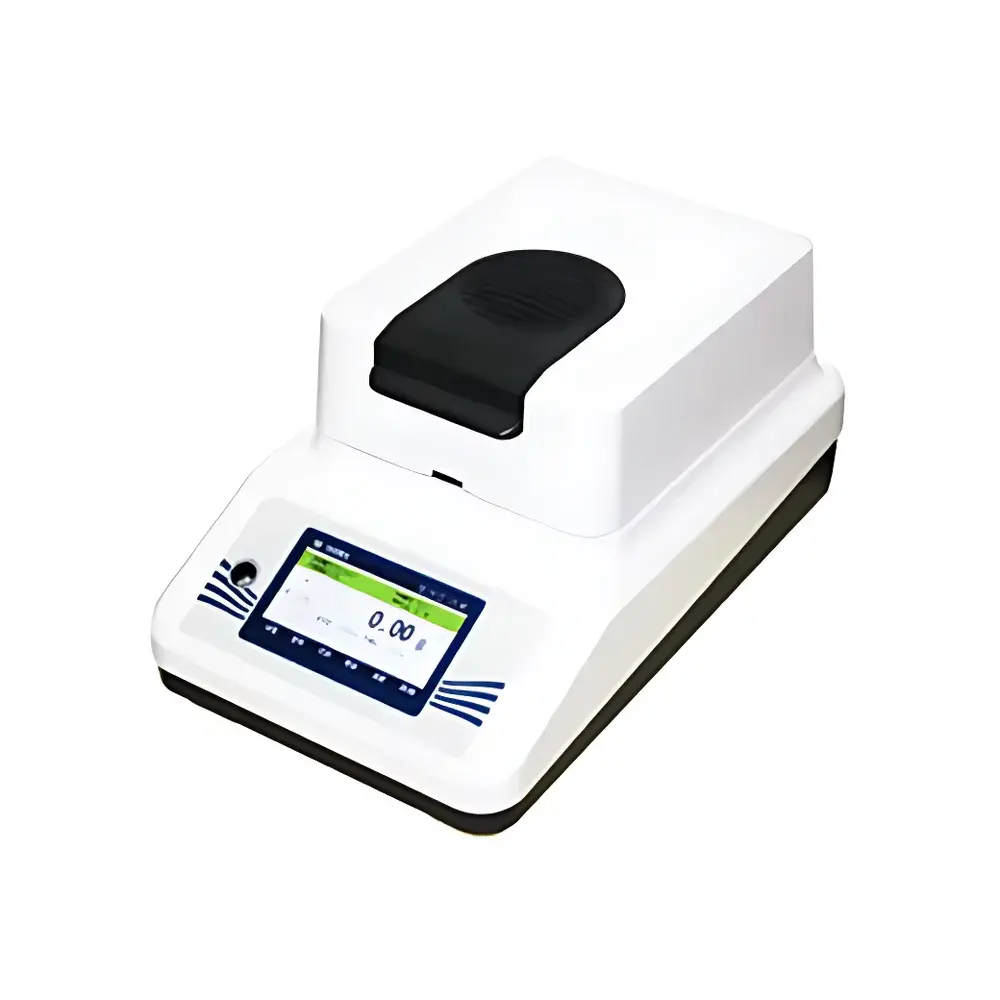
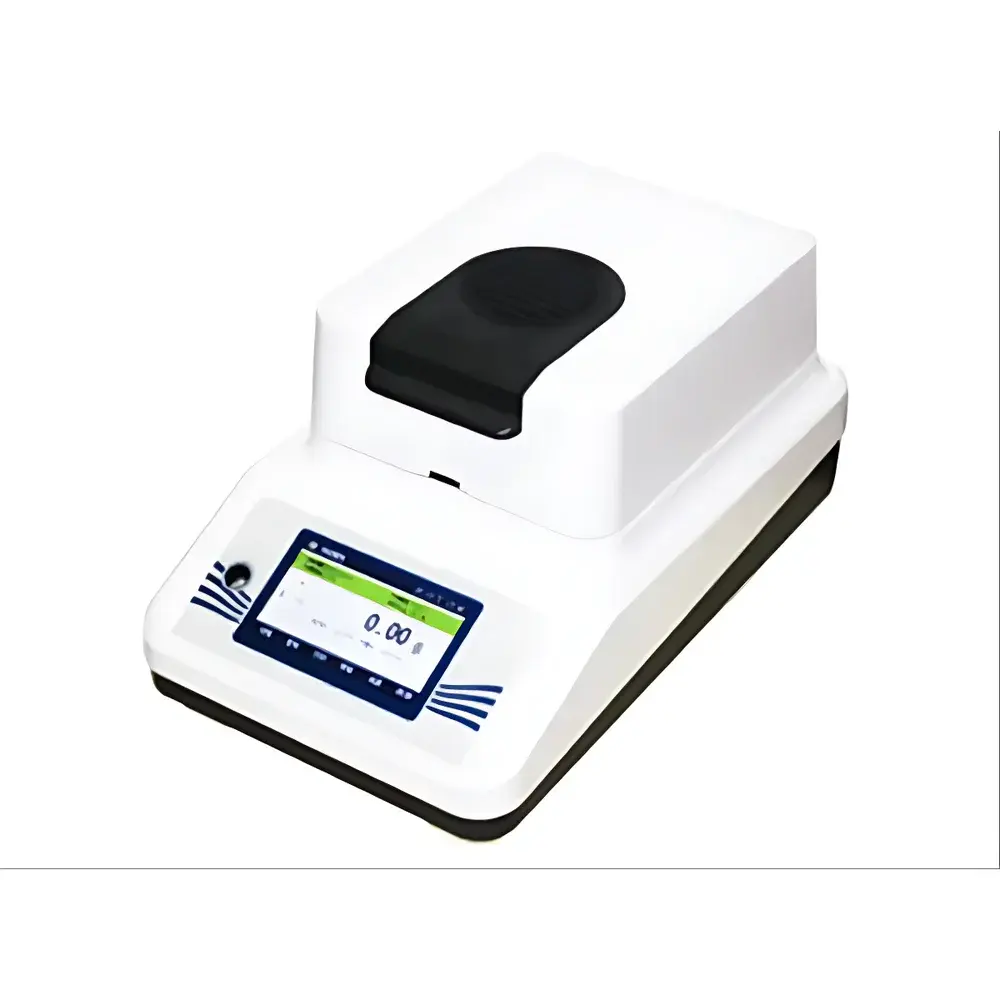
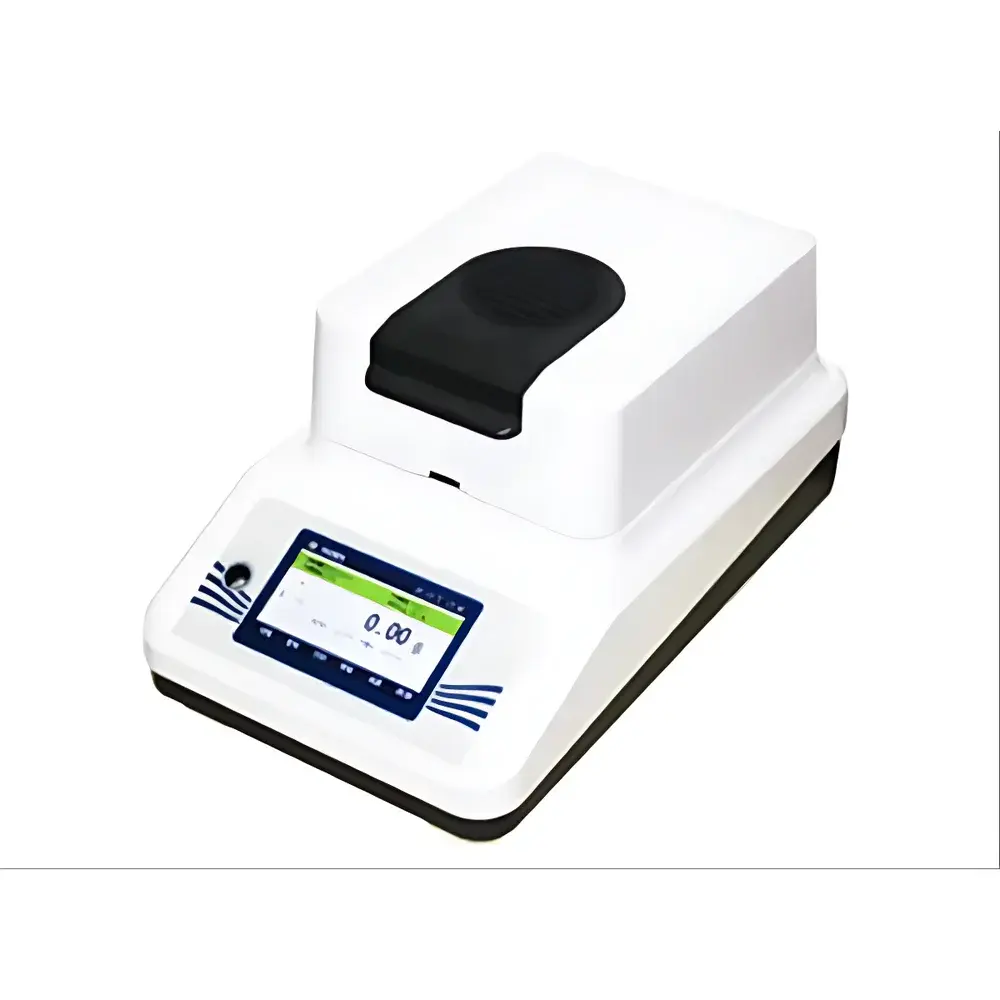
Yoke TSF-50A-1 Touchscreen Halogen Moisture Analyzer
| Brand | Yoke |
|---|---|
| Origin | Shanghai, China |
| Model | TSF-50A-1 |
| Weighing Range | 0–50 g |
| Readability | 1 mg |
| Moisture Resolution | 0.01% |
| Display | 4.3-inch capacitive touchscreen LCD |
| Heating Source | Halogen lamp (adjustable power output) |
| Drying Modes | Standard & Rapid |
| Interface | USB Type-B (for printer, PC, and data export) |
| Compliance | GB/T 29249–2012 (Electronic Moisture Analyzer Based on Gravimetric Drying Method) |
Overview
The Yoke TSF-50A-1 Touchscreen Halogen Moisture Analyzer is a gravimetric moisture determination instrument engineered for precision, repeatability, and operational efficiency in regulated laboratory and production environments. It operates on the principle of loss-on-drying (LOD): a pre-weighed sample is heated under controlled halogen radiation, driving off volatile components—primarily water—while an integrated high-stability weighing module continuously monitors mass loss in real time. The system calculates moisture content (%) as the relative mass difference between initial and final dry weight, referenced to the original sample mass. Unlike convection ovens, the TSF-50A-1 employs focused halogen heating with rapid thermal response (<3 s to reach target temperature), minimizing thermal lag and enabling precise endpoint detection via slope-based algorithm termination. Its insulated load cell architecture isolates the weighing sensor from thermal drift induced by heating, ensuring measurement integrity throughout the drying cycle—critical for compliance with pharmacopeial methods (e.g., USP , EP 2.2.32) and quality control protocols requiring traceable, auditable results.
Key Features
- Halogen heating system: Delivers uniform, controllable radiant heat (up to 200 °C, adjustable in 1 °C increments) with fast ramp-up and minimal overshoot—reducing typical test duration to 2–8 minutes depending on sample matrix.
- Thermally isolated monolithic load cell: A proprietary shielded weighing mechanism prevents heat conduction from the heater to the sensor, maintaining ±1 mg readability stability across full temperature range (ambient to 200 °C).
- 4.3-inch capacitive touchscreen interface: Intuitive graphical UI supports direct parameter configuration—including drying temperature, stop criteria (slope or time), and method naming—without external software.
- Real-time multi-parameter curve display: Simultaneously plots moisture %, sample weight (g), and elapsed time (s) during analysis—enabling visual validation of drying kinetics and endpoint behavior.
- Dual drying mode selection: “Standard” mode applies gradual heating for thermally sensitive materials (e.g., APIs, dairy powders); “Rapid” mode maximizes throughput for robust matrices (e.g., grains, minerals, polymers).
- USB host interface: Supports direct connection to standard USB printers (for GLP-compliant hardcopy reports) and Windows/macOS PCs for CSV data export, method backup, and firmware updates.
Sample Compatibility & Compliance
The TSF-50A-1 accommodates solid, semi-solid, and powdered samples within the 0–50 g capacity range, including pharmaceutical excipients, herbal granules, cereal flours, animal feed pellets, polymer resins, and ceramic precursors. Its performance aligns with national standard GB/T 29249–2012 for electronic moisture analyzers using gravimetric drying principles. While not inherently 21 CFR Part 11 compliant out-of-the-box, the device supports audit-trail-ready operation when paired with validated third-party data management software. Routine calibration verification follows ISO/IEC 17025 guidelines, utilizing certified reference standards (e.g., sodium tartrate dihydrate, USP Reference Standard). Method transfer studies against AOAC 950.46 (cereal moisture) and ASTM D4457 (paints and coatings) demonstrate correlation coefficients ≥0.998 versus reference oven-dry methods.
Software & Data Management
No proprietary desktop software is bundled; however, the USB interface enables native integration with spreadsheet applications (e.g., Microsoft Excel, LibreOffice Calc) via drag-and-drop CSV export. Each measurement generates a timestamped record containing: sample ID, start/end time, initial/final weight, moisture %, drying curve metadata, and operator ID (manually entered). For regulated environments, users may implement external LIMS or ELN systems that ingest exported files with SHA-256 hash verification. All on-device data persists through power cycles and supports manual deletion with confirmation prompt—ensuring basic data governance without embedded database complexity.
Applications
- Pharmaceutical QC labs: Moisture verification of active pharmaceutical ingredients (APIs), tablet granulations, and lyophilized powders per USP .
- Food & beverage R&D: Batch consistency monitoring of coffee beans, starches, spices, and dehydrated fruits.
- Agricultural testing: Grain moisture profiling for storage compliance (ISO 712) and trade certification.
- Chemical manufacturing: Resin and catalyst drying validation prior to packaging.
- Environmental labs: Soil and sludge moisture content determination for waste characterization (EPA SW-846 Method 3010A equivalent).
FAQ
What is the maximum recommended sample size for optimal accuracy?
For most organic matrices, use 3–10 g to ensure even heat distribution and minimize edge effects; for dense or low-moisture materials (e.g., metals, ceramics), up to 50 g may be applied with extended drying time.
Does the instrument support automatic calibration?
No—calibration requires external certified weights (e.g., 10 g and 50 g Class M2) performed manually via the built-in calibration routine per ISO 17025 requirements.
Can multiple user profiles be stored on the device?
No—the TSF-50A-1 does not feature user authentication or profile storage; operator identification is entered textually per test and recorded in the exported report.
Is the halogen lamp replaceable by the end user?
Yes—the lamp module is field-replaceable using standard Torx T10 tools; replacement part number is YK-HL-200W, with typical service life exceeding 5,000 hours.
How is compliance with GMP/GLP documentation requirements addressed?
The device provides raw data export and timestamped records; full compliance requires supplementary procedural controls (e.g., SOPs for calibration, maintenance logs, and method validation) implemented at the site level.





