
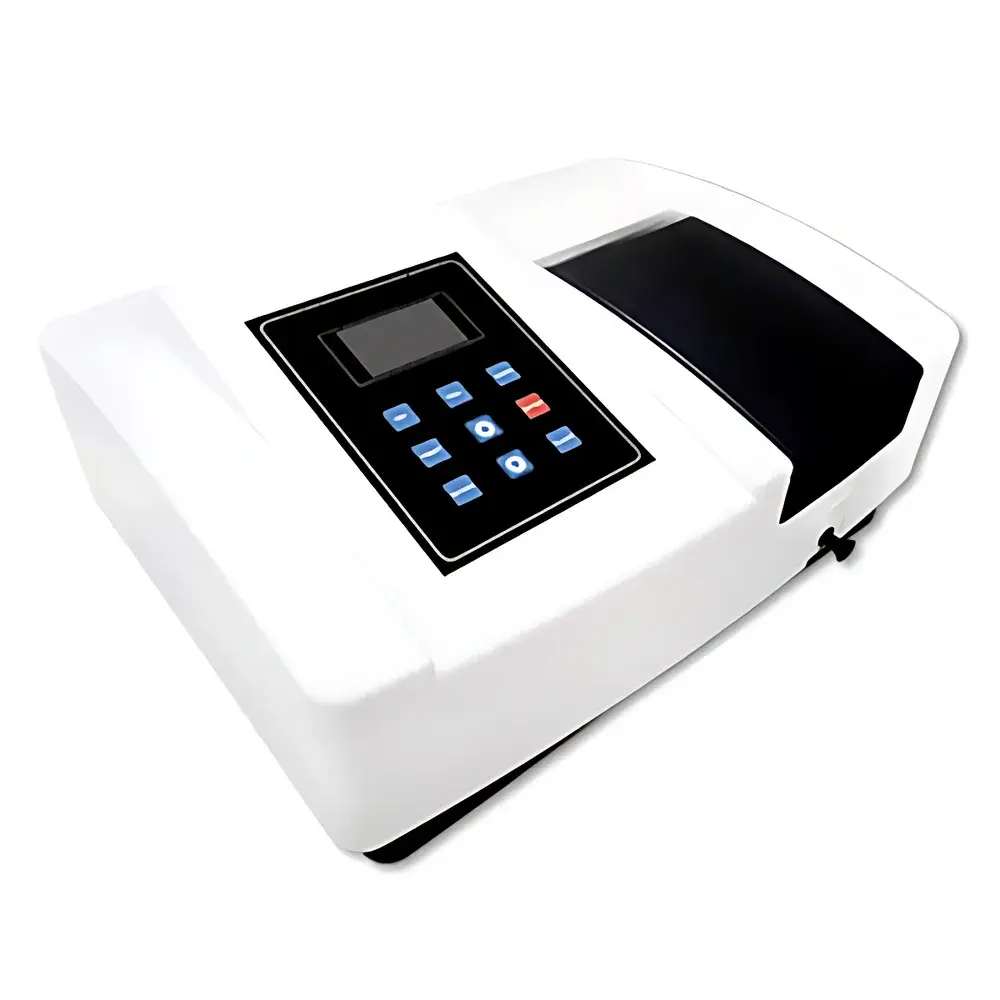
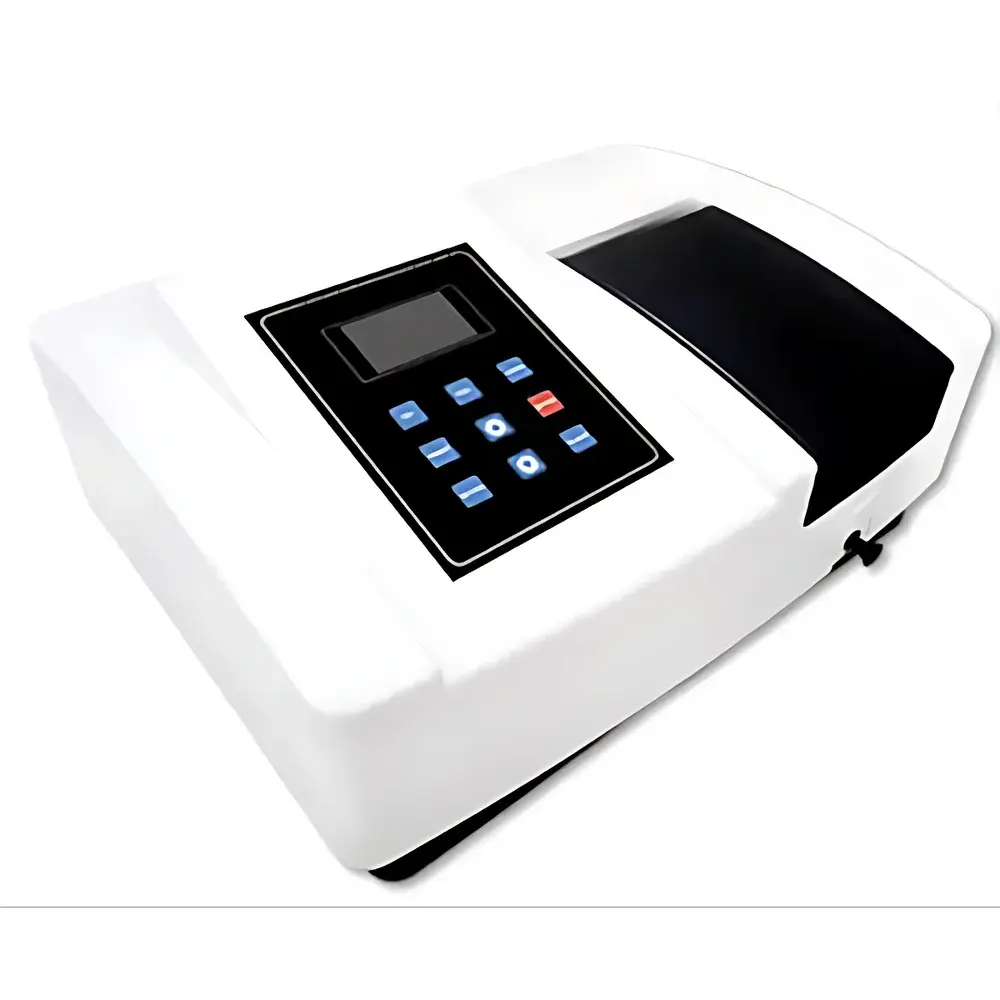
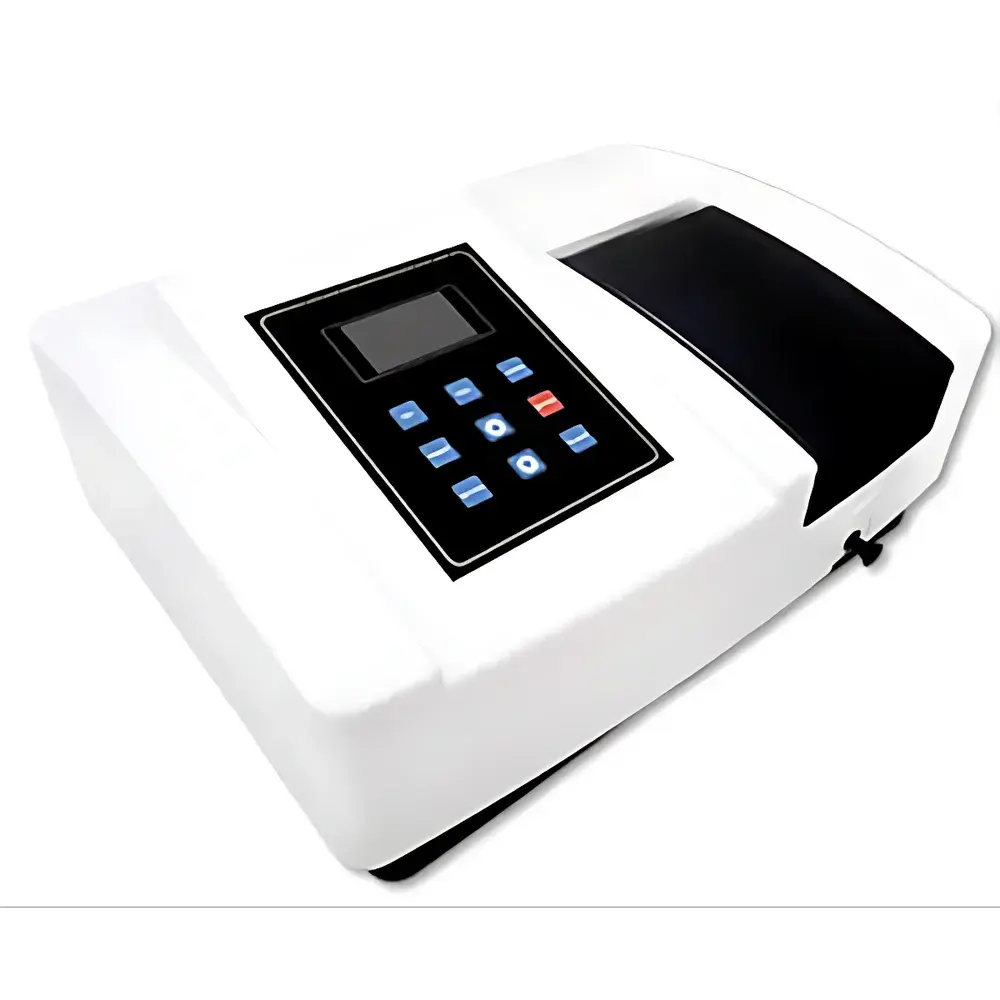
Yoke TUV755B Dual-Beam Ultraviolet-Visible Spectrophotometer
| Brand | Yoke |
|---|---|
| Origin | Shanghai, China |
| Model | TUV755B |
| Optical System | Dual-beam |
| Detector | Photomultiplier Tube (PMT) |
| Wavelength Range | 190–1100 nm |
| Wavelength Accuracy | ±0.3 nm |
| Wavelength Repeatability | ≤0.1 nm |
| Spectral Bandwidth | 1 nm |
| Stray Light | ≤0.03% (at 220 nm, using NaI solution) |
| Wavelength Scanning Mode | Automatic |
| Data Interface | RS-232 & Standard Parallel Printer Port |
| Onboard Storage | Microprocessor-based memory for calibration curves and measurement data |
Overview
The Yoke TUV755B Dual-Beam Ultraviolet-Visible Spectrophotometer is an engineered analytical instrument designed for routine and research-grade quantitative absorption spectroscopy across the ultraviolet, visible, and near-infrared spectral regions (190–1100 nm). Based on the dual-beam optical architecture, it continuously compares sample and reference beam intensities in real time—minimizing errors from source drift, detector instability, or environmental fluctuations. This configuration ensures high photometric stability and measurement reproducibility essential for compliance-driven laboratories. The system employs a high-sensitivity photomultiplier tube (PMT) detector, optimized for low-noise signal acquisition across the full wavelength range. Its 1 nm spectral bandwidth enables sufficient resolution for most pharmaceutical, environmental, and biochemical applications without compromising throughput. The instrument operates under microprocessor control (51-series embedded system), supporting autonomous operation and integration into regulated workflows.
Key Features
- Dual-beam optical design with real-time reference compensation for enhanced baseline stability and long-term photometric accuracy.
- High-performance PMT detector delivering superior signal-to-noise ratio, particularly critical below 250 nm where UV absorbance quantification demands high sensitivity.
- Precise wavelength drive mechanism with ±0.3 nm accuracy and ≤0.1 nm repeatability—verified per ISO 8579-1 and ASTM E275 guidelines for spectrophotometer performance validation.
- Fixed 1 nm spectral bandwidth, aligned with USP recommendations for method robustness in pharmaceutical assay development.
- Onboard microprocessor (51-series architecture) enabling storage of up to 200 calibration curves and 500 measurement records with timestamping.
- Integrated self-diagnostic routines covering lamp status, monochromator positioning, detector linearity, and optical path integrity—generating actionable fault codes for rapid troubleshooting.
- Non-volatile memory with power-loss protection preserves calibration parameters and user-defined methods during unexpected shutdowns.
Sample Compatibility & Compliance
The TUV755B accommodates standard 10 mm pathlength quartz, glass, or plastic cuvettes (including matched pairs for ratio-based measurements), as well as optional microvolume adapters and flow cells for specialized applications. It supports liquid, solution-phase samples compliant with ISO/IEC 17025 requirements for testing laboratories. The instrument meets core optical performance criteria outlined in ISO 6223 (spectrophotometers for chemical analysis) and aligns with general principles of GLP and GMP environments. While not pre-certified for FDA 21 CFR Part 11, its RS-232 interface enables connection to validated LIMS or ELN systems that implement electronic signature, audit trail, and data integrity controls per regulatory expectations.
Software & Data Management
The built-in firmware provides intuitive menu navigation for photometric mode (A/T/%T), quantitative analysis (single/multi-point calibration, linear/non-linear regression), kinetic assays (time-scan at fixed wavelength), full spectral scanning (190–1100 nm), multi-wavelength analysis, and nucleic acid/protein quantification (using preset extinction coefficients for dsDNA, ssDNA, RNA, and BSA). Data export is supported via RS-232 to external PCs running third-party spectral analysis software or custom scripts. The parallel printer port allows direct hardcopy output of spectra, calibration reports, or quantitative results—facilitating documentation traceability in non-digital workflows. All stored data includes metadata (date/time, operator ID placeholder, method name), supporting ALCOA+ data integrity principles when used within controlled procedures.
Applications
The TUV755B serves as a foundational tool in diverse sectors requiring reliable UV-Vis absorbance measurement: pharmaceutical QC labs performing assay validation and dissolution testing per USP ; environmental monitoring agencies quantifying nitrate, phosphate, or heavy metal complexes in water per EPA Method 365.3; food safety laboratories verifying colorant concentrations or antioxidant capacity (e.g., DPPH assay); academic research groups conducting enzyme kinetics or ligand-binding studies; and biotechnology facilities performing routine nucleic acid and protein concentration checks. Its robust construction and consistent performance make it suitable for both teaching laboratories and production support environments where operational simplicity and method transferability are prioritized.
FAQ
What is the maximum scan speed for full-spectrum acquisition?
The TUV755B performs wavelength scanning at a nominal rate of 1,200 nm/min, balancing resolution and signal averaging for optimal S/N in routine scans.
Can the instrument be calibrated using NIST-traceable standards?
Yes—users may perform wavelength calibration using holmium oxide or didymium filters, and photometric calibration using neutral density filters or potassium dichromate solutions traceable to NIST SRM 930e.
Is GLP-compliant audit trail functionality available?
The standalone unit does not generate electronic audit trails; however, when interfaced with validated external software or LIMS, full ALCOA+ compliant data handling—including user authentication, change history, and electronic signatures—is achievable.
What maintenance is required for the PMT detector?
The PMT is sealed and requires no routine servicing; periodic verification of dark current and gain stability is recommended annually or after 1,000 hours of lamp operation.
Does the TUV755B support method export/import between instruments?
Method parameters (calibration curves, scan settings, analysis modes) can be saved to external storage via RS-232 and reloaded manually—though cross-instrument compatibility assumes identical firmware revision levels.




