
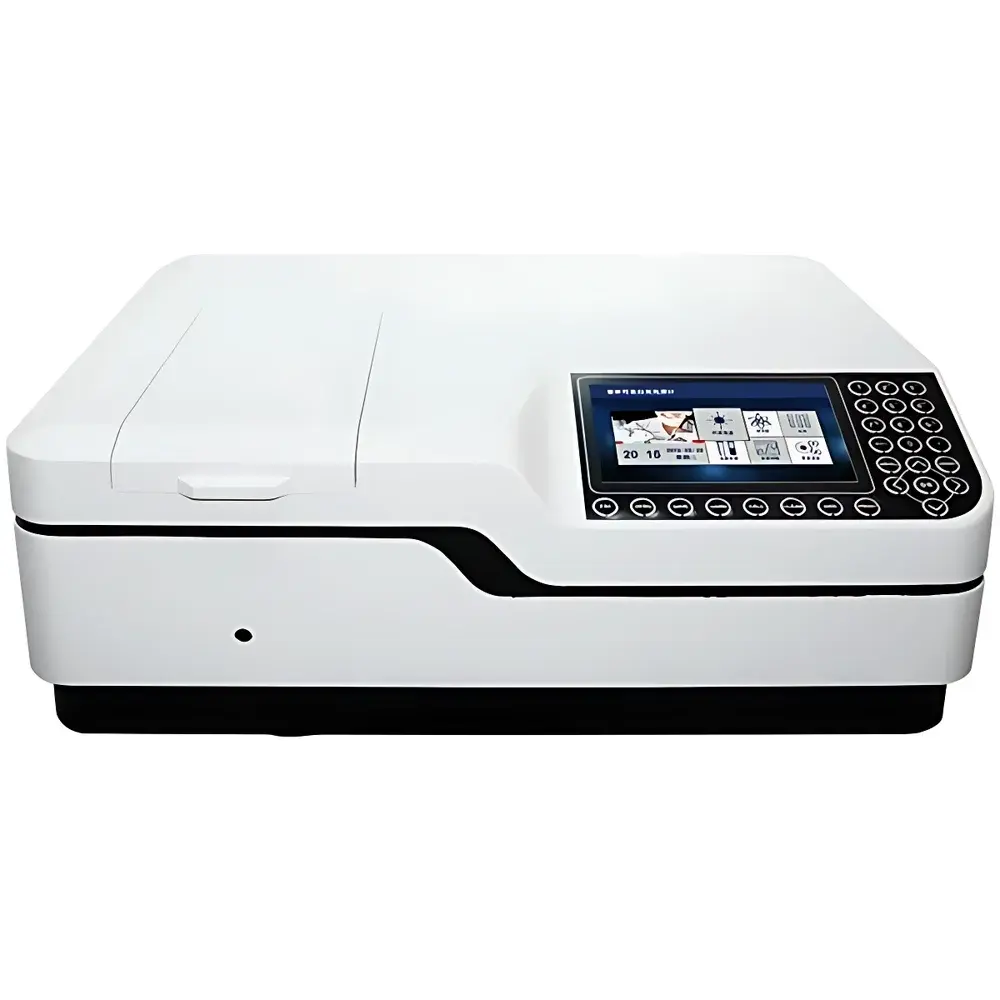
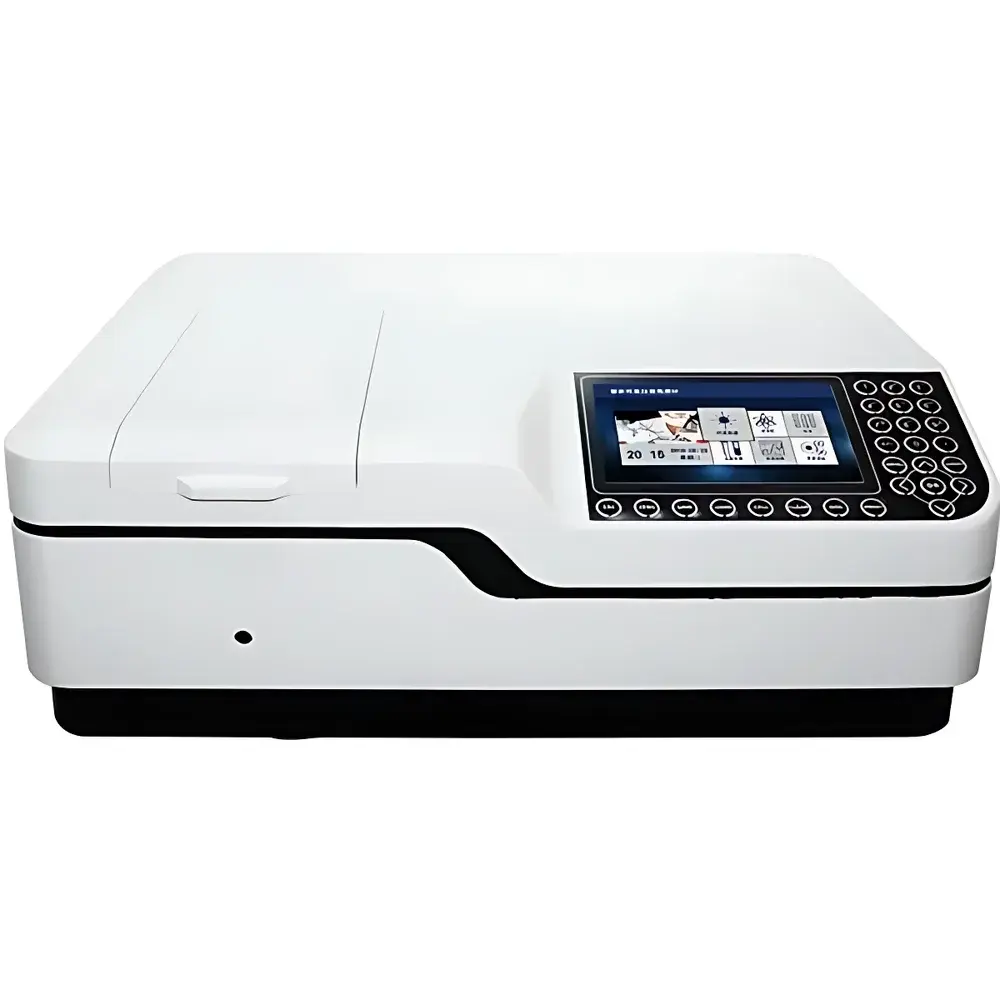
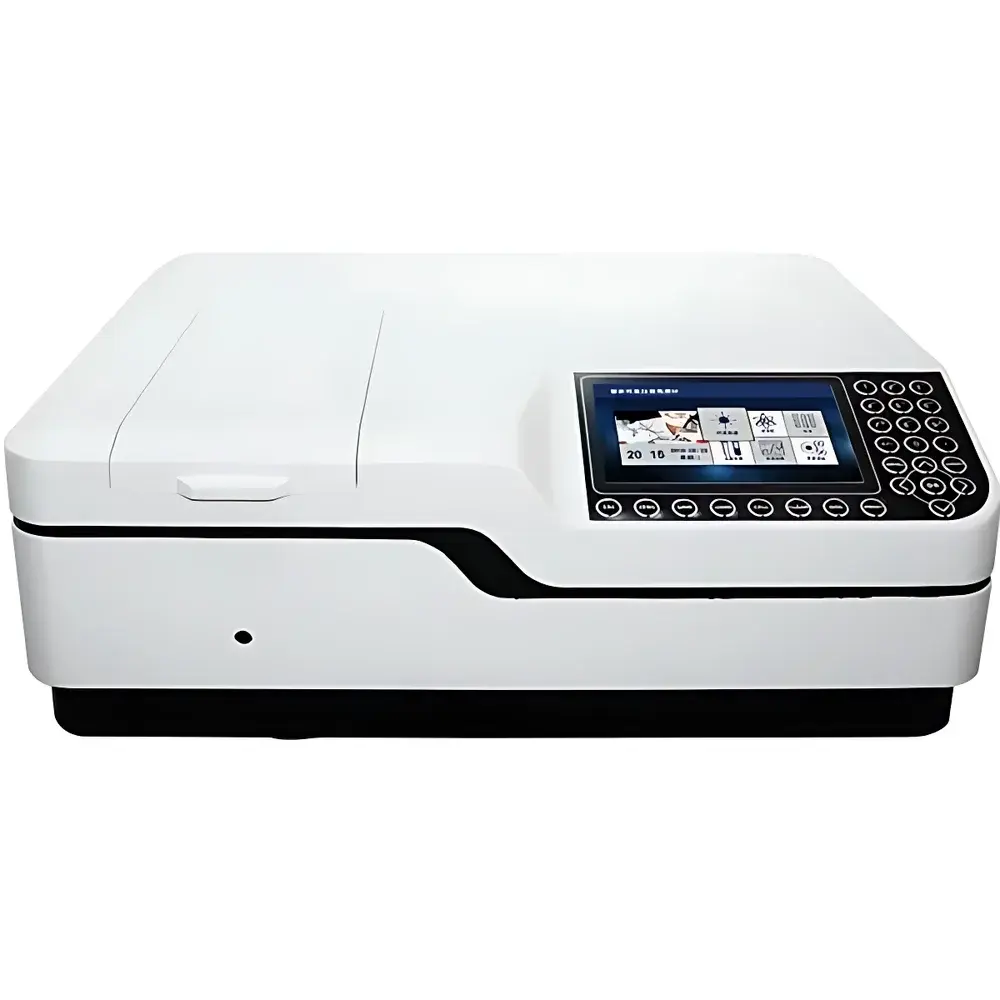
Yoke T-U9 Xenon Lamp Dual-Beam UV-Vis Spectrophotometer
| Brand | Yoke |
|---|---|
| Origin | Shanghai, China |
| Model | T-U9 |
| Optical Design | Dual-beam |
| Detector | Photomultiplier Tube (PMT) |
| Wavelength Range | 190–1100 nm |
| Wavelength Accuracy | ±0.3 nm |
| Wavelength Repeatability | ≤0.1 nm |
| Spectral Bandwidth | 1 nm |
| Stray Light | ≤0.03% at 220 nm (using NaI solution) |
| Automation Level | Automatic Wavelength Scanning |
| Light Source | Pulsed Xenon Lamp |
| Display | 10.1-inch Color Touchscreen |
| Internal Storage | 32 GB |
| Data Storage Capacity | Up to 5,000 absorbance readings or 500 calibration curves |
| Processor | 32-bit ARM Cortex-M3 @ 120 MHz |
| Interface Ports | RS-232C (for printer), USB Device (for PC connection), USB Host (for U-disk), Support for CSV, QUA, TXT, BMP export formats |
Overview
The Yoke T-U9 Xenon Lamp Dual-Beam UV-Vis Spectrophotometer is a precision optical instrument engineered for high-stability quantitative and qualitative analysis across the ultraviolet, visible, and near-infrared spectral regions (190–1100 nm). It operates on the dual-beam optical principle—splitting the xenon lamp output into reference and sample beams that are alternately measured by a single photomultiplier tube (PMT) detector—thereby compensating for source intensity drift and electronic baseline fluctuations in real time. Unlike traditional deuterium/tungsten lamp systems requiring warm-up and frequent replacement, the T-U9 employs a solid-state pulsed xenon lamp rated for ≥1 × 10⁹ flashes, enabling stable operation over a minimum service life of seven years without lamp degradation or recalibration downtime. Its optical architecture features a suspended monochromator assembly mounted on a reinforced aluminum baseplate, isolating the optical path from mechanical vibration and thermal deformation—critical for long-term photometric reproducibility in regulated laboratory environments.
Key Features
- Dual-beam optical design with real-time reference compensation ensures high photometric stability and minimizes baseline drift during kinetic or temperature-variable measurements.
- Pulsed xenon light source eliminates warm-up time; instrument achieves operational readiness within seconds of power-on—ideal for high-throughput QC labs and teaching laboratories.
- 10.1-inch capacitive touchscreen interface with graphical user interface (GUI) supports full standalone operation: spectrum scanning, quantitative analysis, kinetics, multi-wavelength measurement, and derivative spectroscopy—all without external PC dependency.
- Integrated 32 GB internal storage and USB Host port enable direct data export to USB flash drives in multiple formats (CSV, QUA, TXT, BMP), facilitating audit-ready documentation per GLP/GMP requirements.
- High-performance 32-bit ARM Cortex-M3 microcontroller (120 MHz clock speed) delivers rapid spectral acquisition (≤1.5 s for full 190–1100 nm scan at 1 nm bandwidth) and robust on-board data processing.
- Spectral bandwidth of 1 nm meets ISO 9001-compliant resolution requirements for pharmaceutical assay validation and food additive quantification per AOAC and USP guidelines.
Sample Compatibility & Compliance
The T-U9 accommodates standard 10 mm rectangular cuvettes (quartz, glass, or plastic) and optional accessories including 5–50 mm variable-pathlength cells, micro-volume adapters, and temperature-controlled cell holders (−10 to 100 °C, external circulator required). Its stray light performance (≤0.03% at 220 nm using sodium iodide solution) satisfies ASTM E275 and ISO 6223 criteria for high-absorbance accuracy in nucleic acid and protein quantitation. The instrument’s wavelength accuracy (±0.3 nm) and repeatability (≤0.1 nm) align with NIST-traceable verification protocols. While not pre-certified for FDA 21 CFR Part 11, its audit trail-capable data logging (timestamped, user-ID tagged, immutable file export) supports implementation in regulated environments under internal SOPs.
Software & Data Management
All instrument control, method development, and data evaluation occur natively via the embedded Linux-based OS. Measurement parameters—including slit width, scan speed, response time, and smoothing algorithms—are fully configurable. Data files retain metadata (operator ID, date/time stamp, instrument serial number, method name), supporting traceability. Exported CSV files are compatible with LIMS integration; BMP images meet publication-grade resolution standards. Optional PC software (Yoke SpectraLink™) provides advanced curve fitting, spectral library matching, and compliance reporting templates aligned with ISO/IEC 17025 documentation frameworks.
Applications
The T-U9 is routinely deployed in pharmaceutical quality control (e.g., assay of paracetamol, aspirin, and antibiotics per USP chapters and ), environmental water testing (nitrate, phosphate, COD), biochemical research (DNA/RNA A260/A280 ratios, enzyme kinetics), food safety (colorant concentration, antioxidant capacity), and academic instruction. Its broad spectral coverage and low stray light enable reliable analysis of highly absorbing samples—such as concentrated dyes or transition metal complexes—without signal saturation or nonlinear response artifacts.
FAQ
Does the T-U9 require lamp alignment or periodic wavelength calibration?
No. The pulsed xenon lamp is factory-aligned and thermally stabilized; wavelength calibration is performed automatically at startup using internal holmium oxide and didymium filters.
Can the T-U9 be integrated into an automated laboratory workflow?
Yes—via RS-232C or USB Device interface, it supports SCPI command sets for remote triggering, data retrieval, and method loading in robotic liquid handling platforms.
Is the internal memory sufficient for long-term method archiving?
With 32 GB of flash storage and support for hierarchical folder structures, the T-U9 retains >10 years of routine QC data assuming 200 daily measurements.
What maintenance is required beyond routine cleaning?
Annual verification of photometric linearity (using neutral density filters) and wavelength accuracy (per ISO 6223 Annex B) is recommended; no optical realignment or detector replacement is needed under normal use conditions.
How does the suspended optical design improve measurement reliability?
By decoupling the monochromator and detector assembly from the main chassis via elastomeric mounts and using a thickened aluminum baseplate, mechanical resonance and thermal expansion-induced misalignment are reduced by >80% compared to conventional benchtop designs.
Related Products





