
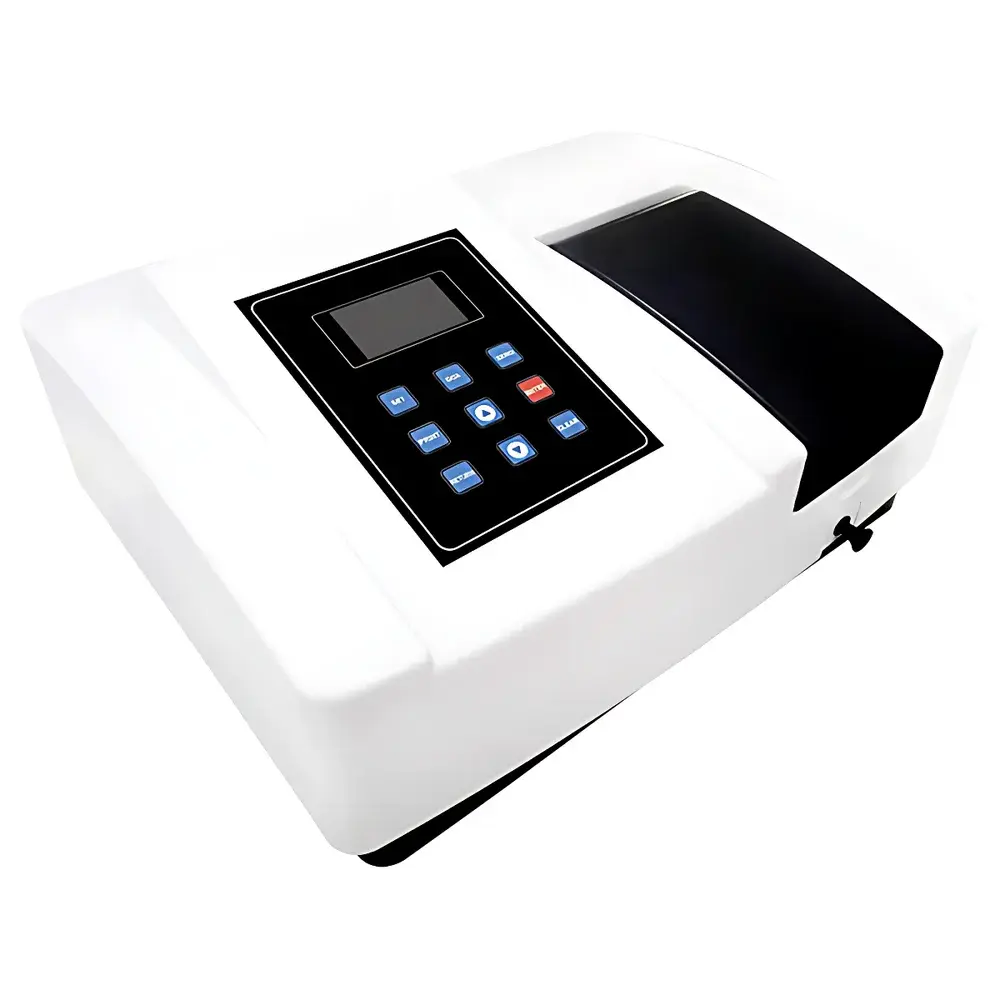
Yoke UV754N Single-Beam Ultraviolet-Visible Spectrophotometer
| Brand | Yoke |
|---|---|
| Origin | Shanghai, China |
| Manufacturer Type | Direct Manufacturer |
| Model | UV754N |
| Optical System | Single-Beam |
| Detector | Photodiode Array |
| Wavelength Range | 190–1100 nm |
| Wavelength Accuracy | ±2 nm |
| Wavelength Repeatability | 0.5 nm |
| Spectral Bandwidth | 4 nm |
| Photometric Accuracy | ±0.5% T |
| Photometric Repeatability | 0.2% T |
| Absorbance Range | –0.030 to 3.0 A |
| Transmittance Range | 0.0–200% T |
| Stray Light | ≤0.3% T at 220 nm and 360 nm |
| Baseline Stability | ±0.002 A/h |
| Display | 128 × 64 Dot-Matrix LCD |
| Interface | RS-232 Serial Port |
| Optional Peripheral | Thermal Printer Support |
| Data Storage | Onboard Microcontroller (51-series) with Standard Curve & Measurement Data Retention |
Overview
The Yoke UV754N is a single-beam ultraviolet-visible (UV-Vis) spectrophotometer engineered for routine quantitative and qualitative analysis in academic teaching laboratories, quality control environments, and small-scale R&D settings. It operates on the principle of Beer–Lambert law-based absorption spectroscopy, measuring the attenuation of monochromatic light as it passes through a sample solution across a continuous spectral range from 190 nm to 1100 nm. Its fixed 4 nm spectral bandwidth provides adequate resolution for standard applications including concentration determination, kinetic studies, and spectral scanning of organic and inorganic compounds. The instrument employs a photodiode array detector for rapid signal acquisition and stable baseline performance, with an optical architecture optimized for mechanical robustness and long-term wavelength fidelity. Designed for reliability under moderate usage conditions, the UV754N integrates core analytical functionality without requiring complex alignment or external calibration hardware.
Key Features
- Single-beam optical design with automatic wavelength scanning driven by stepper motor and grating monochromator
- Photodiode array detector enabling fast spectral response and low-noise signal processing
- Onboard 51-series microcontroller supporting up to 10 user-defined standard curves and persistent storage of measurement datasets
- Self-diagnostic firmware that validates lamp status, detector response, and wavelength drive integrity during startup and operation
- Power-loss recovery mode preserving calibration parameters and active method settings after unexpected shutdown
- Integrated quantitative analysis software with direct calculation of concentration, %T, and absorbance values based on stored calibration functions
- 128 × 64 dot-matrix LCD display with contrast adjustment and real-time graphical preview of absorbance or transmittance spectra
- RS-232 serial interface compliant with EIA/TIA-232-F standards for bidirectional communication with Windows-based PCs running third-party data acquisition or LIMS-compatible software
Sample Compatibility & Compliance
The UV754N accommodates standard 10 mm pathlength quartz or glass cuvettes (12.5 mm outer dimension), compatible with aqueous, organic, and mildly corrosive solvents. It supports both liquid and semi-solid suspensions when used with appropriate cell holders. While not certified for GMP-regulated production environments, its photometric accuracy (±0.5% T) and wavelength repeatability (0.5 nm) align with common educational and industrial QC requirements outlined in ASTM E275, ISO 6059, and USP . The instrument meets CE electromagnetic compatibility (EMC) directives and conforms to IEC 61010-1 safety standards for laboratory electrical equipment. No internal audit trail or electronic signature capability is provided; users implementing this system in regulated workflows must supplement with external documentation controls per FDA 21 CFR Part 11 or GLP/GMP record-keeping protocols.
Software & Data Management
Data handling is facilitated through native onboard firmware and optional PC connectivity. The embedded microcontroller retains calibration curves, measurement history, and instrument configuration parameters in non-volatile memory. Raw spectral scans and quantitative results can be exported via RS-232 using ASCII-formatted text packets, compatible with spreadsheet applications (e.g., Microsoft Excel), custom LabVIEW VIs, or open-source Python scripts utilizing pySerial. No proprietary software suite is bundled; however, the communication protocol is fully documented in the technical manual to support integration into existing laboratory informatics infrastructure. Print output—when enabled via optional thermal printer—is limited to numeric readouts and does not include graphical plots or metadata timestamps.
Applications
- Determination of analyte concentration in pharmaceutical excipients and active ingredients using preloaded calibration models
- Monitoring enzymatic reaction kinetics via time-resolved absorbance changes at characteristic wavelengths (e.g., NADH at 340 nm)
- Verification of dye concentrations in textile and ink manufacturing processes
- Assessment of water quality parameters including nitrate (220 nm), phosphate (880 nm), and COD-related chromophores
- Educational demonstrations of spectral interference, solvent effects, and Beer’s law linearity deviations
- Validation of filter transmission profiles and optical material characterization within UV-Vis range
FAQ
Does the UV754N support dual-beam or ratio referencing?
No—the UV754N implements a single-beam architecture; reference measurements must be performed manually prior to sample analysis.
Is wavelength calibration traceable to NIST standards?
The instrument includes factory calibration using holmium oxide and didymium filters; end-user recalibration requires external certified reference materials and is not automated.
Can the UV754N perform time-scan or multi-wavelength kinetic measurements?
Yes—kinetic mode allows sequential absorbance acquisition at up to three user-defined wavelengths over programmable intervals (1–999 seconds), with data logged to internal memory.
What is the expected lamp lifetime and replacement procedure?
The deuterium and tungsten halogen lamps are rated for approximately 1000 hours; replacement is field-serviceable using standard Torx tools and requires post-installation intensity optimization via the setup menu.
Is GLP-compliant audit trail functionality available?
No—audit trail, electronic signatures, and user access control are not implemented in firmware; such capabilities require external data management systems.





