
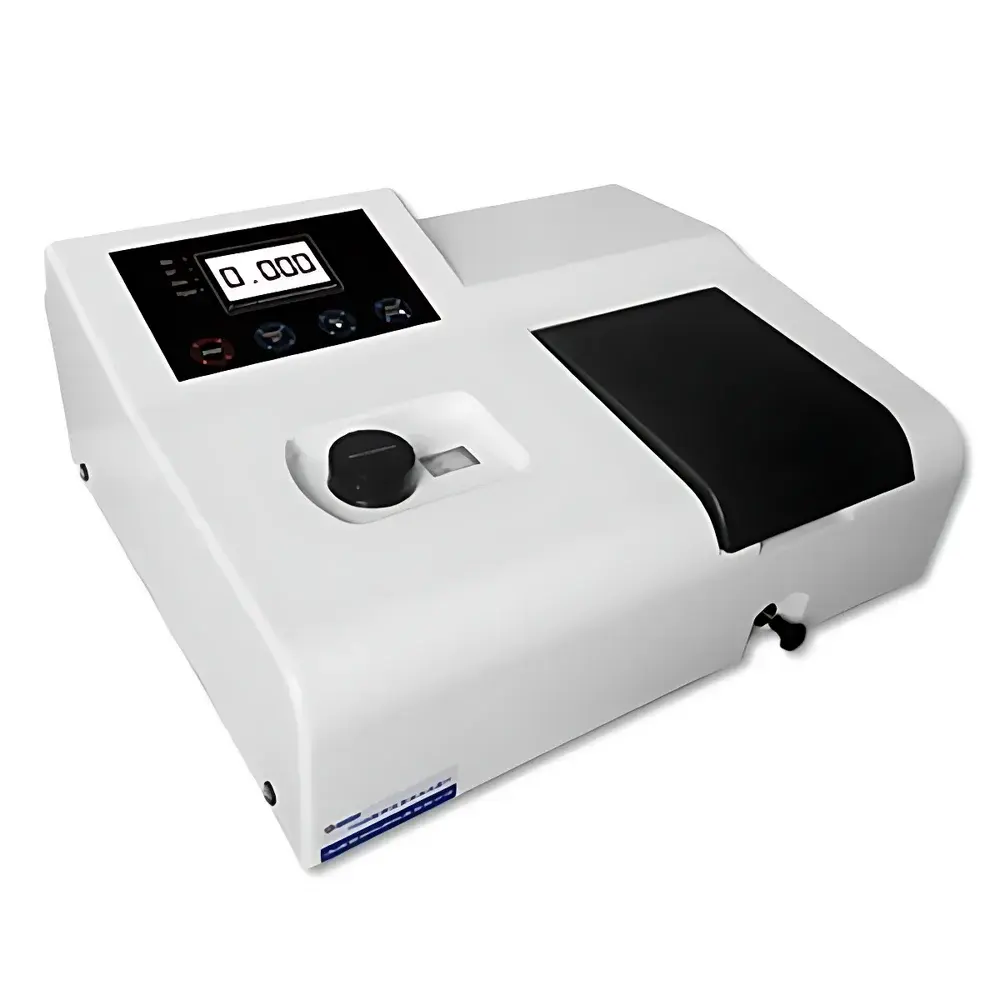
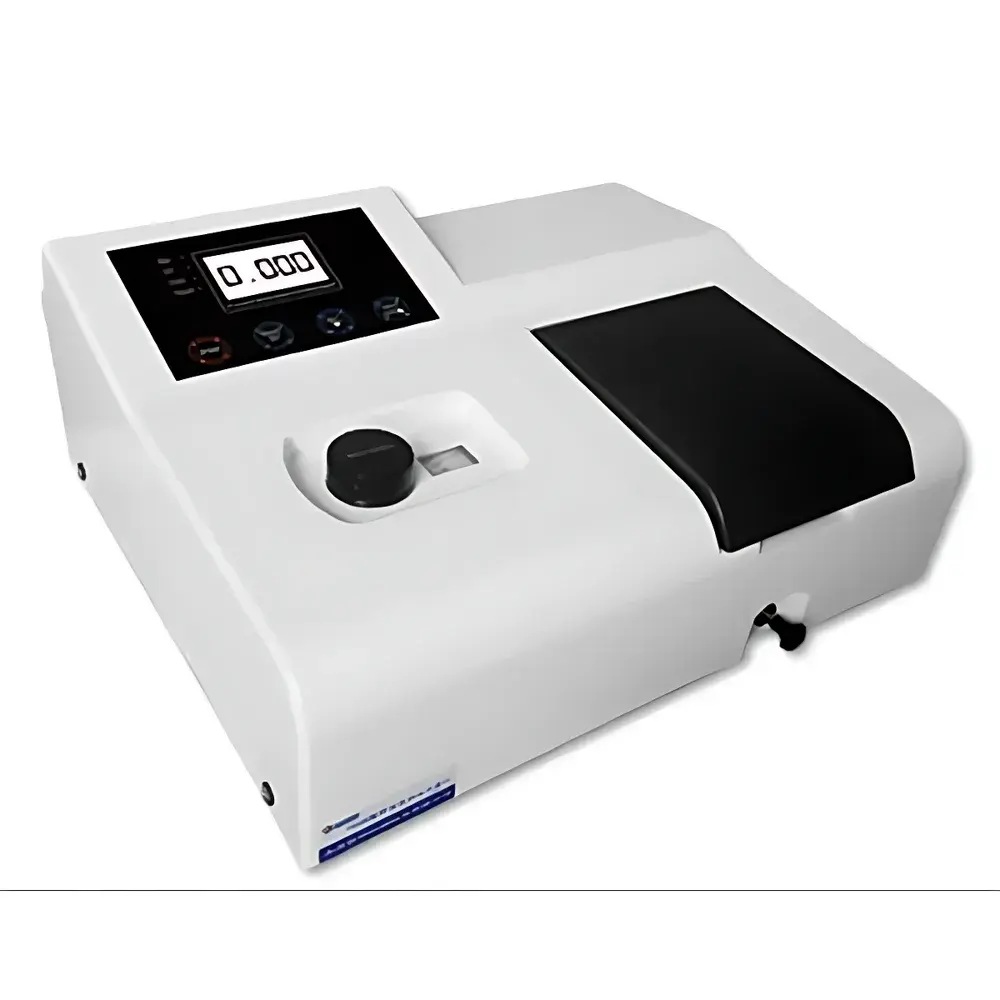
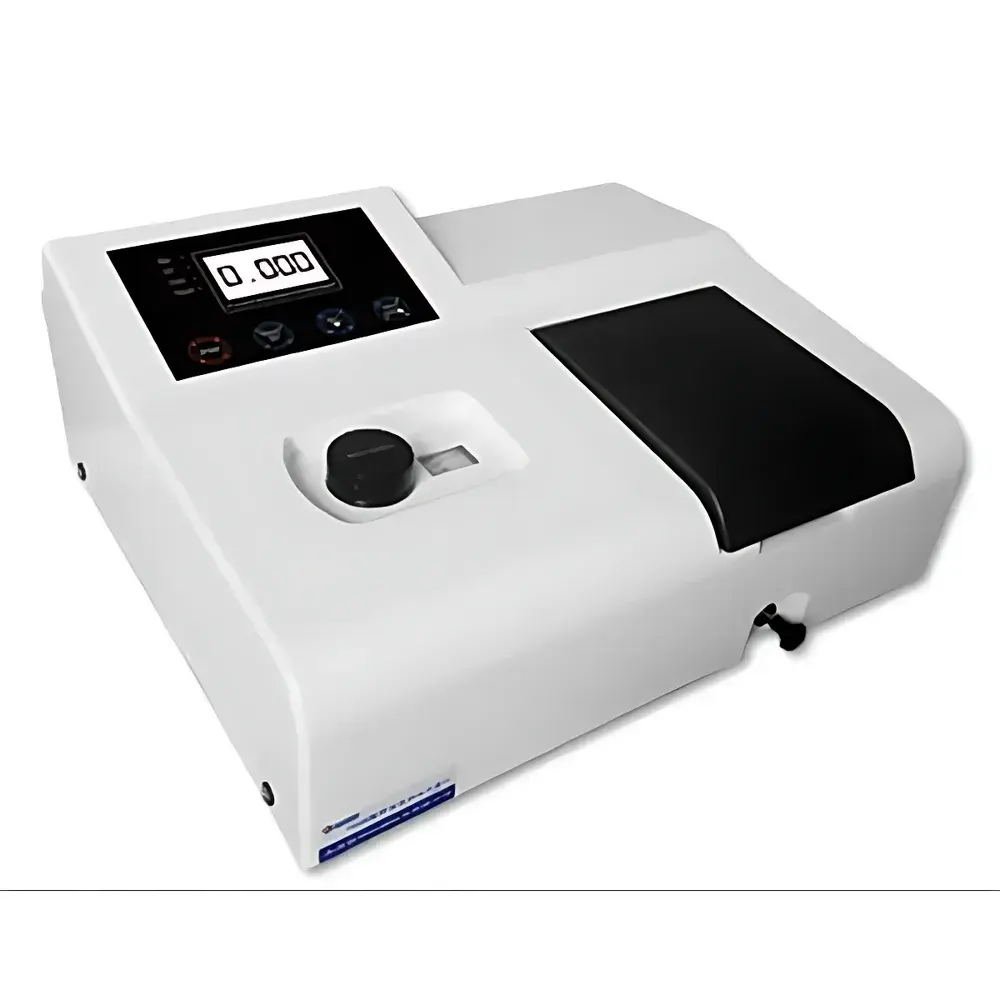
Yoke UV754PC Ultraviolet-Visible Spectrophotometer
| Brand | Yoke |
|---|---|
| Origin | Shanghai, China |
| Model | UV754PC |
| Optical System | Czerny-Turner monochromator with 1200 lines/mm grating |
| Beam Type | Single-beam |
| Detector | Photodiode array |
| Wavelength Range | 190–1100 nm |
| Spectral Bandwidth | 2 nm |
| Wavelength Accuracy | ±2 nm |
| Wavelength Repeatability | ≤1 nm |
| Stray Light | ≤0.5% T (at 220 nm, using NaI) |
| Photometric Accuracy | ±0.3% T |
| Photometric Repeatability | 0.3% T |
| Baseline Stability | ±0.004 A/h (at 500 nm, after 1 h warm-up) |
| Absorbance Range | 0–1.999 A |
| Transmittance Range | 0–199.0% T |
| Concentration Range | 0–1999 C |
| Display | 4-digit LCD |
| Interface | RS-232C serial port |
| Light Sources | 6 V/10 W halogen lamp (Philips) and long-life deuterium lamp |
| Power Supply | 220/110 V AC, 50–60 Hz |
Overview
The Yoke UV754PC Ultraviolet-Visible Spectrophotometer is a precision single-beam instrument engineered for routine quantitative and qualitative analysis in academic laboratories, quality control environments, and industrial R&D settings. Based on the Czerny-Turner optical architecture with a 1200 lines/mm holographic grating, it delivers consistent spectral resolution across its full operational range of 190–1100 nm. The system employs dual light sources — a Philips 6 V/10 W tungsten-halogen lamp for the visible and near-infrared region (350–1100 nm) and a long-life deuterium lamp for deep-UV coverage (190–350 nm) — enabling reliable absorbance and transmittance measurements without manual lamp switching. Its 2 nm spectral bandwidth ensures adequate resolution for standard applications such as concentration determination, kinetic assays, and purity verification per pharmacopoeial methods (e.g., USP , EP 2.2.25). Designed for robustness and operational continuity, the UV754PC achieves baseline stability of ±0.004 A/h at 500 nm after one hour of thermal equilibration — a critical performance benchmark for extended measurement sessions under GLP-compliant workflows.
Key Features
- Single-beam optical design with high-efficiency Czerny-Turner monochromator and 1200 lines/mm grating for reproducible wavelength selection
- Dual-source illumination: imported Philips tungsten-halogen lamp and extended-life deuterium lamp for seamless UV–Vis coverage
- Photodiode array detector providing rapid signal acquisition and improved signal-to-noise ratio compared to traditional photomultiplier tubes
- 2 nm fixed spectral bandwidth optimized for compliance with ISO 9001-controlled analytical procedures and routine QC testing
- High photometric accuracy of ±0.3% T and repeatability of 0.3% T, validated against NIST-traceable standards
- Stable thermal management architecture ensuring ±0.004 A/h baseline drift at 500 nm post warm-up — essential for time-resolved kinetic studies
- RS-232C interface supporting bidirectional communication with external PCs for automated data logging and report generation
- 4-digit LCD display with intuitive menu navigation; no proprietary software required for basic operation
Sample Compatibility & Compliance
The UV754PC accommodates standard 10 mm pathlength quartz or glass cuvettes (including matched pairs for reference subtraction), as well as micro-volume adapters and flow cells compatible with OEM accessories. It supports absorbance (0–1.999 A), transmittance (0–199.0% T), and concentration (0–1999 arbitrary units) measurement modes, facilitating direct implementation of Beer-Lambert law calculations. The instrument meets fundamental requirements outlined in ISO/IEC 17025 for analytical instrument verification and aligns with key sections of USP (Spectrophotometry and Light-Scattering) and EP 2.2.25 (Ultraviolet and Visible Absorption Spectrophotometry). While not inherently 21 CFR Part 11 compliant out-of-the-box, its RS-232C output enables integration into validated LIMS or ELN platforms where electronic signatures, audit trails, and user access controls are centrally managed.
Software & Data Management
Data acquisition and basic processing are performed via the built-in 4-digit LCD interface, eliminating dependency on host software for daily use. For enhanced traceability and regulatory alignment, the RS-232C port permits connection to Windows-based terminal emulators or custom LabVIEW/Python scripts that enforce structured data capture, timestamping, and CSV export. Users may implement third-party spectral analysis tools (e.g., OriginLab, MATLAB) for derivative spectroscopy, multi-component regression, or spectral library matching. All raw intensity values, wavelength coordinates, and calibration metadata are retained in ASCII format — facilitating retrospective reprocessing and cross-platform validation. No embedded database or user authentication system is included; therefore, data integrity relies on procedural controls within the laboratory’s documented SOPs.
Applications
- Quantitative analysis of pharmaceutical actives and excipients in dissolution and stability studies
- Enzyme kinetics monitoring via NADH/NADPH absorbance at 340 nm
- Water quality assessment (e.g., nitrate at 220 nm, phosphate via molybdenum blue method)
- Protein concentration estimation using Bradford or BCA assays (595 nm or 562 nm)
- Validation of UV-curable resin formulations through real-time absorbance decay profiling
- Educational use in undergraduate chemistry and biochemistry labs for spectral interpretation and calibration curve construction
FAQ
What is the minimum detectable absorbance change supported by the UV754PC?
The instrument’s photometric repeatability of 0.3% T corresponds to approximately ±0.003 A at 1.0 A — suitable for detecting small changes in dilute samples but not intended for ultra-low-concentration trace analysis requiring sub-millimolar sensitivity.
Can the UV754PC perform scanning measurements across a defined wavelength range?
Yes — the device supports manual or RS-232-triggered wavelength scanning from 190 nm to 1100 nm in programmable increments, with data points logged sequentially to external storage.
Is the deuterium lamp user-replaceable, and what is its typical lifetime?
The deuterium lamp is field-replaceable using standard alignment tools; rated lifetime exceeds 1000 hours under normal usage conditions, consistent with ICH Q5C photostability guidance for lamp source qualification.
Does the UV754PC include wavelength calibration verification tools?
It does not include built-in holmium oxide or didymium filters; however, the instrument accepts standard NIST-traceable reference materials for periodic verification per ASTM E275 and ISO 6223 protocols.





