
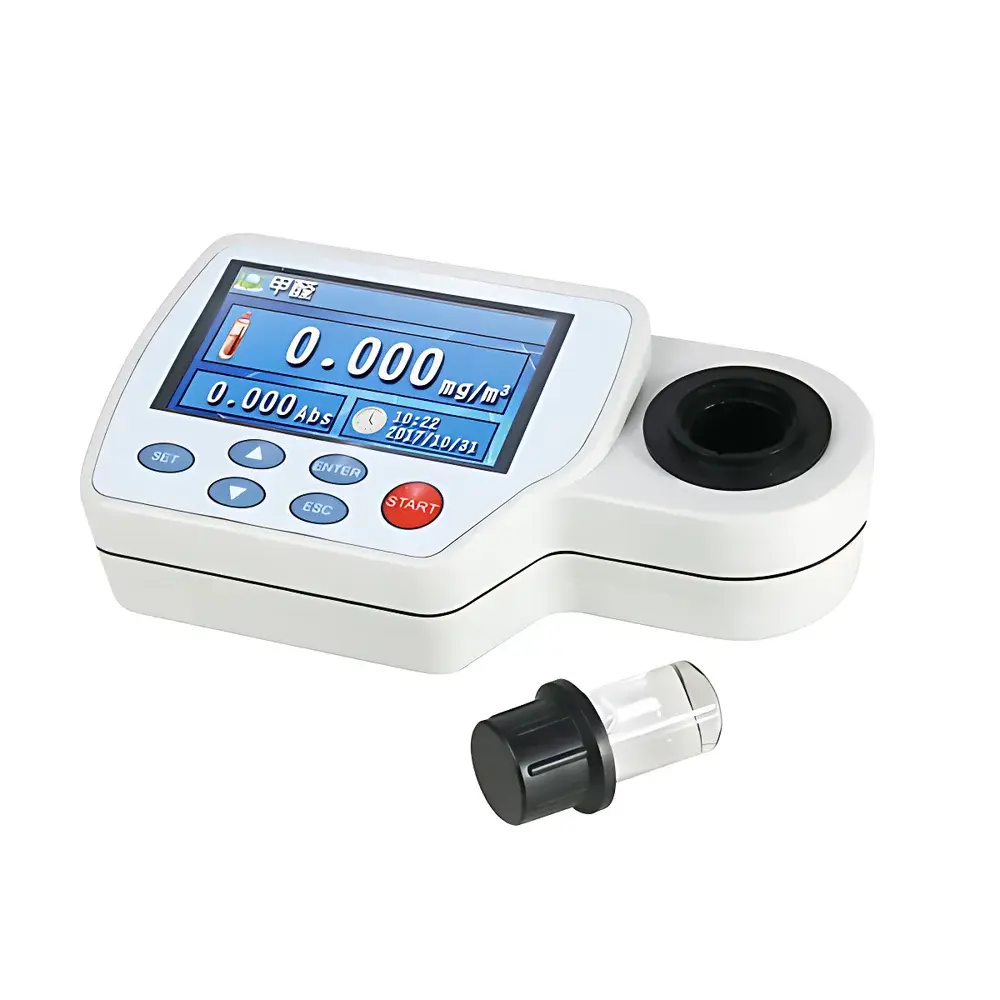
Yoke YKM-BKJ Portable High-Precision Air Formaldehyde Analyzer
| Brand | Yoke |
|---|---|
| Origin | Shanghai, China |
| Manufacturer Type | Manufacturer |
| Model | YKM-BKJ |
| Measurement Principle | Colorimetric Method (Acetylacetone Derivatization) |
| Measurement Range | 0.01–2.00 mg/m³ |
| Resolution | ±5% of reading |
| Repeatability | ±5% of reading |
| Sampling Method | Integrated Active Air Sampler (Pump-Driven) |
| Operating Temperature | 10–30 °C |
| Wavelength | 630 nm |
| Optical Stability | ≤0.001 A/10 min |
| Data Storage Capacity | 5,000 measurement records |
| Calibration Curves | 200 programmable curves (5 factory-default + 195 user-definable) |
| Display | 4.3-inch TFT color touchscreen (Chinese/English bilingual interface) |
| Processor | ARM9 core |
| Internal Memory | 512 MB NAND flash |
| Power System | Rechargeable Li-ion battery with real-time SOC monitoring |
| Charging Interface | USB Type-A (supports PC and 12 V vehicle port) |
| Communication | USB 2.0 (mass storage mode & virtual COM port) |
Overview
The Yoke YKM-BKJ Portable High-Precision Air Formaldehyde Analyzer is a field-deployable, laboratory-grade instrument engineered for quantitative determination of gaseous formaldehyde (HCHO) in ambient air, indoor environments, and occupational settings. It operates on the well-established acetylacetone derivatization method (ISO 16000-23, HJ 482–2009), where formaldehyde in sampled air reacts with acetylacetone under acidic catalysis to form a stable yellow chromophore (3,5-diacetyl-1,4-dihydrolutidine), quantified via fixed-wavelength photometry at 630 nm. Unlike passive diffusion-based sensors, the YKM-BKJ integrates a calibrated micro-pump air sampler—ensuring controlled volumetric sampling per NIOSH Method 2016—and eliminates reliance on external collection media or post-sampling lab analysis. Its optical architecture features a cold LED light source (100,000-hour lifetime), narrow-band interference filter (FWHM < 5 nm), and thermally stabilized detection path, delivering long-term photometric stability (≤0.001 A/10 min) critical for field reproducibility.
Key Features
- 4.3-inch high-resolution TFT color touchscreen with intuitive bilingual (English/Chinese) GUI, optimized for glove-compatible operation in industrial or remediation sites;
- Dual-power architecture: rechargeable lithium-ion battery with real-time state-of-charge (SOC) display and dual charging modes—USB-powered from host PC or 12 V automotive socket;
- ARM9-based embedded control system enabling responsive UI navigation, sub-second assay cycle time, and robust data handling;
- 200 programmable calibration curves—including 5 preloaded ISO/GB-compliant reference curves and 195 user-assignable slots—supporting segmented linear regression (multi-K coefficient modeling) to enhance accuracy across the full 0.01–2.00 mg/m³ range;
- Onboard curve auto-calibration with drift compensation: instrument automatically validates and adjusts calibration coefficients using built-in reference standards prior to each measurement batch;
- 5,000-record non-volatile memory with timestamp, location tag (optional GPS integration via USB serial), operator ID, and raw absorbance values—fully exportable as CSV via USB mass storage;
- Optical module certified to IEC 61326-1:2013 for electromagnetic compatibility in industrial environments and designed for minimal warm-up time (<60 s) and thermal drift (<0.002 A/°C).
Sample Compatibility & Compliance
The YKM-BKJ is validated for use with standard 10 mL absorption solution (acetylacetone–ammonium acetate–glacial acetic acid reagent) collected via its integrated pump-driven sampler (flow rate: 0.1–1.0 L/min, adjustable). It complies with Chinese national standard HJ 482–2009 “Ambient Air – Determination of Formaldehyde – Acetylacetone Spectrophotometric Method” and aligns with the technical basis of ISO 16000-23:2012 “Indoor air – Part 23: Determination of formaldehyde and other carbonyl compounds – DNPH derivatization method (reference for method validation framework)”. While not a direct GC-MS replacement, its performance meets QA/QC requirements for routine screening per EPA Compendium Method TO-11A (for comparison-level verification) and supports GLP documentation workflows through audit-trail-capable data logging. The device bears CE marking (EMC Directive 2014/30/EU) and conforms to RoHS 2011/65/EU material restrictions.
Software & Data Management
Data export and instrument configuration are managed via native USB 2.0 interface operating in dual-mode: mass storage (for direct CSV file access) and virtual COM port (for real-time telemetry and remote command execution). No proprietary software installation is required—CSV files open natively in Excel, LibreOffice, or LIMS platforms. Each record includes ISO 8601 timestamp, measured absorbance, calculated concentration, curve ID, operator code, and battery voltage. Firmware updates are delivered as signed .bin files via USB; version history and update logs are retained in internal memory. All stored data adhere to ALCOA+ principles (Attributable, Legible, Contemporaneous, Original, Accurate, Complete, Consistent, Enduring, Available) when exported with metadata intact—enabling traceability in regulated environments subject to ISO/IEC 17025 or ISO 9001 internal audit requirements.
Applications
- Routine indoor air quality (IAQ) assessment in residential, commercial, and educational buildings post-renovation or furniture installation;
- Ongoing occupational exposure monitoring in plywood manufacturing, resin synthesis, textile finishing, and disinfection facilities (per OSHA PEL 0.75 ppm / 0.9 mg/m³ 8-hr TWA);
- Pre-occupancy verification testing for LEED IEQ Credit 3.2 (Construction IAQ Management Plan) and WELL Building Standard W02;
- Field validation of HVAC filtration efficiency and activated carbon adsorber breakthrough in remediation projects;
- Academic research on formaldehyde emission kinetics from building materials (e.g., particleboard, MDF, urea-formaldehyde adhesives) per ASTM D6007–22;
- Regulatory compliance support for local environmental protection bureaus conducting spot-check campaigns under China’s “Three-Year Action Plan for Air Pollution Prevention and Control”.
FAQ
What sample volume is required for a valid measurement?
A minimum of 5 L of air must be drawn through the absorption solution at 0.5 L/min for standard sensitivity; total sampling volume is configurable between 1–20 L depending on expected concentration and desired LOD.
Can the instrument be used without a power source?
Yes—the integrated 4,200 mAh Li-ion battery provides ≥8 hours of continuous operation at 0.5 L/min sampling flow, with low-power sleep mode extending standby to 72 hours.
How often does the optical system require recalibration?
Factory calibration is stable for 12 months under normal use; however, users should perform zero-point verification with blank reagent before each sampling session and full 3-point calibration every 30 days or after filter replacement.
Is the device compatible with third-party LIMS systems?
Yes—CSV exports contain structured headers compliant with ASTM E1461-21 (Standard Practice for Electronic Data Interchange in Laboratory Information Systems), supporting automated ingestion into common LIMS platforms without middleware.
Does the YKM-BKJ meet FDA or EU medical device requirements?
No—it is classified as an environmental monitoring instrument, not a medical device; it is not intended for clinical diagnosis, patient exposure assessment, or regulatory submission under 21 CFR Part 820 or MDR 2017/745.
Related Products







