
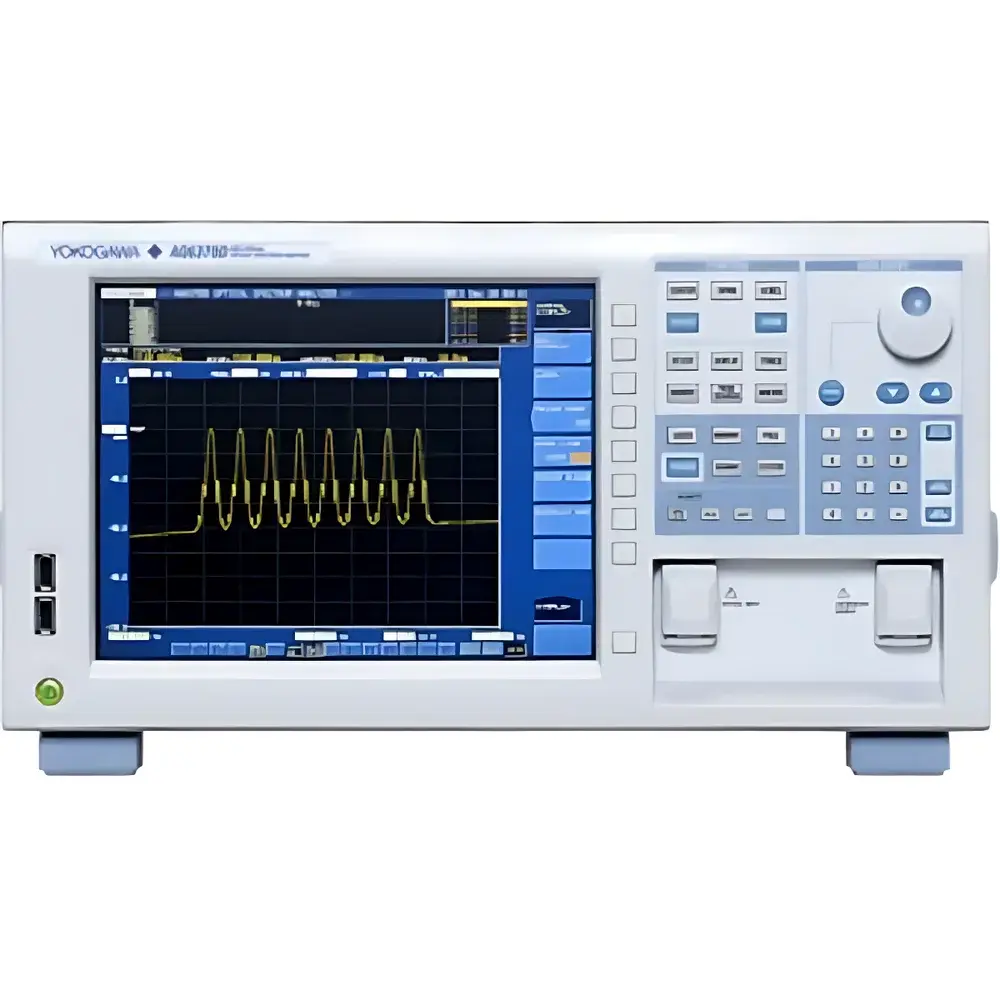
Yokogawa AQ6370D Optical Spectrum Analyzer
| Brand | Yokogawa |
|---|---|
| Model | AQ6370D |
| Wavelength Range | 600–1700 nm |
| Wavelength Accuracy | ±0.01 nm |
| Wavelength Resolution | 0.02 nm |
| Dynamic Range | 78 dB (typ.) |
| Power Range | +20 to −90 dBm |
| Sweep Time | 0.2 s (for 100 nm span) |
| Fiber Compatibility | Single-mode and multimode fiber |
| Origin | Japan (manufactured in Yokogawa facilities |
Overview
The Yokogawa AQ6370D Optical Spectrum Analyzer (OSA) is a high-performance benchtop instrument engineered for precision spectral characterization of optical signals in research, development, and manufacturing environments. Based on diffraction grating monochromator architecture with dual-pass optical path design, the AQ6370D delivers exceptional wavelength fidelity and radiometric accuracy across the near-infrared telecom and photonics bands (600–1700 nm). Its core measurement principle relies on high-stability scanning gratings coupled with thermoelectrically cooled InGaAs detector arrays, enabling traceable, repeatable spectral power distribution (SPD) analysis with minimal thermal drift. Designed for applications demanding metrological-grade validation—such as laser diode characterization, DWDM channel verification, optical amplifier gain profiling, and passive component insertion loss measurement—the AQ6370D meets stringent requirements for spectral resolution, dynamic range, and measurement speed without compromising calibration integrity.
Key Features
- Ultra-high wavelength accuracy of ±0.01 nm (calibrated against internal He-Ne reference laser), supporting compliance with ITU-T G.694.1 channel grid specifications.
- Minimum resolvable wavelength separation of 0.02 nm (FWHM), enabling resolution of closely spaced DFB laser modes and narrowband filter passbands.
- 78 dB typical dynamic range (measured at 1550 nm, 0.1 nm resolution bandwidth), sufficient to resolve weak spontaneous emission sidebands adjacent to strong CW signals.
- Wide optical power measurement range from +20 dBm to −90 dBm, accommodating both high-power pump lasers and low-level ASE noise floors.
- Sub-second spectral acquisition: full 100 nm sweep completed in 0.2 s, facilitating real-time monitoring of transient spectral behavior during device biasing or temperature ramping.
- Native compatibility with standard SMF-28 single-mode fiber and 50/125 µm and 62.5/125 µm multimode fibers via FC/PC or FC/APC input interfaces.
- Integrated alignment optimization algorithms reduce coupling loss variability, improving measurement reproducibility across operator shifts and fiber patch cord changes.
Sample Compatibility & Compliance
The AQ6370D accepts free-space-coupled or fiber-pigtailed inputs without requiring external collimation optics. It supports industry-standard fiber connectors (FC/PC, FC/APC) and accommodates both polarization-maintaining and non-PM fiber configurations when used with optional polarization controllers. Instrument firmware conforms to IEC 61326-1 (EMC for laboratory equipment) and IEC 61010-1 (safety requirements). Measurement data traceability aligns with ISO/IEC 17025 requirements when operated within validated environmental conditions (23 ± 2 °C, <65% RH) and calibrated per Yokogawa’s accredited service schedule (recommended annually). The analyzer is routinely deployed in GLP-compliant optical labs and supports audit-ready documentation for FDA-regulated photonic medical device validation.
Software & Data Management
The AQ6370D operates with Yokogawa’s proprietary OSA Application Software (v3.x), providing intuitive GUI-based control, automated pass/fail testing, and customizable report generation (PDF, CSV, XML). Remote operation is supported via Ethernet (VXI-11, SCPI over TCP/IP) and GPIB interfaces, enabling integration into automated test systems compliant with IEEE 488.2 and IVI-C drivers. All measurement sessions include embedded timestamping, user ID tagging, and hardware configuration logging—features essential for 21 CFR Part 11–compliant environments requiring electronic record integrity and operator accountability. Data export formats support interoperability with MATLAB, Python (via PyVISA), and LabVIEW for advanced spectral modeling and statistical process control (SPC).
Applications
- Characterization of tunable lasers, DFB/DBR lasers, and superluminescent diodes (SLDs) including linewidth, side-mode suppression ratio (SMSR), and wavelength drift vs. temperature.
- Optical signal-to-noise ratio (OSNR) measurement in EDFA and Raman amplifier development per ITU-T G.698.2.
- Spectral loss profiling of FBGs, AWGs, arrayed waveguide gratings, and thin-film filters.
- Verification of WDM system channel spacing, power uniformity, and crosstalk in multi-channel transceivers.
- Research in integrated photonics, silicon photonics, and quantum optics where sub-picometer spectral stability is critical.
- Educational use in university optics laboratories for hands-on spectroscopy, interferometry, and fiber optic communications courses.
FAQ
What calibration standards does the AQ6370D reference for wavelength accuracy?
The instrument uses an internal stabilized He-Ne laser (632.8 nm) as primary wavelength reference, traceable to NIST through Yokogawa’s ISO/IEC 17025-accredited calibration laboratory.
Can the AQ6370D measure optical return loss (ORL)?
No—ORL requires bidirectional reflectance measurement; the AQ6370D is a unidirectional power-integrating spectrometer. ORL testing necessitates dedicated ORL test sets or OTDRs.
Is firmware upgrade support available after purchase?
Yes—Yokogawa provides free firmware updates via registered user portal, including enhancements to measurement algorithms, compliance reporting, and interface protocol support.
Does the analyzer support external triggering for synchronized measurements?
Yes—TTL-compatible trigger input/output ports enable precise synchronization with laser current sources, temperature controllers, or other instrumentation in multi-parameter test setups.
What is the recommended recalibration interval under continuous lab use?
Annual calibration is recommended; however, Yokogawa advises quarterly performance verification using built-in self-test routines and reference light sources for mission-critical applications.





