
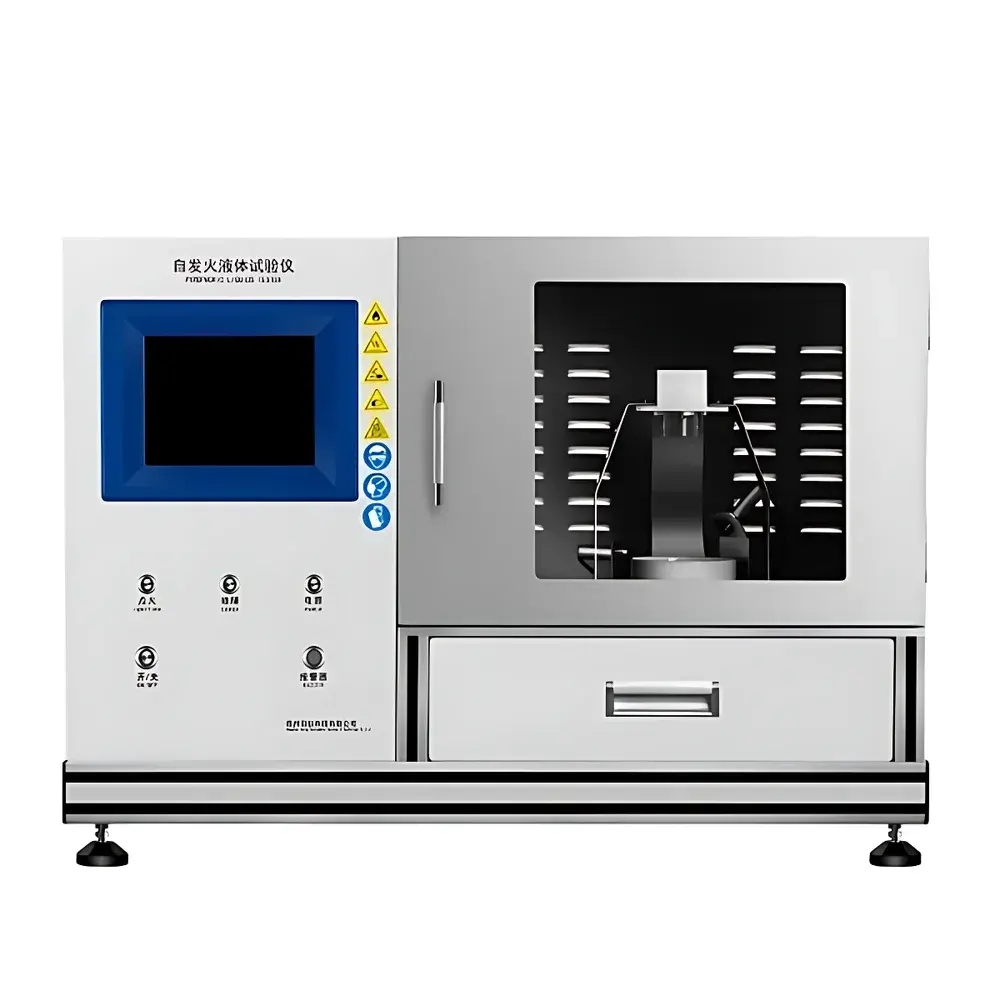
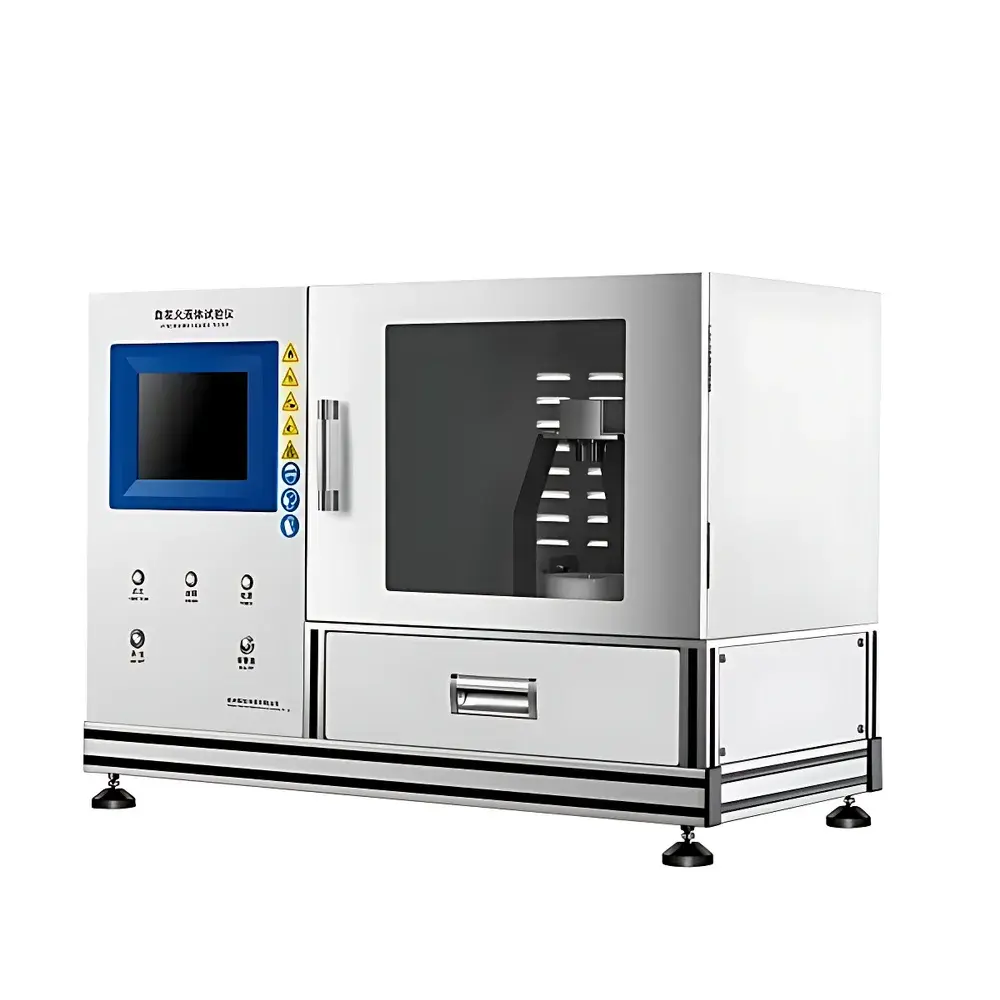
Young Instruments HWP16-10S Spontaneously Combustible Liquids Tester
| Brand | Young Instruments |
|---|---|
| Origin | Zhejiang, China |
| Manufacturer Type | Direct Manufacturer |
| Origin Category | Domestic (China) |
| Model | HWP16-10S |
| Pricing | Available Upon Request |
| Operating Temperature Range | −5 °C to 45 °C |
| Relative Humidity Limit | <95% RH |
| Flame Detection Method | Infrared Sensor |
| Char Detection Method | Colorimetric Standard-Based Optical Analysis |
| Timing Range | 0–999 s |
| Timing Accuracy | ±0.01 s |
| Time Display Resolution | 1 s |
| Reaction Vessel | Ceramic, Ø100 mm |
| Ambient Temperature Measurement Range | −10 °C to +60 °C |
| Ambient Temperature Accuracy | ±0.5 °C |
| Ambient Humidity Measurement Range | 5–95% RH |
| Ambient Humidity Accuracy | ±5.0% RH |
Overview
The Young Instruments HWP16-10S Spontaneously Combustible Liquids Tester is a fully automated, CE-compliant benchtop instrument engineered for precise evaluation of spontaneous ignition behavior in liquid substances under ambient atmospheric conditions. It implements the standardized test protocol defined in Section 33.3.1.5 (Test N.3) of the United Nations Recommendations on the Transport of Dangerous Goods — Manual of Tests and Criteria, which assesses whether a liquid—when applied to an inert carrier or filter paper—undergoes self-heating sufficient to ignite or produce charring without external ignition source. The instrument operates on dual-path detection logic: infrared-based flame recognition and spectrally calibrated colorimetric analysis for char formation, enabling unambiguous classification per UN GHS Category 1 (spontaneously combustible liquids) and alignment with regulatory definitions under CLP Regulation (EC) No. 1272/2008 and OSHA Hazard Communication Standard 29 CFR 1910.1200.
Key Features
- Embedded Windows CE control system with real-time process monitoring and deterministic event logging
- 8-inch capacitive touch display interface supporting intuitive parameter configuration, live status visualization, and immediate result annotation
- Dual-mode testing capability: configurable selection between inert carrier exposure mode (e.g., diatomaceous earth) and standardized filter paper contact mode per UN Test N.3 specifications
- Nanosecond-response photodiode sensor array for high-temporal-resolution detection of incipient luminance changes associated with autoignition onset
- Integrated ceramic reaction vessel (Ø100 mm) providing thermal stability, chemical inertness, and repeatable sample geometry for inter-laboratory reproducibility
- Automated pass/fail decision engine: triggers audible and visual alarm upon flame detection, char threshold exceedance, or timeout expiration—eliminating subjective endpoint interpretation
- Onboard environmental monitoring module continuously records ambient temperature (−10 °C to +60 °C, ±0.5 °C) and relative humidity (5–95% RH, ±5.0% RH), with pre-test validation alerts if conditions fall outside ISO 17025-recommended operational bounds
Sample Compatibility & Compliance
The HWP16-10S accommodates liquid samples ranging from low-viscosity hydrocarbons to polar solvents and metal-organic precursors, provided they do not chemically degrade the ceramic reaction vessel or optical detection surfaces. Sample volume is standardized at 0.5 mL applied uniformly to either the inert carrier substrate or Grade 1 qualitative filter paper (Whatman 1 or equivalent). All test procedures comply with UN Manual of Tests and Criteria Rev. 7 (2019), ASTM E659-18 (Standard Test Method for Autoignition Temperature of Liquid Chemicals), and are compatible with GLP documentation workflows. Data output includes timestamped thermal/humidity logs, detection event timestamps, and binary classification output (combustible/non-combustible), supporting audit-ready reporting for regulatory submissions to ECHA, DOT, or IMDG Code authorities.
Software & Data Management
The instrument’s embedded software supports full traceability in accordance with FDA 21 CFR Part 11 requirements for electronic records and signatures. Each test generates a cryptographically signed .CSV file containing: initiation timestamp, environmental readings at t=0 and t=end, infrared intensity curve (sampled at 100 Hz), colorimetric delta-E trajectory, and final classification verdict. Data export is USB-host enabled; no cloud dependency or proprietary viewer required. Audit trail functionality captures all user actions—including parameter edits, calibration resets, and report generation—with immutable timestamps and operator ID fields. Optional integration with LIMS via RS-232 or Ethernet (TCP/IP Modbus RTU) enables centralized data aggregation for enterprise-scale hazard classification databases.
Applications
- Classification of new chemical entities for SDS authoring and transport classification (UN Class 4.2)
- Quality control screening of solvent batches post-synthesis or distillation
- Stability assessment of metal alkyls, organolithium reagents, and pyrophoric catalyst residues
- Regulatory due diligence for REACH registration dossiers requiring autoignition data
- Research into oxidation kinetics of bio-based esters and fatty acid methyl esters (FAMEs)
- Validation of storage protocols for air-sensitive intermediates in fine chemical manufacturing
FAQ
Does the HWP16-10S require external calibration gases or reference standards?
No. The system relies on factory-calibrated infrared and optical sensors; only annual verification using certified reference filters and black-body sources is recommended per ISO/IEC 17025 Clause 6.5.
Can test results be exported directly to Excel or LIMS without intermediate software?
Yes. Raw data files (.CSV) are natively readable by Microsoft Excel, Python pandas, or any LIMS accepting flat-file ingestion via USB or network transfer.
Is the ceramic reaction vessel replaceable, and what is its expected service life?
Yes—vessels are field-replaceable consumables with typical service life exceeding 500 tests under proper cleaning (acetone rinse, air-dry). A spare vessel kit is included with initial shipment.
How does the instrument handle false positives from ambient light fluctuations or dust interference?
The infrared detector employs narrow-band spectral filtering centered at 4.26 µm (CO₂ emission band), while the colorimetric module uses CIELAB ΔE*₀₀ calculation against NIST-traceable grayscale references—minimizing environmental optical noise susceptibility.
Does the system support multi-language UI beyond English?
Currently English-only; however, the underlying Unicode-compliant OS architecture permits localized firmware updates for EU or APAC regional deployment upon request.




