
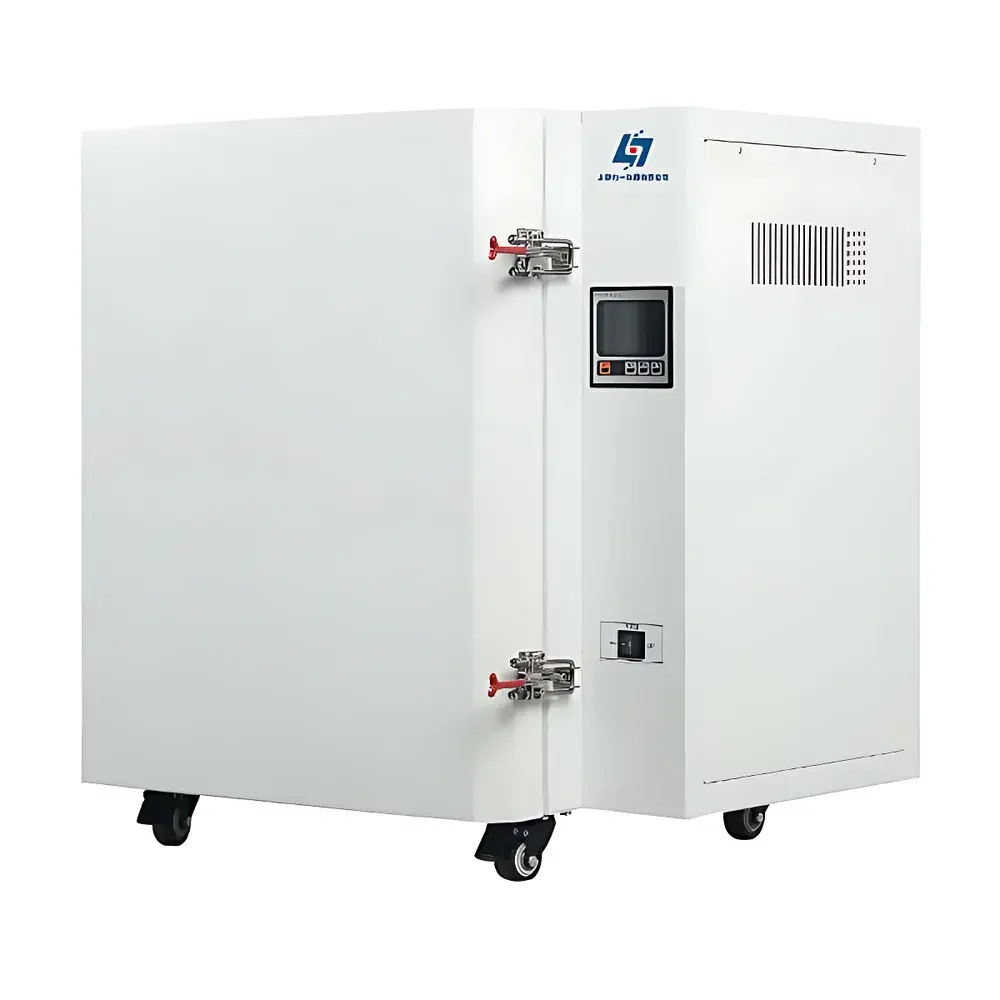
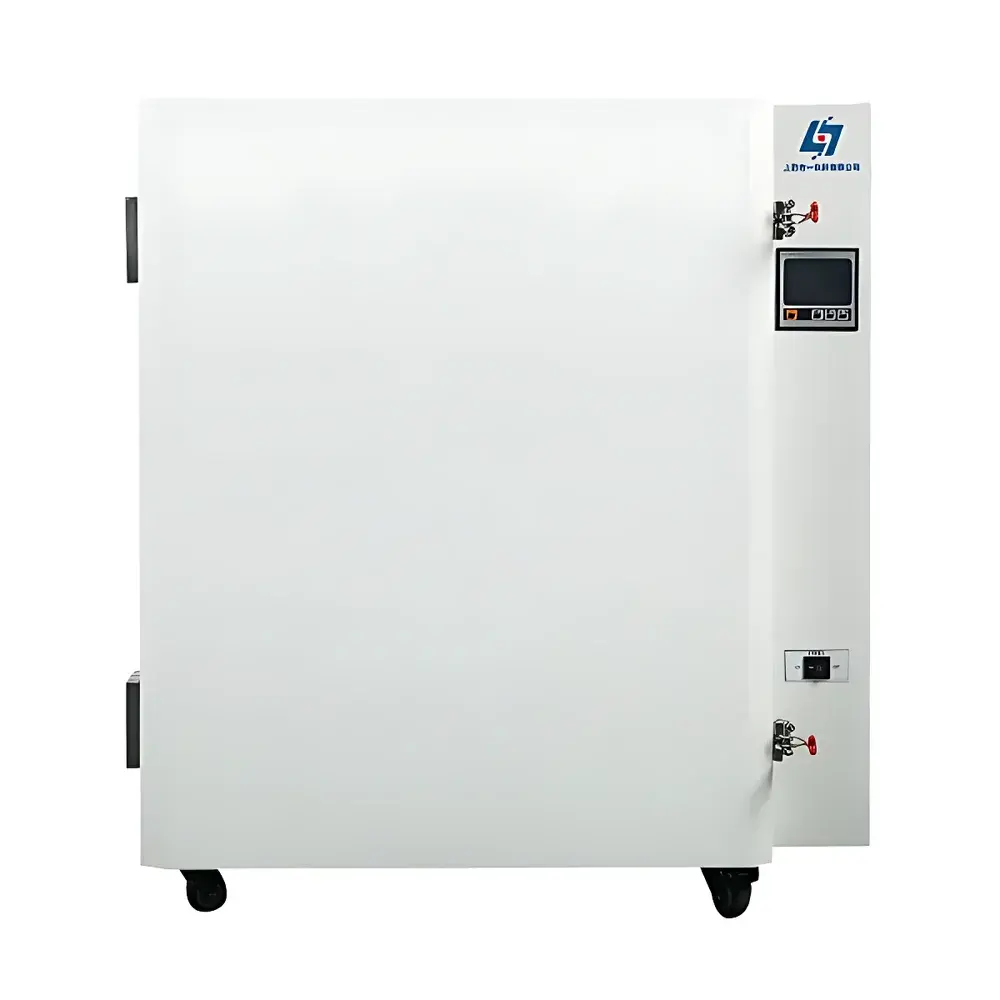
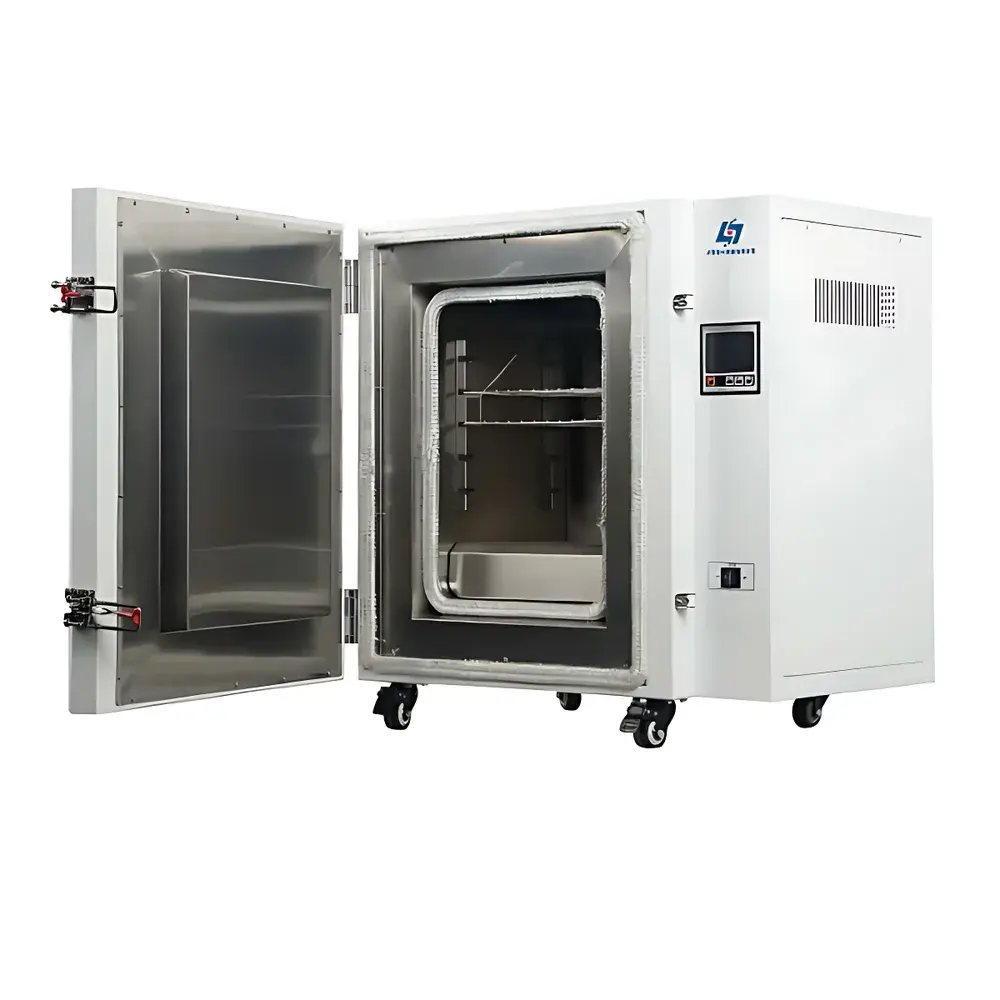
Yoyi DGG-148C High-Temperature Nitrogen-Purged Forced-Air Oven
| Brand | Yoyi |
|---|---|
| Origin | Shanghai, China |
| Manufacturer Type | Direct Manufacturer |
| Model | DGG-148C |
| Temperature Range | RT+20°C to 400°C |
| Temperature Resolution | 1°C |
| Interior Material | Mirror-Finish Stainless Steel (SUS304) |
| Temperature Uniformity | ±2.5% (measured at 100°C, non-purged condition) |
| Nitrogen Inlet Port | Φ10 mm |
| Gas Flow Control | 0–10 L/min (calibrated rotameter) |
| Power Supply | AC 380 V, 50 Hz |
| Input Power | 4400 W |
| Chamber Dimensions (W×D×H) | 450×550×550 mm |
| External Dimensions (W×D×H) | 820×730×900 mm |
| Capacity | 140 L |
| Standard Shelving | 2 adjustable stainless steel trays |
| Timer Range | 1–9999 minutes |
Overview
The Yoyi DGG-148C is a high-temperature, nitrogen-purged forced-air drying oven engineered for precise thermal processing under inert atmospheric conditions. Designed in compliance with GB/T 30435–2013 (Industrial Electric Heating Ovens – Technical Requirements), it supports critical laboratory and industrial applications requiring oxygen-sensitive thermal treatment—including polymer curing, catalyst activation, powder sintering pre-treatment, moisture-free annealing of electronic components, and residual solvent removal from high-performance coatings. Its core architecture integrates a dual-stage air circulation system: ambient air is first drawn into a preheating chamber, uniformly heated via embedded tubular heating elements, then mixed and delivered tangentially into the working chamber through optimized duct geometry—ensuring rapid thermal ramp rates and minimizing cold spots. The nitrogen purge capability (via standardized Φ10 mm inlet with calibrated rotameter) enables controlled displacement of ambient oxygen to ≤100 ppm, mitigating oxidation risks during prolonged exposure at temperatures up to 400°C.
Key Features
- Microprocessor-based PID temperature controller with LCD interface, featuring programmable multi-segment ramp/soak profiles, auto-tuning, power modulation, and real-time deviation compensation.
- Mirror-finish SUS304 stainless steel interior with rounded internal corners and tool-free removable shelves—facilitating cleaning, residue inspection, and ISO-compliant validation protocols.
- Dual-layer door seal: outer silicone gasket + inner ceramic fiber rope—rated for continuous operation at 400°C with low outgassing and long-term compression set resistance.
- High-efficiency centrifugal blower (IP54-rated motor with aluminum alloy impeller) delivering laminar, low-turbulence airflow across the chamber volume at adjustable velocity.
- Robust thermal insulation: 120 mm thick glass fiber blanket between chamber and outer casing, achieving surface temperature rise <35 K above ambient at 400°C steady state.
- Intelligent safety architecture: independent mechanical overtemperature cut-off (adjustable up to 420°C), power-fail data retention with automatic recovery, and door-open interlock disabling heater output.
Sample Compatibility & Compliance
The DGG-148C accommodates a broad range of sample forms—including crucibles, petri dishes, quartz boats, metal trays, and custom fixtures—within its 140 L working volume. Its uniform temperature distribution (±2.5% at 100°C, per GB/T 30435 verification methodology) meets ASTM E145 Class B requirements for gravity/convection ovens used in quality control laboratories. While not certified to IEC 61000-6-3 or UL 61010-1 out-of-box, the unit conforms to essential safety and EMC principles required for CE-marked lab equipment when installed per manufacturer-specified grounding and ventilation guidelines. It supports GLP/GMP documentation workflows via optional RS485 communication (Modbus RTU) and time-stamped event logging (power-on, setpoint change, alarm trigger).
Software & Data Management
The standard microcontroller firmware includes non-volatile memory for storing up to 16 user-defined temperature programs (each with 30 segments), cycle counters, and alarm history (last 200 events). Optional accessories extend traceability: an RS485 interface enables integration with LIMS or SCADA systems; a thermal printer provides hard-copy audit trails compliant with FDA 21 CFR Part 11 Annex 11 expectations (when paired with validated timestamping and user authentication); and a programmable controller upgrade adds Ethernet connectivity, CSV export, and remote parameter adjustment via HTTPS-secured web interface.
Applications
- Oxidation-sensitive drying of lithium battery cathode precursors (e.g., NMC, LFP) prior to calcination.
- Moisture-free aging of optical adhesives and encapsulants in photonic device manufacturing.
- Controlled pyrolysis of organic templates in mesoporous material synthesis (e.g., SBA-15, MCM-41).
- Residual solvent extraction from pharmaceutical granules under nitrogen blanket—supporting ICH Q5C stability protocol adherence.
- Pre-baking of printed circuit board (PCB) substrates to eliminate interlayer moisture before lamination.
- Calibration reference oven for thermocouple wire annealing per ASTM E230/E230M Annex A3 procedures.
FAQ
What inert gases are compatible with the DGG-148C nitrogen inlet?
The Φ10 mm port accepts nitrogen (N₂), argon (Ar), and helium (He) at regulated flow rates up to 10 L/min. Gas compatibility is limited by hose material (standard EPDM seals rated to 150°C; optional Viton seals available for >200°C service).
Is temperature uniformity verified under nitrogen purge conditions?
Per GB/T 30435, uniformity is specified at 100°C without purge. Under active nitrogen flow (≥3 L/min), measured uniformity degrades by ≤0.8% due to convective cooling effects—validated using 9-point PT100 probe mapping per ISO 17025 internal calibration SOP.
Can the oven be validated for GMP environments?
Yes—when equipped with optional RS485 + printer, it supports IQ/OQ documentation. Users must perform PQ per their site-specific protocol; Yoyi provides as-built drawings, calibration certificates for controller sensor, and material compliance declarations (RoHS, REACH).
What maintenance intervals are recommended for sustained 400°C operation?
Blower motor bearings require relubrication every 12 months; ceramic fiber door seal inspection every 6 months; and full thermocouple recalibration annually or after 500 thermal cycles above 350°C.
Does the unit support external data logging without optional hardware?
No—the base controller lacks analog/digital outputs. Real-time data export requires either the RS485 module or embedded printer add-on. Local display retains only current setpoint, PV, timer, and alarm status.



