
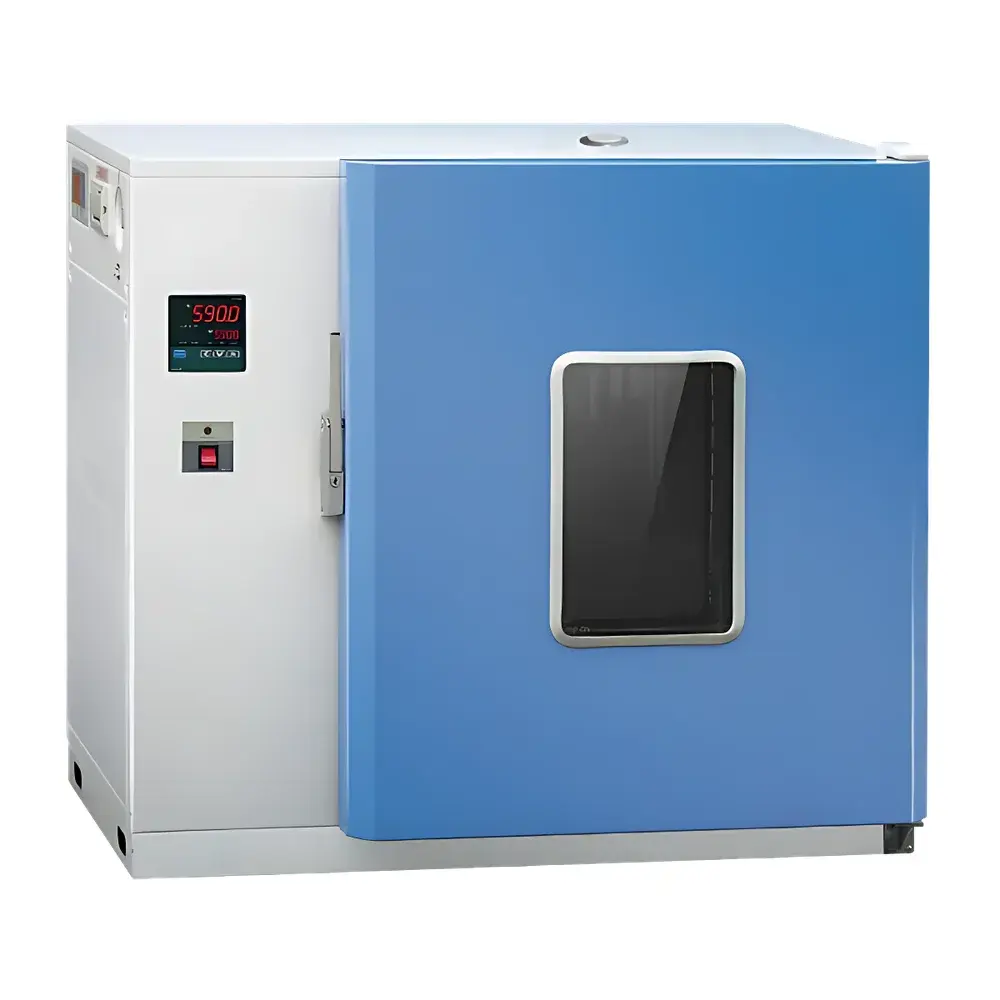
YSEI CS101-ABN Forced-Air Drying Oven
| Brand | YSEI |
|---|---|
| Origin | Chongqing, China |
| Manufacturer Type | Direct Manufacturer |
| Instrument Type | High-Temperature Forced-Air Oven |
| Temperature Range | Ambient +20 °C to 250 °C (Max. 300 °C) |
| Temperature Uniformity | ±2.5 °C |
| Temperature Fluctuation | ±1 °C |
| Temperature Resolution | 0.1 °C |
| Chamber Dimensions (W×D×H) | 450×550×550 mm |
| External Dimensions (W×D×H) | 620×970×770 mm |
| Inner Chamber Material | Mirror-Finish SUS304 Stainless Steel |
| Heating Method | Electric Resistance Heating with Forced Air Circulation |
| Operating Ambient Temperature | 5–35 °C |
| Max. Ambient Humidity | ≤85% RH |
| Compliance Standard | GB/T 30435–2013 |
Overview
The YSEI CS101-ABN Forced-Air Drying Oven is an engineered precision thermal processing instrument designed for consistent, repeatable drying, baking, sterilization, and temperature-stabilized testing in regulated laboratory environments. It operates on the principle of forced convection—using a high-efficiency axial fan and optimized internal airflow ducting to ensure uniform heat distribution across the entire working chamber. Unlike natural convection ovens, the CS101-ABN’s integrated blower system actively circulates heated air at controlled velocity, minimizing thermal stratification and significantly improving temperature homogeneity (±2.5 °C) and stability (±1 °C). Its operational range spans from ambient +20 °C up to 250 °C (with short-term capability to 300 °C), making it suitable for applications requiring precise thermal exposure without vacuum or inert atmosphere requirements.
Key Features
- Mirror-finish SUS304 stainless steel inner chamber—resistant to corrosion, easy to clean, and compliant with ISO 14644-1 Class 8 cleanroom-compatible surface standards.
- Dual independent temperature control system: primary PID controller for process regulation and a separate mechanical overtemperature cutoff (independent of main controller) for fail-safe protection.
- High-accuracy digital temperature display with 0.1 °C resolution and real-time deviation indication.
- Three standardized chamber configurations—enabling scalability from benchtop validation studies to large-batch quality control workflows.
- Front-access double-layer tempered glass door with silicone gasket seal—provides visual monitoring while maintaining thermal integrity and minimizing energy loss.
- Robust electric resistance heating elements mounted on chamber walls and rear baffle, coupled with adjustable airflow vanes to optimize thermal response time and uniformity.
Sample Compatibility & Compliance
The CS101-ABN accommodates standard laboratory glassware (e.g., Petri dishes, weighing bottles, crucibles), metal trays, polymer substrates, and pre-sterilized packaging materials. It is routinely deployed in pharmaceutical QC labs for residual solvent removal (per ICH Q5C), moisture content determination (ASTM E1868), and dry-heat depyrogenation validation (USP ). The unit complies with GB/T 30435–2013 (“Electrically Heated Forced-Circulation Laboratory Ovens”), which aligns with core safety and performance benchmarks of IEC 61010-1 (electrical safety) and EN 60529 (IP20 ingress protection). While not inherently vacuum-rated, its sealed chamber design supports optional integration with external humidity sensors or data loggers for GLP-compliant environmental monitoring.
Software & Data Management
The CS101-ABN features a stand-alone microprocessor-based controller with non-volatile memory for storing up to 10 user-defined programs (each with ramp/soak segments). Optional RS485 communication interface enables connection to centralized lab management systems (LIMS) or SCADA platforms via Modbus RTU protocol. When paired with certified third-party data acquisition software, the oven supports audit-trail-enabled operation meeting FDA 21 CFR Part 11 requirements—including electronic signatures, event logging, and change history tracking. All temperature profiles and alarm events are timestamped and exportable in CSV format for regulatory submission or internal SOP documentation.
Applications
- Pharmaceutical: Dry-heat sterilization of glass vials and stainless steel components; excipient drying prior to tablet compression.
- Materials Science: Thermal aging of polymer films and composites per ASTM D573; binder burnout in ceramic green bodies.
- Food & Agriculture: Moisture analysis of grains and dairy powders (AOAC 950.46); enzyme inactivation studies.
- Clinical Diagnostics: Pre-analytical sample desiccation for ELISA plate preparation; reagent kit stabilization.
- Academic Research: Controlled thermal treatment of nanomaterial precursors; catalyst calcination under atmospheric conditions.
FAQ
What is the maximum continuous operating temperature?
The rated continuous operating range is ambient +20 °C to 250 °C. Short-duration exposure up to 300 °C is permissible for calibration or process qualification—but not recommended for routine use.
Does the oven support programmable ramp-and-soak cycles?
Yes—up to 10 multi-segment programs can be stored locally, each supporting ramp rates (°C/min), dwell times (min), and target temperatures.
Is the chamber pressure-rated or vacuum-capable?
No—the CS101-ABN is a standard atmospheric-pressure forced-air oven. Vacuum or inert-gas purging requires external modifications not covered under warranty.
How is temperature uniformity validated?
Per GB/T 30435–2013, uniformity is measured using nine calibrated PT100 probes placed on a 3×3 grid at working volume center height; results are reported as maximum deviation from setpoint across all points.
What maintenance intervals are recommended for optimal performance?
Fan filter cleaning every 3 months; annual verification of sensor calibration and overtemperature cutoff functionality by qualified service personnel.



