
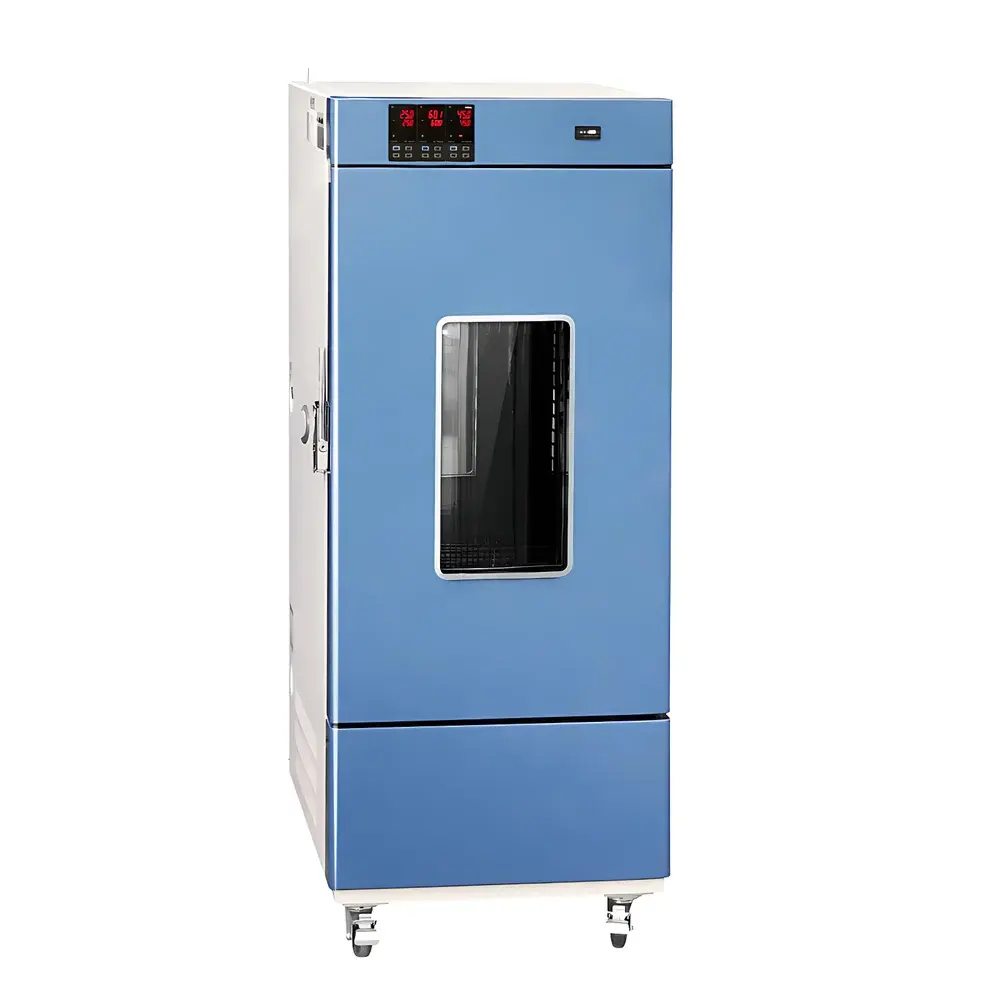
YSEI SHH-500GSD Comprehensive Drug Stability Testing Chamber
| Brand | YSEI |
|---|---|
| Origin | Chongqing, China |
| Manufacturer Type | Direct Manufacturer |
| Model | SHH-500GSD |
| Temperature Range | 0–60 °C |
| Humidity Range | 10–95 %RH |
| Illumination Control | 0–10,000 lx (with UV-filtered white light) |
| Chamber Volume | 500 L |
| Power Consumption | ≤2.8 kW (at 40 °C / 75 %RH, single compressor active) |
| Ambient Operating Conditions | 5–35 °C, ≤85 %RH |
| Compliance | ICH Q1A(R3), Q1B, Q5C |
| Data Recording | Integrated thermal printer (adjustable interval), real-time temperature/humidity/light logging with ≥36-month onboard storage |
| Safety Systems | Independent overtemperature cutoff, dry-run protection for humidifier, compressor overload relay, SMS-based alarm (power failure, deviation >±2 °C / ±5 %RH) |
Overview
The YSEI SHH-500GSD Comprehensive Drug Stability Testing Chamber is an engineered environmental simulation system designed specifically for pharmaceutical stability studies in accordance with ICH Q1 series guidelines and regional pharmacopoeial requirements. It implements a tri-variable control architecture—simultaneous, independent regulation of temperature, relative humidity, and photometric illumination—to replicate long-term (25 °C/60 %RH), accelerated (40 °C/75 %RH), intermediate (30 °C/65 %RH), and low-humidity stress conditions (e.g., 40 °C/20 %RH for large-volume parenterals). The chamber’s stainless-steel interior, double-wall insulation, and PID-controlled refrigeration/humidification subsystems ensure spatial uniformity (±0.5 °C, ±3 %RH across working volume) and temporal stability (±0.3 °C/24 h drift at setpoint), critical for generating data suitable for regulatory submission under FDA 21 CFR Part 11 and EU Annex 11 frameworks.
Key Features
- Tri-parameter environmental control: Precise, decoupled regulation of temperature (0–60 °C), humidity (10–95 %RH), and illumination (0–10,000 lx, UV-filtered white light per ICH Q1B)
- Regulatory-grade data integrity: Onboard thermal printer with user-defined logging intervals (1 min to 24 h); timestamped, tamper-evident records compliant with ALCOA+ principles
- Redundant safety architecture: Independent high-limit thermostat, humidifier dry-run cutoff, compressor thermal overload relay, and dual-stage door interlock
- Remote monitoring & alerting: GSM-enabled SMS notification for power interruption, temperature deviation (>±2 °C), humidity excursion (>±5 %RH), or door-open events—configurable per device group
- Energy-optimized operation: Variable-speed compressors, high-efficiency PTC humidifiers, and adaptive fan control reduce average power draw by up to 32% vs. legacy chambers (tested per ISO 15502 Annex C)
- Acoustic performance: Sound pressure level ≤52 dB(A) at 1 m distance during continuous 40 °C/75 %RH operation
Sample Compatibility & Compliance
The SHH-500GSD accommodates standard ICH-compliant sample configurations—including open trays, sealed vials, blister packs, and ampoules—within its 500 L working volume (W650 × D720 × H1100 mm). Its internal lighting system integrates calibrated, UV-stabilized LED arrays meeting ICH Q1B photo-stability irradiance requirements (≥1.2 million lux·hr visible, ≥200 Wh/m² UV). The chamber is validated for use in GLP and GMP environments: IQ/OQ documentation packages are provided, including sensor calibration certificates traceable to NIM (China) and optional UKAS-accredited third-party verification. All firmware and data handling routines comply with 21 CFR Part 11 electronic record requirements, supporting audit trails, role-based access control, and electronic signatures.
Software & Data Management
Data acquisition is managed via embedded Linux-based controller with 8 GB flash memory—storing ≥36 months of 1-minute-interval temperature, humidity, and light intensity readings with cryptographic hashing for integrity verification. Export options include CSV, PDF reports (with digital signature fields), and direct integration into LIMS via Modbus TCP or OPC UA protocols. Optional YSEI StabilitySuite™ software enables multi-chamber fleet monitoring, trend analysis (Shewhart X-bar/R charts), and automated report generation aligned with ICH Q5C biologics stability protocols. All data exports retain full metadata: operator ID, instrument serial number, calibration dates, and environmental deviation flags.
Applications
- ICH Q1A(R3)-compliant long-term, accelerated, and intermediate condition testing for small-molecule APIs and finished dosage forms
- Low-humidity stability assessment of hygroscopic injectables (e.g., 40 °C/20 %RH per Chinese Pharmacopoeia 2020 Section 9001)
- Photostability screening per ICH Q1B using controlled visible/UV irradiance profiles
- Accelerated degradation kinetics modeling for shelf-life prediction (Arrhenius and Eyring-based approaches)
- Reference standard storage under defined ambient conditions (e.g., 15–25 °C/40–60 %RH)
- Method suitability verification for dissolution, assay, and impurity testing under stressed storage conditions
FAQ
Does the SHH-500GSD support 21 CFR Part 11 compliance for electronic records?
Yes—the system includes audit trail functionality, electronic signature capability, and role-based user authentication. Full validation documentation (IQ/OQ) and configuration files are supplied.
Can humidity be maintained stably at 20% RH while operating at 40°C?
Yes—this low-humidity high-temperature profile is factory-validated per Chinese Pharmacopoeia specifications, using desiccant-assisted dehumidification and precision dew-point control.
Is remote SMS alerting dependent on local cellular coverage?
Yes—GSM module requires SIM card with active data plan and LTE-M/NB-IoT coverage; fallback email alerts are configurable via optional Ethernet gateway.
What is the calibration interval recommendation for built-in sensors?
Annual recalibration is recommended; YSEI provides NIM-traceable certificates and on-site calibration services with ISO/IEC 17025 accreditation.
How is photometric uniformity verified across the chamber volume?
Pre-delivery mapping per ICH Q1B Annex 2 confirms irradiance variation ≤±5% across all sample positions using NIST-traceable spectroradiometers.





