
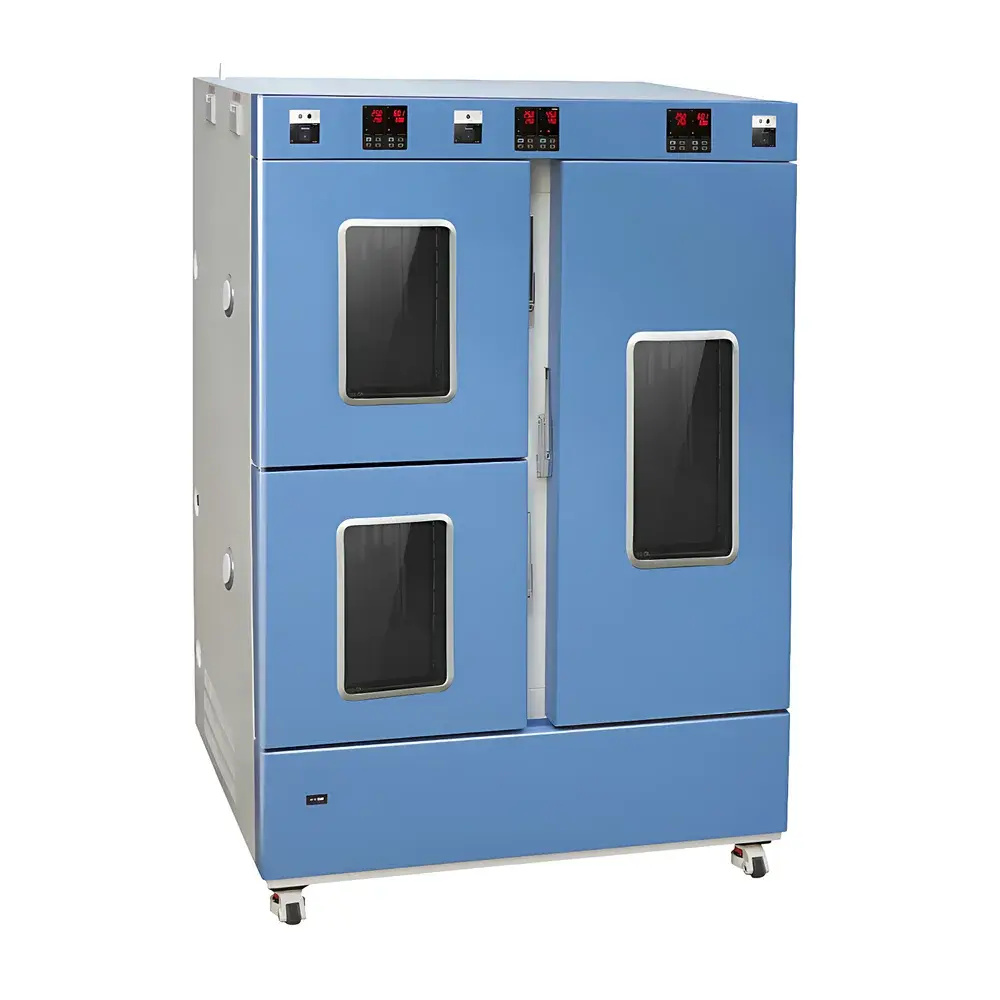
YSEI SHH-SDT Multi-Chamber Comprehensive Drug Stability Testing System
| Brand | YSEI |
|---|---|
| Origin | Chongqing, China |
| Manufacturer Type | Direct Manufacturer |
| Product Category | Domestic |
| Model | SHH-SDT |
| Price Range | USD 11,200 – 14,000 (FOB China) |
| Chamber Independence | Fully Independent Control per Chamber |
| Temperature Range | 0°C to 60°C (±0.5°C uniformity) |
| Humidity Range | 10% to 95% RH (±3% RH accuracy) |
| Low-Humidity Capability | 20% RH @ 40°C |
| Data Recording | Integrated thermal printer with adjustable print interval |
| Compliance | Meets USP <1150>, ICH Q1A(R2), Q1B, Q5C, FDA 21 CFR Part 11 (audit trail enabled), and Chinese Pharmacopoeia 2020 Edition Vol. IV General Chapter 9001 |
| Safety Protections | Independent chamber overtemperature cutoff, humidifier dry-run protection, compressor overload protection, SMS-based alarm system for power failure and out-of-spec temperature/humidity events |
| Power Consumption | ≤2.8 kW (per chamber, measured at 40°C / 75% RH with one refrigeration unit active) |
| Ambient Operating Conditions | 5–35°C ambient temperature, ≤85% RH non-condensing |
| Structural Configuration | Modular multi-chamber architecture (standard configuration: 3–6 independently conditioned chambers |
| Data Output | Time-stamped温湿度 history curves + tabular CSV export via USB port |
Overview
The YSEI SHH-SDT Multi-Chamber Comprehensive Drug Stability Testing System is an engineered platform designed explicitly for long-term, accelerated, intermediate, and stress-condition stability studies in accordance with ICH Q1 series guidelines and regulatory requirements defined by the U.S. FDA, EMA, PMDA, and the Chinese Pharmacopoeia. Unlike single-chamber systems, the SHH-SDT employs a modular architecture comprising multiple physically isolated environmental chambers—each operating under independent, programmable temperature and relative humidity setpoints. This design enables concurrent execution of distinct ICH protocols (e.g., 25°C/60% RH for long-term, 40°C/75% RH for accelerated, and 40°C/20% RH for low-humidity stress testing of large-volume parenterals) within a single footprint. The system utilizes dual PID-controlled refrigeration circuits, precision steam-based humidification with deionized water feed, and high-stability PT100 sensor arrays calibrated traceably to NIST standards. All climatic parameters are continuously monitored with real-time logging at user-defined intervals (1–60 minutes), ensuring full data integrity for GLP/GMP-regulated submissions.
Key Features
- Fully independent environmental control per chamber—no cross-contamination or parameter coupling between zones
- Extended low-humidity capability: stable operation at 20% RH @ 40°C, validated per ICH Q1B photostability annex requirements for moisture-sensitive biologics and lyophilized formulations
- Integrated thermal line printer with configurable print frequency (1 min to 24 h); generates tamper-evident paper records compliant with ALCOA+ principles
- SMS-based remote alarm system supporting multi-device management—triggers alerts for temperature deviation (>±1.0°C), humidity excursion (>±5% RH), power loss, or safety interlock activation
- Triple-layer insulation with vacuum-sealed polyurethane panels and magnetic door gaskets ensures thermal stability and energy efficiency (≤2.8 kW/chamber at 40°C/75% RH)
- Compressor overload protection, independent chamber overtemperature cutoff (hardware-level limit switch), and humidifier dry-run detection prevent hardware damage and sample compromise
Sample Compatibility & Compliance
The SHH-SDT accommodates standard stability storage configurations including ICH-specified amber glass vials, blister packs, HDPE bottles, and ISO 8573-compliant air-tight containers. Chamber interiors are constructed from electropolished 316L stainless steel with rounded corners to support cleaning validation and minimize particle generation. Each chamber includes a removable, autoclavable stainless-steel shelf system with optional UV-transparent quartz inserts for photostability integration (when paired with external ICH Q1B-compliant light sources). Regulatory alignment includes full traceability to USP “Stability Testing”, ICH Q5C “Quality of Biotechnological Products: Stability Testing of Biotechnological/Biological Products”, and Annex 15 of EU GMP Guidelines. IQ/OQ documentation packages—including protocol templates, test scripts, calibration certificates, and as-built schematics—are provided pre-validated and ready for site execution.
Software & Data Management
The embedded control interface runs on a real-time Linux OS with encrypted local database storage (SQLite3 with WAL journaling). All operational logs—including setpoint changes, alarm events, sensor readings, and printer activity—are time-stamped with UTC synchronization and retain full audit trails per FDA 21 CFR Part 11 requirements (electronic signatures, role-based access control, and immutable record retention). Data export is supported via USB 2.0 port in CSV format with ISO 8601 timestamping and metadata headers (chamber ID, sensor channel, units, uncertainty values). Optional Ethernet connectivity enables integration into enterprise LIMS or MES platforms using Modbus TCP or OPC UA protocols. No cloud dependency or third-party SaaS components are required—ensuring data sovereignty and compliance with GDPR and China’s PIPL.
Applications
- ICH Q1A(R2)-compliant long-term stability studies (25°C/60% RH, 30°C/65% RH) for shelf-life determination
- Accelerated stability assessment (40°C/75% RH, 50°C/80% RH) to support registration dossiers
- Intermediate condition testing (30°C/65% RH) for bracketing and matrixing strategies
- Low-humidity stress testing (40°C/20% RH) for large-volume parenterals, powders, and desiccant-containing packaging
- Forced degradation studies under controlled thermal-hygrometric stress for impurity profiling
- Method transfer validation and QC lab qualification of stability storage infrastructure
FAQ
Does the SHH-SDT meet FDA 21 CFR Part 11 requirements for electronic records?
Yes—the system implements role-based user authentication, electronic signatures with biometric or token-based verification, immutable audit trails, and secure data export without post-processing modification.
Can individual chambers be validated separately for IQ/OQ/PQ?
Yes—each chamber is a self-contained climatic unit with independent sensors, actuators, and firmware. Full qualification documentation supports per-chamber validation per ASTM E2500 and ISPE GAMP 5.
Is the thermal printer output accepted as primary data in regulatory submissions?
Yes—printed records include chamber ID, timestamped parameter values, operator ID, and digital signature hash; they satisfy ALCOA+ criteria when used alongside electronic backups.
What maintenance is required during routine operation?
Monthly deionized water tank inspection, quarterly sensor verification against NIST-traceable references, and annual refrigerant pressure calibration—documented in the included Preventive Maintenance Logbook.
How is temperature uniformity verified across each chamber?
Per ICH Q1A(R2) Appendix A, 9-point mapping (3×3 grid at working volume center plane) is performed during OQ using calibrated thermocouples; results are recorded in the validation report with ±0.5°C maximum deviation.





