
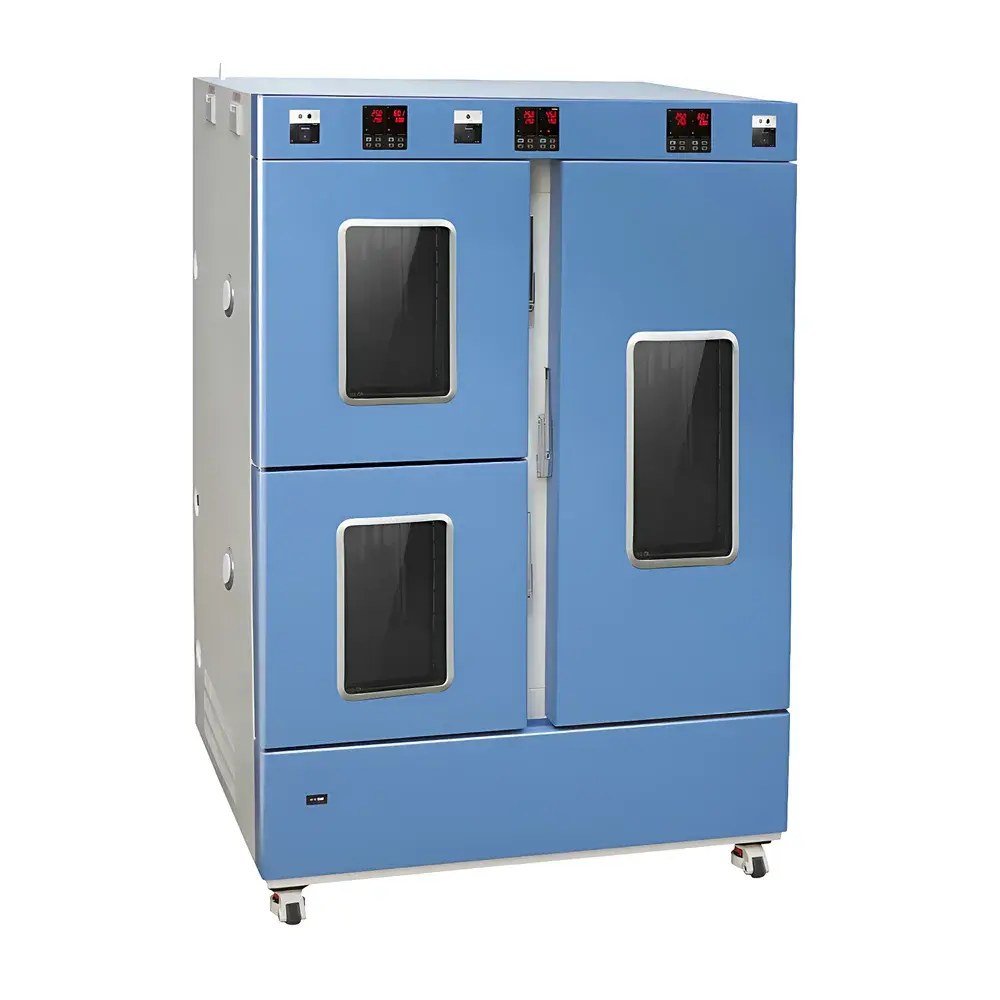
YSEI SHH-SSD Multi-Chamber Integrated Drug Stability Testing System
| Brand | YSEI |
|---|---|
| Origin | Chongqing, China |
| Manufacturer Type | Direct Manufacturer |
| Country of Origin | China |
| Model | SHH-SSD |
| Price Range | USD 11,200 – 14,000 (FOB) |
| Chamber Independence | Fully Independent Control per Chamber |
| Temperature Range | 0°C to 60°C (±0.5°C uniformity) |
| Humidity Range | 10%–95% RH (±3% RH accuracy) |
| Low-Humidity Capability | 20% RH @ 40°C |
| Data Recording | Built-in thermal printer with adjustable print interval |
| Compliance | Meets USP <1150>, ICH Q1A(R3), Q5C, FDA 21 CFR Part 11 (audit trail enabled), and Chinese Pharmacopoeia 2020 Edition Vol. IV General Chapter <9001> |
| Safety Protections | Independent chamber overtemperature cutoff, dry-run protection for humidifier, compressor overload protection, SMS-based real-time alarm (power failure, T/RH deviation, multi-unit monitoring) |
| Power Consumption | ≤2.8 kW (per chamber, at 40°C/75% RH, single-compressor operation) |
| Ambient Operating Conditions | 5–35°C ambient, ≤85% RH non-condensing |
| Structural Configuration | Modular stacked chambers (standard 2–4 chambers), each with dedicated sensor array, PID-controlled heating/cooling/humidification/dehumidification systems |
| Data Integrity | Time-stamped, tamper-evident digital + paper logs |
Overview
The YSEI SHH-SSD Multi-Chamber Integrated Drug Stability Testing System is an engineered platform designed explicitly for regulatory-grade stability studies in pharmaceutical development, manufacturing, and quality control laboratories. Based on the principles of controlled environmental stress exposure—precisely regulated temperature, humidity, and light—the system enables long-term, accelerated, intermediate, and stress condition testing as defined by ICH Q1 series guidelines (Q1A–Q1E), USP , and the Chinese Pharmacopoeia 2020 Edition General Chapter . Unlike single-chamber units, the SHH-SSD architecture integrates multiple thermally and hygroscopically isolated chambers within a unified structural frame, each operating under independent PID-controlled environmental profiles. This design eliminates cross-chamber interference, ensures test integrity across parallel protocols (e.g., 25°C/60% RH for long-term vs. 40°C/75% RH for accelerated studies), and supports concurrent evaluation of multiple drug formulations or packaging configurations under distinct ICH-specified conditions.
Key Features
- Fully independent chamber control: Each chamber features dedicated temperature sensors (PT100 Class A), capacitive RH transducers (calibrated traceable to NIST standards), dual-stage refrigeration, PTC heating, ultrasonic humidification, and desiccant-assisted dehumidification—enabling simultaneous execution of ICH long-term (25°C/60% RH), accelerated (40°C/75% RH), and low-humidity stress tests (40°C/20% RH for large-volume parenterals).
- Regulatory-compliant data acquisition: Embedded real-time logging records temperature, relative humidity, elapsed time, chamber ID, operator tag, and method identifier at user-defined intervals (1–60 min). All entries are digitally signed and timestamped, satisfying FDA 21 CFR Part 11 requirements for electronic records and signatures.
- Integrated thermal printing: Onboard micro-printer generates audit-ready paper records with adjustable print frequency. Output includes full温湿度 history curves (T/RH vs. time), statistical summaries (min/max/mean/stdev), and event annotations (alarm triggers, door openings, setpoint changes).
- Multi-layer safety architecture: Per-chamber overtemperature cutoff (mechanical backup + digital limit), humidifier dry-run detection with auto-shutdown, compressor current monitoring with thermal overload relay, and optional GSM-enabled SMS alerting for power loss, T/RH excursions (>±2°C / >±5% RH), and system faults—configurable for centralized fleet management.
- Energy-optimized thermal envelope: High-density polyurethane insulation (≥120 mm thickness), magnetically sealed double-glazed observation doors, and variable-speed EC fans reduce power consumption by up to 32% versus legacy stability chambers while maintaining ≤45 dB(A) acoustic emission during continuous operation.
Sample Compatibility & Compliance
The SHH-SSD accommodates a broad range of pharmaceutical dosage forms—including tablets, capsules, injectables (vials, ampoules, IV bags), topical creams, ointments, and lyophilized powders—within standardized stainless-steel shelving (optional UV-stabilized acrylic lighting for photostability add-on). Each chamber supports up to six ISO 17025-compliant validation points for temperature and humidity mapping per ICH Q5C Annex 3. The system is preconfigured to meet qualification requirements for Installation Qualification (IQ) and Operational Qualification (OQ) per ASTM E2500 and ISPE GAMP5. Comprehensive IQ/OQ documentation packages—including protocol templates, evidence logs, calibration certificates (NIST-traceable), and URS alignment matrices—are supplied with every unit. All firmware and software modules comply with ALCOA+ data integrity principles and support 21 CFR Part 11 audit trails with role-based access control (RBAC).
Software & Data Management
The embedded stability management software (v3.2+) provides local HMI operation via a 10.1″ capacitive touchscreen with glove-compatible interface. Remote monitoring and control are supported via Ethernet/Wi-Fi using TLS 1.2-encrypted HTTPS API endpoints compatible with LIMS integration (HL7 v2.5.1, ASTM E1384). Raw data exports are available in CSV, PDF/A-2b (archival standard), and XML formats compliant with CDISC SDTM domains. Audit trail configuration includes immutable logging of all user actions (login/logout, parameter edits, report generation, alarm acknowledgments), with retention configurable from 3 months to 25 years. Electronic signatures follow PKI-based signing workflows aligned with Annex 11 and EU GMP Annex 11 requirements.
Applications
- ICH Q1A(R3)-compliant long-term stability studies (25°C/60% RH, 30°C/65% RH) for shelf-life determination and expiration dating.
- Accelerated stability assessment (40°C/75% RH) per Q1B to identify degradation pathways and support bracketing/matrixing strategies.
- Intermediate condition testing (30°C/65% RH) for products demonstrating high sensitivity in accelerated studies.
- Stress testing per Q5C: oxidative, thermal, photolytic, and low-humidity (40°C/20% RH) evaluations for parenteral solutions and moisture-sensitive biologics.
- Package compatibility testing: simultaneous evaluation of primary container-closure systems (glass vials, polymer syringes, blister packs) under varying humidity gradients.
- Academic and CMC training: reproducible, documented environmental exposure for graduate-level pharmaceutics curricula and analytical method transfer workshops.
FAQ
Does the SHH-SSD support 21 CFR Part 11 compliance for electronic records and signatures?
Yes. The system implements role-based user authentication, automated audit trails with immutable timestamps, electronic signature workflows with PKI certificate binding, and secure data export—all validated per Part 11 Annex A and aligned with EU Annex 11 expectations.
Can individual chambers operate at different temperature and humidity setpoints simultaneously?
Yes. Each chamber has fully autonomous control logic, dedicated sensor arrays, and independent HVAC subsystems—enabling concurrent protocols such as 25°C/60% RH, 40°C/75% RH, and 40°C/20% RH without thermal or humidity crosstalk.
Is IQ/OQ documentation provided, and does it include validation support services?
Yes. A complete IQ/OQ package—including protocol templates, executed reports, calibration certificates (NIST-traceable), and risk assessments—is included. Optional on-site OQ execution and PQ protocol development are available through YSEI’s global validation services team.
What is the lowest achievable humidity level at 40°C, and how is it maintained?
The system achieves and sustains 20% RH at 40°C using a hybrid dehumidification strategy combining refrigerant-based condensation and regenerative desiccant modules—validated per ICH Q5C Annex 3 mapping requirements.
How is data integrity ensured during power interruption or network outage?
All critical parameters are buffered in non-volatile memory (EEPROM) with battery-backed real-time clock. Paper printouts continue uninterrupted via internal power reserve; digital logs resume seamlessly upon recovery with gap-filling timestamps and integrity checksums.




