
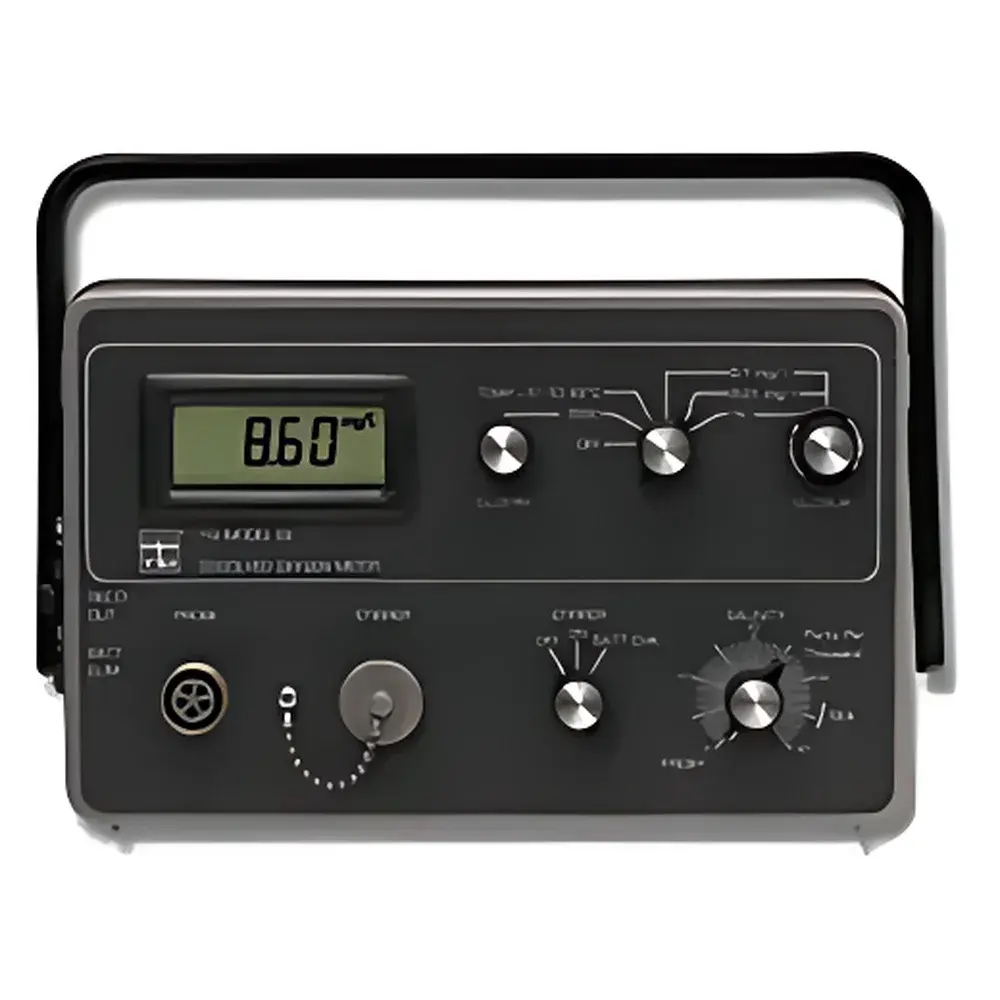
YSI 58 Portable Dissolved Oxygen Meter
| Brand | YSI |
|---|---|
| Origin | USA |
| Model | YSI 58 |
| Type | Portable |
| Measurement Principle | Clark-type polarographic electrode |
| DO Range (mg/L) | 0–20 mg/L |
| DO Resolution (mg/L) | 0.01 mg/L |
| DO Accuracy (mg/L) | ±0.03 mg/L |
| DO Range (% air saturation) | 0–200% |
| DO Resolution (% sat) | 0.1% |
| DO Accuracy (% sat) | ±0.3% |
| Temperature Range | −5 to +45 °C |
| Temperature Resolution | 0.1 °C |
| Temperature Accuracy | ±0.3 °C |
| Temp Compensation Range | 0 to +45 °C |
| Salinity Compensation Range | 0–40 ppt |
| Salinity Compensation Accuracy | ±0.3% of compensated reading ±1 digit |
| Recorder Output | 0–1 V DC (0.5 V = 1 digit), ±0.4% full scale ±1 least significant digit, min. load 50 kΩ |
| Power | 4 × D-cell batteries (Zn-C or alkaline), ~1000 h life |
| Dimensions | 21.6 × 28.0 × 9.5 cm |
| Weight | 1.90 kg |
Overview
The YSI 58 Portable Dissolved Oxygen Meter is a field-proven, electrochemical measurement system engineered for high-reliability dissolved oxygen (DO) quantification in freshwater, estuarine, and marine environments. As the world’s first commercially deployed instrument utilizing the Clark-type polarographic electrode principle, the YSI 58 established foundational performance benchmarks for portable DO instrumentation. Its design centers on galvanic current generation at a gold cathode and silver/silver chloride anode within an oxygen-permeable membrane—enabling direct, stable, and temperature- and salinity-compensated measurement of molecular oxygen concentration. The instrument delivers dual readouts—milligrams per liter (mg/L) and percent air saturation (% sat)—with traceable accuracy under ambient pressure and variable thermal conditions. Its robust architecture, sealed housing, and battery-operated portability make it suitable for both laboratory calibration verification and extended field deployments in wastewater treatment plants, limnological surveys, aquaculture monitoring, and regulatory compliance sampling.
Key Features
- Clark-type polarographic sensor interface with built-in temperature and salinity compensation circuits
- Dual-parameter display: simultaneous mg/L and % air saturation readings with independent resolution and accuracy specifications
- Auto temperature compensation (ATC) across −5 to +45 °C, correcting for membrane permeability and oxygen solubility drift
- Direct salinity input (0–40 ppt) with integrated temperature-coupled compensation algorithm for accurate marine/estuarine DO reporting
- Backlit LCD display ensuring legibility under low-light field conditions
- IP-rated sealed enclosure with protective covers for recorder output and power connectors
- Flexible power options: four D-cell batteries (Zn-C or alkaline) providing up to 1000 hours of continuous operation; optional AC adapter for benchtop use
- Internal battery compartment accommodating spare cells for optional external stirrer units
- Analog recorder output (0–1 V DC) compliant with standard chart recorders and data loggers, calibrated to ±0.4% full scale
Sample Compatibility & Compliance
The YSI 58 is validated for use with natural waters, treated effluents, surface runoff, groundwater, and saline aquatic systems. Its Clark electrode configuration meets the operational requirements of EPA Method 360.1 (Dissolved Oxygen in Water by Membrane Electrode), ASTM D888-22 (Standard Test Methods for Dissolved Oxygen in Water), and ISO 5814:2012 (Water quality — Determination of dissolved oxygen — Electrochemical probe method). While not inherently 21 CFR Part 11-compliant due to its analog-only architecture and absence of electronic audit trails, the instrument supports GLP/GMP-aligned workflows when paired with validated external data acquisition systems and documented calibration logs. All measurements adhere to standard atmospheric pressure assumptions unless corrected manually via air-saturation mode—enabling consistent reporting even when water temperature and local barometric pressure are unknown.
Software & Data Management
The YSI 58 operates as a standalone analog instrument without embedded firmware, USB connectivity, or proprietary software. Data acquisition relies on external analog-to-digital interfaces, such as strip-chart recorders, programmable logic controllers (PLCs), or third-party dataloggers compatible with 0–1 V DC input ranges. Users must maintain manual calibration records—including zero and span checks using saturated air and sodium sulfite solutions—and document environmental parameters (temperature, salinity, sample depth) per ISO/IEC 17025 traceability guidelines. Though lacking digital storage or wireless transmission, its electrical output stability and long-term sensor reproducibility ensure compatibility with legacy and modern SCADA-compatible monitoring infrastructures.
Applications
- Regulatory wastewater discharge monitoring per NPDES permit requirements
- Biological oxygen demand (BOD) incubation validation and endpoint verification
- Aquaculture pond management—real-time DO trending during feeding cycles and aeration events
- Lake and reservoir stratification studies, including hypolimnetic oxygen depletion profiling
- Riverine and tidal estuary surveys requiring rapid, repeatable in-situ DO assessment
- Field validation of online DO analyzers installed in municipal water distribution systems
- Educational laboratory exercises demonstrating oxygen solubility dependencies on temperature, salinity, and partial pressure
FAQ
What calibration standards are recommended for routine verification?
Zero-point calibration is performed using freshly prepared sodium sulfite solution (0 mg/L O₂); span calibration uses ambient air-saturated water equilibrated at known temperature and salinity.
Can the YSI 58 measure DO in highly turbid or particulate-laden samples?
Yes—provided the Clark electrode membrane remains unobstructed and the sample is gently stirred during measurement to ensure diffusion-layer stability.
Is barometric pressure correction required for accurate % air saturation readings?
No—the air-saturation mode internally references standard atmospheric pressure (760 mmHg); for altitudes >500 m, users may apply empirical correction factors based on local barometric data.
How often should the electrode membrane and electrolyte be replaced?
Typical service intervals are every 2–4 weeks for field use and monthly for lab-based applications; replacement frequency increases with exposure to oils, surfactants, or hydrogen sulfide.
Does the instrument support automatic logging or timestamped data export?
No—the YSI 58 provides only real-time analog output; time-stamped digital logging requires integration with an external datalogger or SCADA system.
Related Products







