
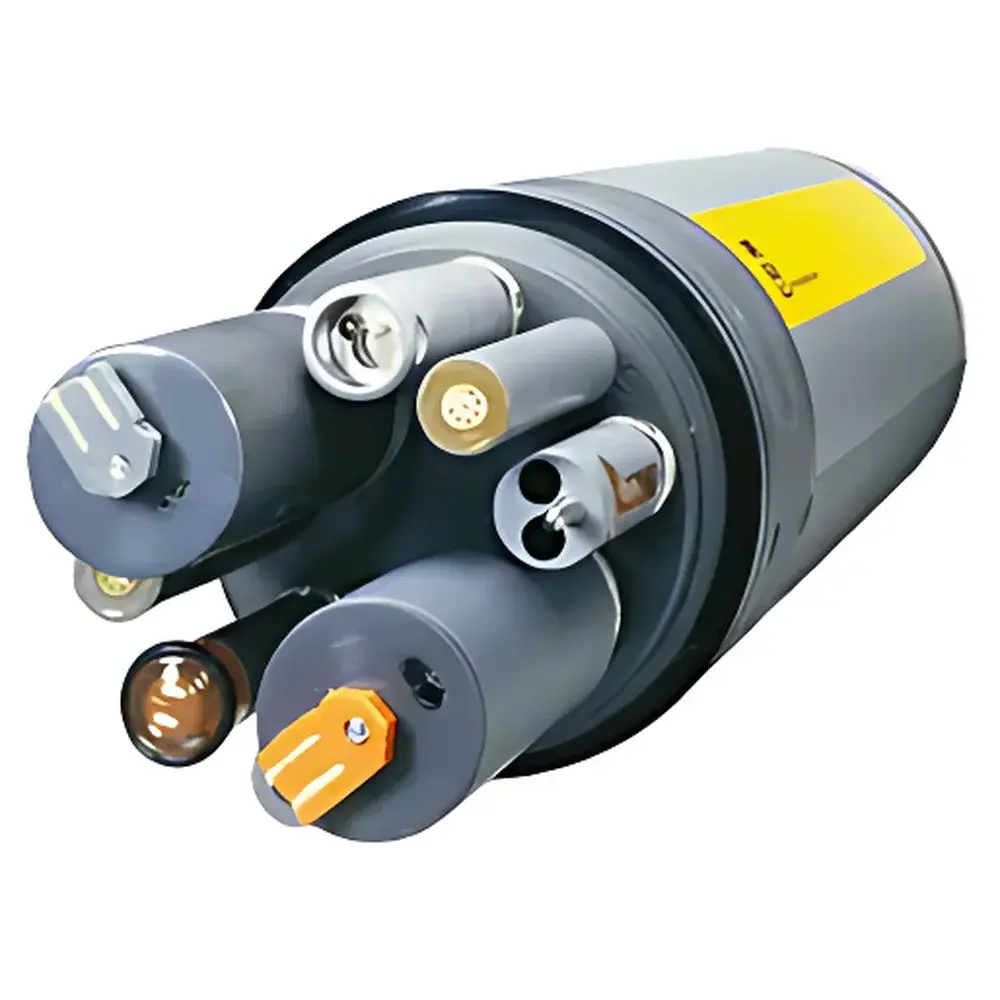
YSI 6600V2-2 Multi-Parameter Water Quality Monitoring Sonde
| Brand | YSI |
|---|---|
| Origin | USA |
| Model | YSI 6600V2-2 |
| Depth Rating | 200 m |
| Dissolved Oxygen (DO) | 0–500% air saturation / 0–50 mg/L |
| Conductivity | 0–100 mS/cm |
| Temperature | −5 to 50 °C |
| pH | 0–14 |
| ORP | −999 to +999 mV |
| Salinity | 0–70 ppt |
| Turbidity | 0–1,000 NTU |
| Chlorophyll-a | 0–400 µg/L |
| Rhodamine WT | 0–200 µg/L |
| Ammonia-N & Nitrate-N | 0–200 mg N/L |
| Chloride | 0–1,000 mg/L |
| Memory Capacity | 150,000 readings |
| Battery Life | up to 90 days |
Overview
The YSI 6600V2-2 is a high-performance, field-deployable multi-parameter water quality monitoring sonde engineered for long-term in-situ deployment in freshwater, estuarine, and coastal environments. Designed around a modular probe architecture, it integrates up to 17 simultaneous physical, chemical, and biological parameters using industry-standard electrochemical, optical, and pressure-based sensing principles. Its core measurement methodology includes galvanic and pulsed-polarographic dissolved oxygen detection, temperature-compensated conductivity via four-electrode cell technology, potentiometric pH and ORP determination, and optical fluorescence-based quantification of chlorophyll-a and rhodamine WT. The sonde operates under hydrostatic pressure up to 200 meters, enabling profiling through stratified water columns and sustained bottom-mounted deployments. All sensors are calibrated traceably to NIST-certified standards and validated per Standard Methods for the Examination of Water and Wastewater (23rd ed.), ensuring data integrity across regulatory, research, and operational applications.
Key Features
- Modular 9-channel probe interface with dual optical ports—supporting concurrent installation of turbidity, chlorophyll-a, and rhodamine WT sensors without cross-interference
- Pulsed-polarographic DO sensor with zero-flow dependency and <5% calibration drift over 30 days—eliminating need for mechanical stirring and enabling accurate measurement in quiescent hypolimnetic zones
- Self-cleaning optical sensor brush system that mitigates biofouling and bubble adhesion while maintaining spectral isolation from ambient light
- Integrated depth-rated pressure transducer with three calibrated ranges (shallow: 0–9 m; mid: 0–61 m; deep: 0–200 m) and factory-traceable accuracy specifications
- Non-volatile flash memory storing up to 150,000 timestamped, parameter-tagged readings—retaining full datasets during power interruption or retrieval delays
- Dual digital communication interfaces: RS-232 for direct laptop connection and SDI-12 for seamless integration with third-party dataloggers, telemetry gateways, and automated monitoring networks
- Field-serviceable design—electrochemical and optical sensors may be individually replaced, recalibrated, or cleaned without returning the entire sonde to the manufacturer
Sample Compatibility & Compliance
The YSI 6600V2-2 is optimized for natural and engineered aquatic systems including rivers, lakes, reservoirs, wetlands, wastewater effluents, and brackish estuaries. Ammonia-N and nitrate-N measurements are validated for freshwater only (max operating depth 15.2 m), while conductivity, salinity, TDS, and resistivity calculations adhere strictly to Standard Methods equations (e.g., Method 2510B). The sonde meets IP68 ingress protection rating and complies with ASTM D5128 (field conductivity), ASTM D888 (dissolved oxygen), and ISO 5815-1 (BOD-related DO protocols). Data logging metadata—including sensor ID, calibration timestamps, operator ID, and environmental conditions—is structured to support GLP/GMP audit trails and US EPA-approved monitoring programs.
Software & Data Management
EcoWatch software provides native platform support for real-time telemetry, post-processing, statistical analysis, and regulatory reporting. It imports raw binary files directly from the sonde’s internal memory and auto-generates QA/QC flags based on user-defined thresholds, sensor stability metrics, and inter-parameter consistency checks (e.g., DO vs. temperature correlation). Export formats include CSV, Excel, and XML compliant with WQX (Water Quality Exchange) schema for submission to USGS NWIS, EPA STORET, and international water information systems. Software supports 21 CFR Part 11-compliant electronic signatures, audit logs, and role-based access control—enabling secure deployment in regulated utility and municipal monitoring frameworks.
Applications
- Long-term limnological studies tracking thermal stratification, nutrient loading, and phytoplankton dynamics across seasonal cycles
- Regulatory compliance monitoring for NPDES permits, TMDL implementation, and drinking water source protection programs
- Early-warning systems for harmful algal bloom (HAB) prediction using real-time chlorophyll-a, DO, and nutrient co-variation trends
- Wastewater treatment plant influent/effluent characterization with simultaneous NH₄⁺-N, NO₃⁻-N, Cl⁻, and conductivity profiling
- Groundwater-surface water interaction studies utilizing high-resolution depth-resolved conductivity and temperature gradients
- Calibration and validation of remote sensing algorithms (e.g., Sentinel-3 OLCI) through synchronized in-situ optical measurements
FAQ
What is the maximum recommended deployment duration for unattended operation?
Up to 90 days on standard alkaline battery packs under typical temperature and sampling interval conditions (e.g., 15-minute logging cycle); extended life achievable with lithium-thionyl chloride options.
Can the sonde be used in seawater?
Yes—for conductivity, salinity, temperature, DO, pH, ORP, turbidity, and depth measurements—up to full 200 m rating. However, ammonia-N, nitrate-N, and chloride sensors are restricted to freshwater applications per validation scope.
How is sensor calibration verified in the field?
Each probe includes embedded calibration coefficients and date-stamped verification records. Field recalibration is performed via EcoWatch using certified reference standards (e.g., Winkler titration for DO, NIST-traceable pH buffers, KCl solutions for conductivity).
Is firmware upgrade supported remotely?
Firmware updates require physical connection via RS-232 and must be initiated from EcoWatch; no over-the-air (OTA) capability is implemented due to data integrity and cybersecurity requirements for environmental monitoring hardware.
Does the system support time-synchronized multi-sonde deployments?
Yes—via GPS-synced external clock modules or master-slave configuration using SDI-12 timing handshaking, enabling spatially distributed profiling with sub-second temporal alignment.
Related Products







