
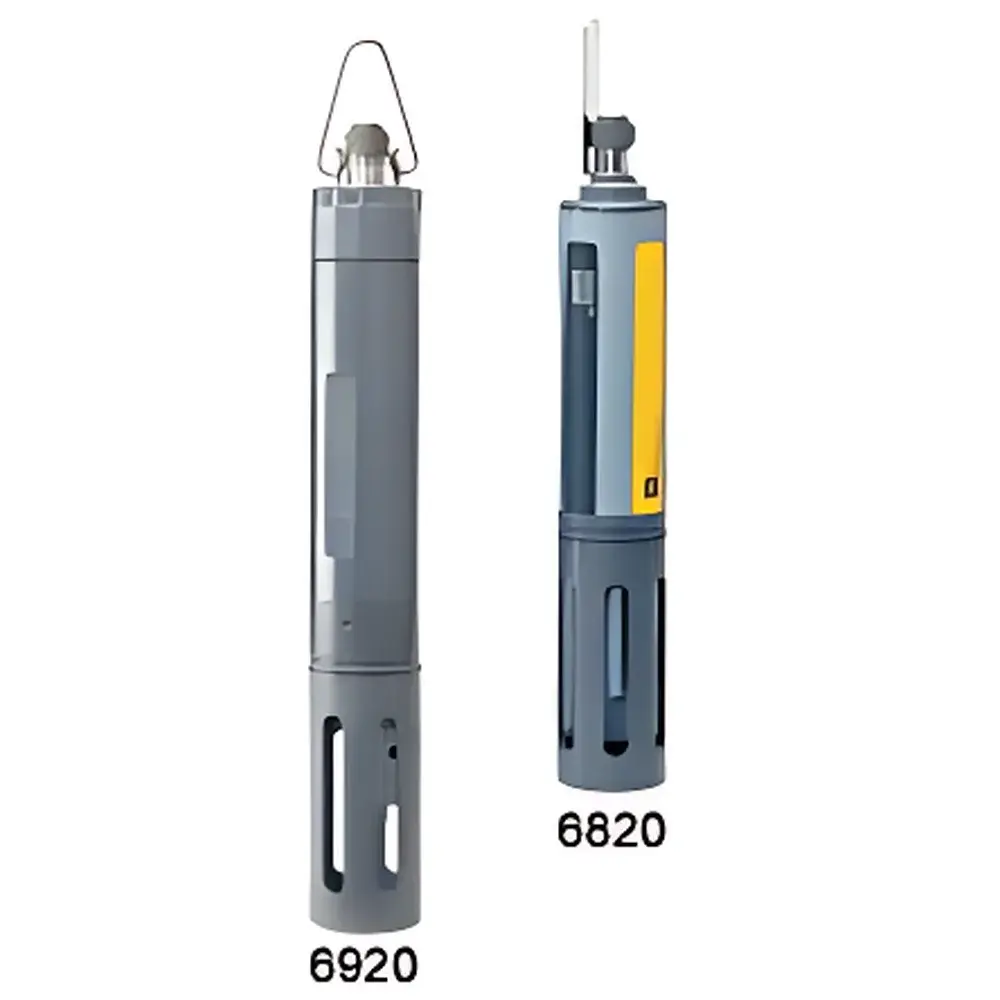
YSI 6820/6920 Portable Multiparameter Water Quality Monitoring System
| Brand | YSI |
|---|---|
| Origin | USA |
| Model | 6820 / 6920 |
| Dissolved Oxygen (DO) | 0–500% air saturation (±2% or 2% of reading, whichever is greater, for 0–200% |
| Conductivity | 0–100 mS/cm (±0.5% + 0.001 mS/cm) |
| Temperature | −5 to 50 °C (±0.15 °C) |
| pH | 0–14 (±0.2) |
| ORP | −999 to +999 mV (±20 mV) |
| Salinity | 0–70 ppt (±1.0% or 0.1 ppt, whichever is greater) |
| Depth (Shallow) | 0–9 m (±0.018 m) |
| Depth (Medium) | 0–61 m (±0.12 m) |
| Barometric Pressure-Compensated Water Level | 0–9 m (±0.003 m) |
| Turbidity | 0–1000 NTU (±2% or 0.3 NTU, whichever is greater) |
| Chlorophyll-a | 0–400 µg/L (detection limit: 0.1 µg/L |
| Rhodamine WT | 0–200 µg/L (±5% or 1 µg/L, whichever is greater) |
| Ammonia/Nitrate (Freshwater only) | 0–200 mg N/L (±10% or 2 mg N/L, whichever is greater) |
| Chloride (Freshwater only) | 0–1000 mg/L (±15% or 5 mg/L, whichever is greater) |
Overview
The YSI 6820 and 6920 Portable Multiparameter Water Quality Monitoring Systems are field-deployable, high-reliability platforms engineered for long-term unattended monitoring, vertical profiling, and multi-station survey work in freshwater and estuarine environments. Designed around YSI’s proprietary Rapid Pulse™ dissolved oxygen sensor technology, these instruments eliminate flow dependency—enabling accurate DO measurement in stagnant or low-flow conditions where traditional polarographic sensors fail. The systems operate on the principle of electrochemical (DO, pH, ORP), optical (chlorophyll-a, rhodamine WT, turbidity), and inductive (conductivity) sensing, with all parameters referenced to standardized calibration protocols aligned with Standard Methods for the Examination of Water and Wastewater (23rd ed.). Unlike benchtop analyzers, the 6820/6920 series integrates sensor fusion, pressure-compensated depth measurement, and non-volatile memory into a ruggedized, submersible housing rated to 61 meters—making them suitable for regulatory-grade environmental monitoring under EPA, ISO 5815-1, and ASTM D888-compliant workflows.
Key Features
- Rapid Pulse™ DO sensor: Eliminates membrane fouling sensitivity and reduces calibration drift to <5% over 30 days; delivers stable readings without mechanical stirring or flow conditioning
- Modular probe architecture: All sensors except depth transducer are user-replaceable, field-calibratable, and serviceable—minimizing downtime and total cost of ownership
- Auto-cleaning optical modules: Turbidity, chlorophyll-a, and rhodamine WT probes incorporate motor-driven wipers that remove biofilm, sediment, and air bubbles without compromising optical path integrity or introducing ambient light artifacts
- High-capacity non-volatile memory: Stores up to 150,000 timestamped measurements with full parameter sets—including derived values such as specific conductance (25 °C), resistivity, and TDS calculated per Standard Methods equations
- Dual power configurations: The 6920 includes an integrated battery compartment for autonomous, cable-free deployment (up to 6 months typical runtime); the 6820 offers reduced mass (<1.4 kg) for handheld transect surveys and rapid probe exchange
- Multi-protocol digital interface: Native RS-232 and SDI-12 outputs ensure seamless integration with third-party data loggers (e.g., Campbell Scientific CR1000X), telemetry gateways, and SCADA-based water quality networks
Sample Compatibility & Compliance
The YSI 6820/6920 systems are validated for use in natural waters including rivers, lakes, reservoirs, wetlands, and tidal estuaries. Sensor response characteristics meet the operational requirements of U.S. EPA Method 365.2 (phosphate), Method 365.3 (nitrate), and Method 160.1 (DO). Conductivity-derived parameters (specific conductance, TDS, resistivity) adhere to Standard Methods 2510B and 2540C. The pH and ORP electrodes comply with ISO 10523 and ASTM D1293 for field deployment. While ammonia and nitrate sensors are restricted to freshwater matrices (≤5 ppt salinity), chloride measurement is limited to non-corrosive, low-suspended-solids environments per manufacturer specifications. All firmware and data handling routines support audit-trail generation compatible with GLP and GMP documentation frameworks.
Software & Data Management
EcoWatch™ software—supplied at no additional cost in English and Chinese editions—provides real-time telemetry visualization, statistical trend analysis (e.g., seasonal DO stratification, chlorophyll bloom onset detection), and automated report generation compliant with USGS NWIS and state-level WQX submission formats. Raw binary files (.dat) are convertible to CSV, Excel, and NetCDF via embedded conversion utilities. The software enforces metadata tagging (site ID, operator, calibration history, sensor serial numbers) and supports time-synchronized multi-instrument deployments. For regulated applications, EcoWatch implements role-based access control and electronic signature logging aligned with FDA 21 CFR Part 11 requirements when deployed on validated Windows OS environments.
Applications
- Long-term limnological monitoring: Tracking diel oxygen cycling, thermal stratification dynamics, and nutrient loading in reservoirs and eutrophic lakes
- Wetland restoration assessment: Quantifying redox gradients, sulfate reduction zones, and emergent macrophyte productivity via coupled ORP–chlorophyll–turbidity profiles
- Drinking water source protection: Detecting upstream contamination events using rhodamine WT tracer studies and real-time nitrate/ammonia anomaly detection
- Regulatory compliance reporting: Supporting TMDL implementation, NPDES permit verification, and State Water Board 303(d) listing criteria through traceable, timestamped datasets
- Academic research: Enabling high-resolution benthic boundary layer characterization in shallow marine systems (with appropriate salinity compensation)
FAQ
What is the difference between the YSI 6820 and 6920 models?
The 6920 includes an internal battery compartment enabling self-contained, cable-free deployments for up to six months; the 6820 is lighter (sub-1.4 kg) and optimized for handheld, multi-point sampling—requiring external power during operation.
Can the system measure in seawater?
Conductivity, temperature, depth, turbidity, chlorophyll-a, and rhodamine WT functions operate in full-strength seawater (35 ppt); however, ammonia, nitrate, and chloride sensors are validated only for freshwater applications (≤5 ppt salinity).
How often does the DO sensor require calibration?
YSI recommends field calibration every 30 days under typical environmental conditions; the Rapid Pulse™ design ensures <5% drift over this interval, reducing maintenance frequency compared to Clark-type sensors.
Is the data storage immune to power loss?
Yes—the instrument uses industrial-grade non-volatile flash memory; all stored data persist through battery replacement, voltage drop, or accidental shutdown.
Does the system support remote telemetry?
Via optional cellular or satellite modems connected through its RS-232 port, the 6820/6920 can transmit time-series data to cloud platforms (e.g., AWS IoT Core, Azure IoT Hub) using Modbus RTU or custom ASCII protocols.
Related Products







