
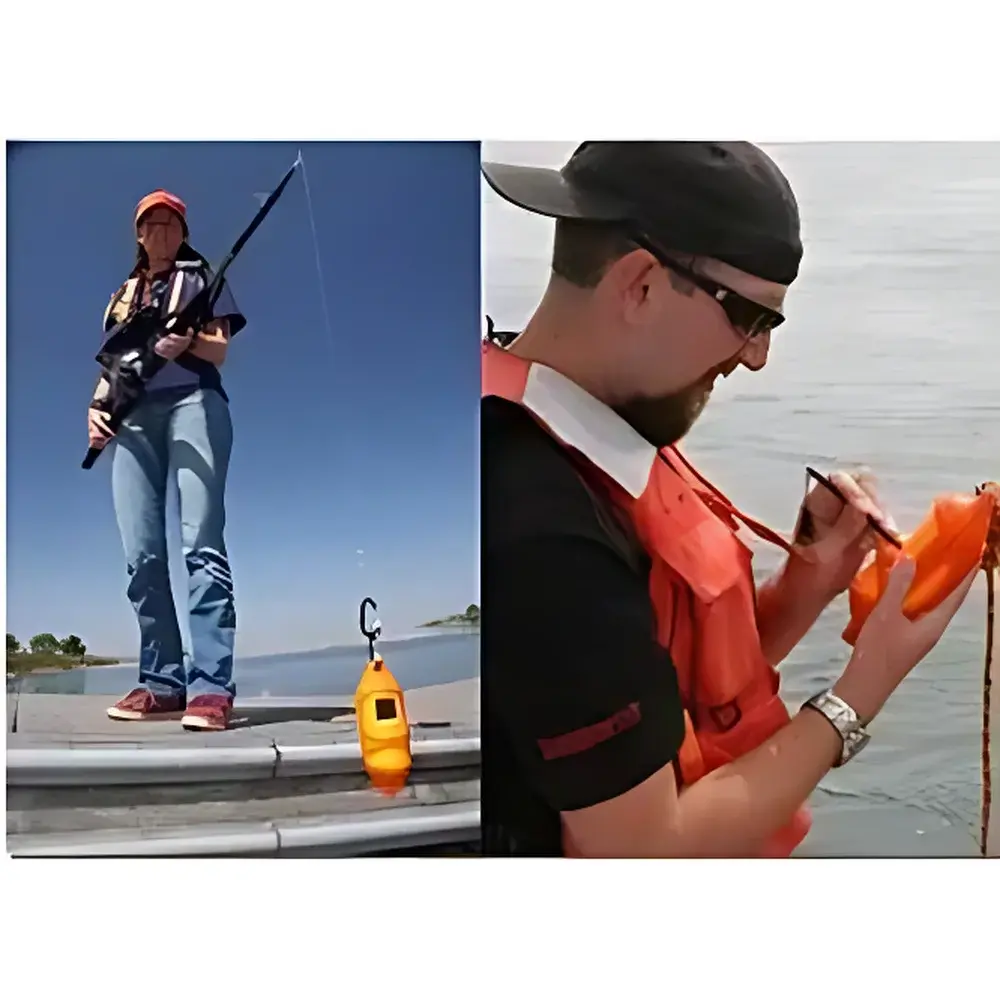
YSI CastAway™ CTD Profiler
| Brand | YSI |
|---|---|
| Origin | USA |
| Model | YSI CastAway™ CTD |
| Sampling Rate | 5 Hz |
| Power | Standard AA batteries (≥40 h operation) |
| GPS | Integrated, with timestamped georeferenced data |
| Waterproof Interface | IP68-rated, operational above and below water surface |
| Wireless Communication | Bluetooth 4.0 |
| Calibration | Factory-calibrated, no user calibration required |
| Conductivity Range | 0–100,000 µS/cm |
| Conductivity Accuracy | ±0.25% of reading ±51 µS/cm |
| Conductivity Resolution | 0.01 µS/cm |
| Temperature Range | −5 to +45 °C |
| Temperature Accuracy | ±0.05 °C |
| Temperature Resolution | 0.01 °C |
| Pressure Range | 0–100 dBar (equivalent to ~100 m depth) |
| Pressure Accuracy | ±0.25% FS |
| Pressure Resolution | 0.01 dBar |
| Salinity Range | 0–42 PSU (PSS-78) |
| Salinity Accuracy | ±0.1 PSU (PSS-78) |
| Salinity Resolution | 0.01 PSU |
| Sound Velocity Range | 1400–1730 m/s |
| Sound Velocity Accuracy | ±0.15 m/s |
| Sound Velocity Resolution | 0.01 m/s |
| GPS Horizontal Accuracy | <10 m (typical, uncorrected) |
Overview
The YSI CastAway™ CTD Profiler is a handheld, self-contained oceanographic instrument engineered for rapid, high-fidelity vertical profiling of conductivity, temperature, and pressure (CTD) in marine, estuarine, and freshwater environments. Unlike traditional tethered or shipboard CTD systems, the CastAway operates on a “drop-and-retrieve” principle grounded in robust microelectromechanical sensor architecture and embedded real-time signal processing. Its measurement methodology conforms to internationally accepted physical oceanography standards: temperature is acquired via high-stability thermistor circuits traceable to NIST reference standards; conductivity employs four-electrode AC excitation to minimize polarization effects and electrode fouling artifacts; pressure is measured using a compensated silicon piezoresistive transducer compliant with IEC 61298-2. Derived salinity follows the Practical Salinity Scale 1978 (PSS-78), and sound velocity is computed in real time using the Chen-Millero-Li algorithm—ensuring full compatibility with hydrographic data reporting requirements under IOC/IHO standards.
Key Features
- True field-deployable CTD: No external cables, laptops, or docking stations required—enables immediate deployment from vessels, piers, bridges, or ice edges.
- Integrated GPS module provides geotagged, time-synchronized metadata (UTC) for every profile, supporting spatially referenced data integration into GIS and hydrodynamic modeling frameworks.
- IP68-rated housing ensures reliable operation both above and submerged—tested to 100 m depth with continuous functionality at surface interface during retrieval.
- Bluetooth 4.0 wireless interface enables secure, low-power data transfer to iOS/Android tablets or ruggedized field computers—no proprietary drivers or firmware updates needed.
- Factory-calibrated sensor suite eliminates routine user recalibration; calibration certificates are traceable to NIST and include uncertainty budgets per ISO/IEC 17025.
- 5 Hz sampling rate delivers high-resolution vertical profiles—even at descent speeds up to 2 m/s—supporting detection of fine-scale thermohaline structures such as pycnoclines and haloclines.
- Low-power design powered by standard AA alkaline batteries supports ≥40 hours of continuous operation or >1,000 individual casts under typical field conditions.
Sample Compatibility & Compliance
The CastAway™ CTD is optimized for in situ profiling across diverse aquatic matrices—including turbid estuaries, coral reef lagoons, glacial fjords, aquaculture pens, and brackish groundwater discharge zones. Its corrosion-resistant titanium sensor housing and non-polarizing electrodes ensure stable performance in high-salinity (>40 PSU) and biofouling-prone environments. All measurements adhere to ASTM D5540 (Standard Test Method for Determining Salinity of Water), ISO 7888 (Water Quality – Determination of Electrical Conductivity), and UNESCO Technical Papers in Marine Science guidelines for CTD data quality control. Data output formats (CSV, .ctd) are compatible with Sea-Bird Scientific SBE Data Processing, Ocean Data View (ODV), and NOAA’s NODC archival standards. The device meets CE, FCC Part 15, and RoHS compliance requirements for electromagnetic compatibility and environmental safety.
Software & Data Management
YSI’s CastAway Mobile App (iOS/Android) provides intuitive profile visualization, real-time QC flagging, and one-touch export to cloud storage (Dropbox, Google Drive) or local network shares. Raw sensor time-series data include full audit trails: timestamp, GPS coordinates, battery voltage, internal temperature, and sensor diagnostics. Exported files contain embedded metadata headers compliant with CF (Climate and Forecast) conventions, enabling direct ingestion into MATLAB, Python (xarray/netCDF4), or R-based oceanographic analysis pipelines. For regulated environments—such as EPA-certified monitoring programs or GLP-compliant aquaculture audits—the app supports optional 21 CFR Part 11–compliant electronic signatures and role-based access controls when deployed with YSI’s enterprise cloud platform.
Applications
- Coastal zone mapping and bathymetric survey support via real-time sound velocity correction for multibeam echosounder systems.
- Rapid assessment of saltwater intrusion dynamics in coastal aquifers and estuarine mixing zones.
- Pre-deployment and post-deployment field validation of fixed-platform sensors (e.g., moored CTDs, buoy networks).
- Hydrographic reconnaissance for marine construction, dredging operations, and offshore wind farm site characterization.
- Academic and NGO-led citizen science initiatives requiring low-barrier, standardized water column profiling protocols.
- Regulatory compliance monitoring for shellfish growing areas under FDA National Shellfish Sanitation Program (NSSP) criteria.
FAQ
Does the CastAway require annual recalibration?
No—YSI performs full factory calibration prior to shipment, including temperature-conductivity-pressure cross-sensitivity verification. Recalibration is recommended only after mechanical shock, exposure to extreme contaminants (e.g., hydrocarbons), or every 24 months for mission-critical applications.
Can it be used in icy or freezing conditions?
Yes—the operating temperature range extends to −5 °C, and the pressure housing remains functional under partial ice cover; however, deployment through solid ice requires a dedicated ice-port adapter (sold separately).
Is the GPS signal usable underwater?
No—GPS reception occurs only at the surface before submersion and immediately upon retrieval; position data are interpolated vertically using pressure-derived depth and linear descent assumptions.
How is data integrity ensured during Bluetooth transmission?
All wireless transfers use AES-128 encryption and CRC-32 checksum validation; incomplete or corrupted packets are automatically retransmitted without user intervention.
What depth accuracy can be expected at 100 m?
Pressure-derived depth uncertainty is ≤±2.5 cm at 100 m (based on ±0.25% FS specification and thermal compensation), meeting IHO Order 1b hydrographic survey tolerances.







