
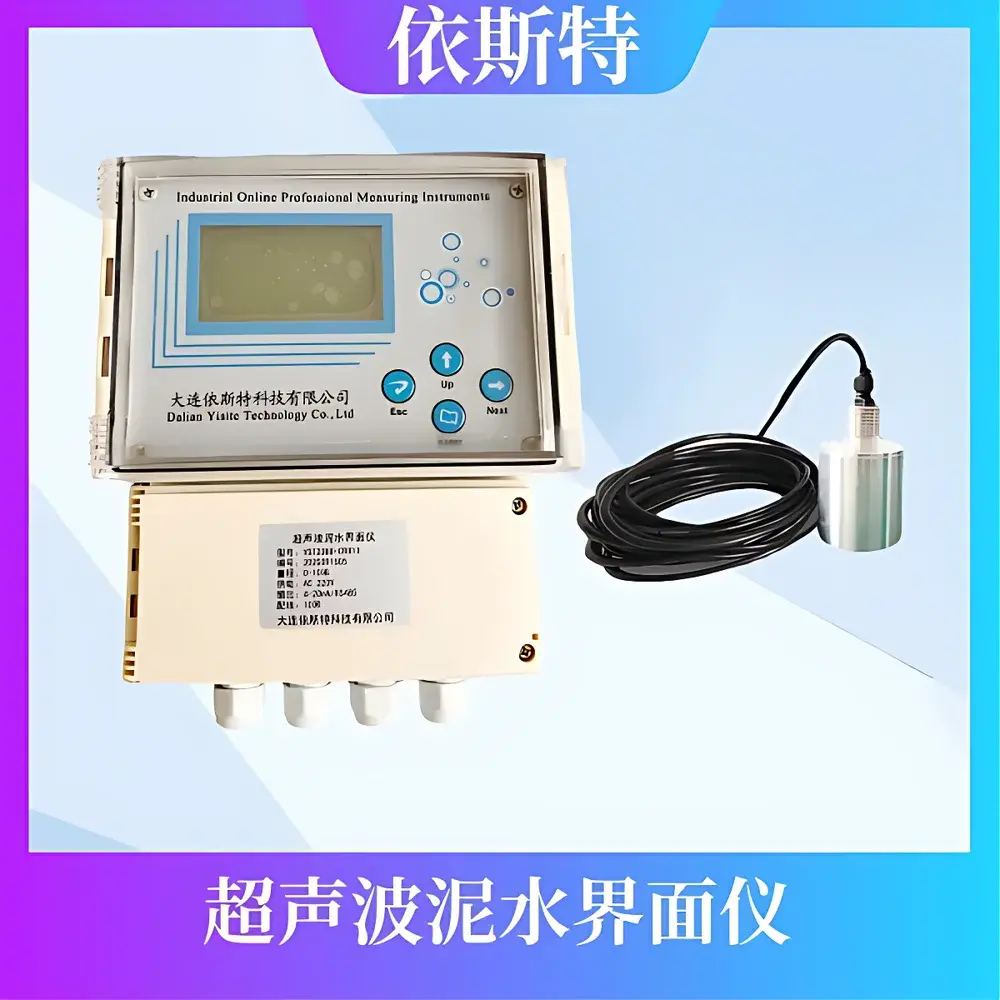
YST208B-CR810 Sludge-Water Interface Detector (Ultrasonic, Mounting-Bracket Type)
| Brand | YST (Dalian Yist) |
|---|---|
| Origin | Liaoning, China |
| Model | YST208B-CR810 |
| Measuring Range | 0–10 m |
| Accuracy | ±0.5% to ±1% FS |
| Resolution | 1 mm |
| Ultrasonic Frequency | 20–200 kHz |
| Transmitter Operating Temperature | −20 °C to +70 °C |
| Sensor Operating Temperature | 0 °C to +70 °C |
| Enclosure Rating | IP65 (Transmitter), IP68 (Sensor) |
| Power Supply | AC 220 V or DC 24 V |
| Output Signals | 4–20 mA analog, RS485 digital (Modbus RTU) |
| Installation | Fixed bracket mount |
| Maintenance Interval | Quarterly |
Overview
The YST208B-CR810 Sludge-Water Interface Detector is an industrial-grade ultrasonic interface gauge engineered for continuous, non-contact measurement of sludge blanket depth in sedimentation, thickening, and clarification basins. It operates on the time-of-flight (ToF) principle: a high-frequency ultrasonic transducer emits pulsed acoustic energy vertically into the liquid column; the signal reflects at the acoustic impedance discontinuity between clarified supernatant and suspended solids-rich sludge layer. The system precisely calculates distance by measuring the elapsed time between emission and echo reception, then derives sludge thickness by subtracting this distance from pre-configured tank depth. Designed for long-term deployment in municipal wastewater treatment plants, industrial effluent facilities, and drinking water clarification systems, the YST208B-CR810 integrates real-time temperature compensation via an embedded thermistor—critical for maintaining measurement fidelity across seasonal water temperature fluctuations (0–70 °C). Its robust mechanical architecture and sealed sensor housing meet stringent environmental demands typical of wet, chemically aggressive, and particulate-laden process environments.
Key Features
- Intelligent echo analysis algorithm that identifies the primary amplitude transition point within the return waveform—effectively distinguishing true sludge interface reflection from spurious echoes caused by suspended flocs, entrained air bubbles, or floating scum layers.
- Dual-mode cleaning mechanism: integrated ultrasonic vibration (20–200 kHz) combined with optional high-pressure water jet interface—minimizes sensor fouling from viscous, adhesive sludges without requiring manual intervention.
- Local human-machine interface featuring backlit monochrome LCD with bilingual (English/Chinese) menu navigation, real-time distance display, status indicators, and configurable alarm thresholds.
- Self-diagnostic capability including transducer continuity check, signal-to-noise ratio monitoring, and temperature drift validation—generates event logs for predictive maintenance planning.
- Industrial-grade signal conditioning circuitry ensuring stable 4–20 mA output linearity and low-noise RS485 Modbus RTU communication over distances up to 1,200 meters.
Sample Compatibility & Compliance
The YST208B-CR810 is validated for use in heterogeneous aqueous matrices containing suspended solids concentrations ranging from 0.1 g/L (clarified effluent) to >30 g/L (activated sludge thickeners). It maintains functional integrity in wastewater streams with pH 4–10, conductivity up to 20 mS/cm, and moderate organic loading. While not certified to IEC 61508 SIL or ATEX directives, its design adheres to general-purpose industrial safety standards applicable to fixed-mount process instrumentation. The device supports data integrity practices aligned with EPA Method 1631 and ISO 5667-3 for wastewater sampling and analysis—particularly when deployed as part of a larger QA/QC framework for sludge management reporting. Its analog and digital outputs are compatible with SCADA, DCS, and PLC platforms commonly used in regulated utilities operating under U.S. EPA Clean Water Act requirements or EU Urban Wastewater Treatment Directive compliance frameworks.
Software & Data Management
Internal firmware includes non-volatile memory capable of storing ≥12 months of timestamped interface position records at user-defined intervals (1 min to 24 h). Data export is supported via Modbus register polling or local USB dump (optional adapter). The unit does not include proprietary cloud software but exports raw values in standard industrial protocols—enabling seamless integration with third-party platforms such as Siemens Desigo, Schneider EcoStruxure, or open-source IIoT stacks (e.g., Node-RED + InfluxDB). Audit trail functionality logs configuration changes, calibration events, and alarm activations with UTC timestamps—supporting GLP-aligned operational documentation where required. Firmware updates are performed via secure serial interface using signed binary files.
Applications
- Municipal Wastewater Treatment: Real-time monitoring of secondary clarifier sludge blanket height to optimize scraper torque control, prevent sludge bulking overflow, and synchronize waste activated sludge (WAS) pumping cycles.
- Industrial Effluent Management: Interface tracking in lamella settlers and gravity thickeners handling petrochemical, pulp & paper, or food processing wastewaters—enabling dynamic dosing of coagulants and polymers based on actual solids concentration profiles.
- Drinking Water Clarification: Detection of floc blanket depth in conventional or high-rate clarifiers to fine-tune coagulant dosage, improve turbidity removal efficiency, and reduce filter backwash frequency.
- Resource Recovery Facilities: Supporting anaerobic digester feed consistency by stabilizing thickener underflow solids content prior to digestion—contributing to biogas yield predictability.
FAQ
What is the maximum recommended installation depth for accurate sludge interface detection?
The YST208B-CR810 is rated for full-scale measurement up to 10 meters. For optimal signal integrity in highly attenuating media (e.g., high-TSS or aerated zones), it is recommended to install the sensor no deeper than 8 meters below the water surface.
Does the device require periodic recalibration in the field?
No routine recalibration is required. The system performs automatic zero-point verification during power-up and employs factory-traceable acoustic velocity compensation. Field verification may be conducted annually using a calibrated depth reference rod or ultrasonic comparator block.
Can the unit operate reliably in saline or brackish water environments?
Yes—the transducer housing and signal processing electronics are corrosion-resistant and rated for continuous immersion in conductive media. However, salinity-induced sound speed variation is automatically compensated via the built-in temperature sensor; no additional salinity input is needed.
Is Modbus RTU communication compatible with common SCADA HMI systems?
Yes—standard Modbus function codes 03 (Read Holding Registers) and 06 (Write Single Register) are fully implemented. Register mapping documentation is provided in the technical manual for direct tag configuration in Ignition, WinCC, or VTScada.
How does the self-cleaning function interact with existing plant water supply infrastructure?
The high-pressure water flush option requires connection to a clean water source delivering ≥3 bar pressure and ≥10 L/min flow. A solenoid valve and pulse timer module are included; integration with plant PLC enables scheduled or demand-triggered cleaning cycles.
Related Products







