
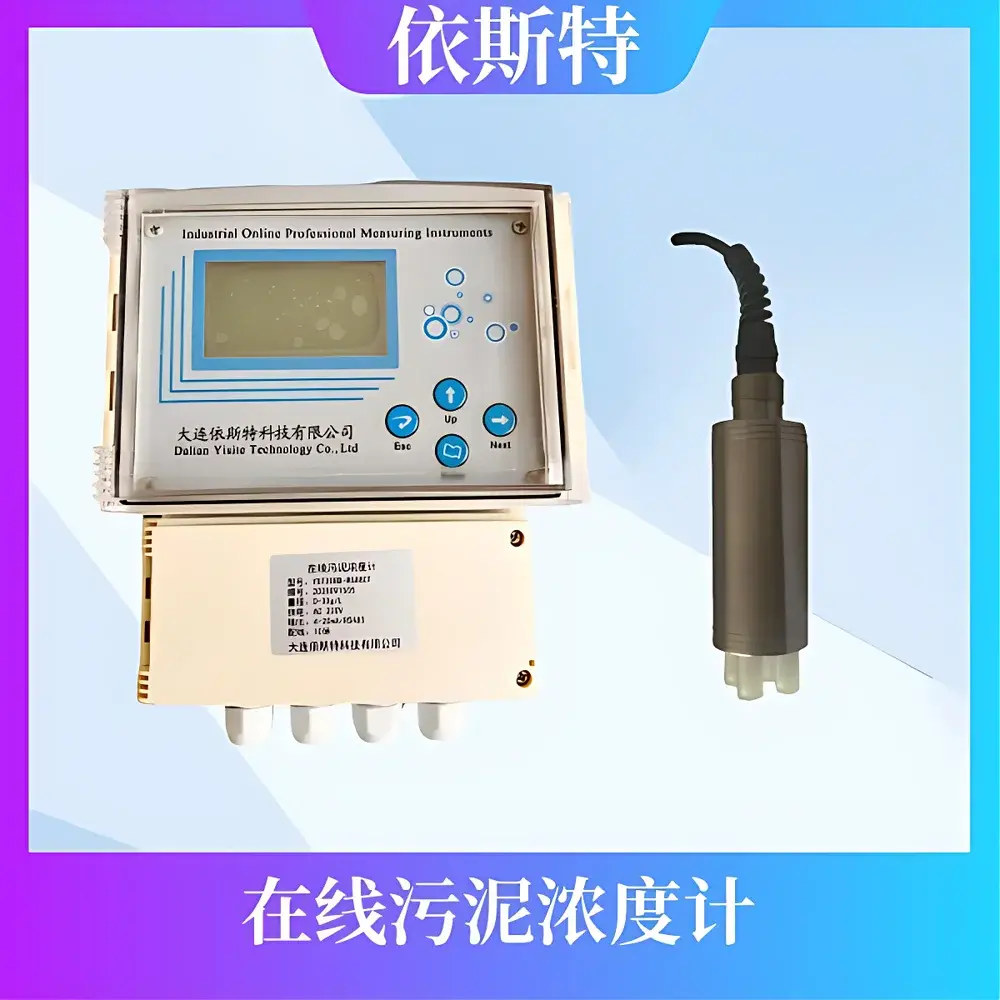
YST308B-MS880T Infrared Scattering Sludge Concentration Monitor
| Brand | YST (Dalian Yist) |
|---|---|
| Origin | Liaoning, China |
| Model | YST308B-MS880T |
| Measurement Principle | Infrared Light Scattering (ISO 7027 Compliant) |
| Range | 0–20 g/L |
| Resolution | 0.01 g/L |
| Accuracy | ±2% FS |
| Sensor IP Rating | IP68 |
| Transmitter IP Rating | IP65 |
| Response Time (T90) | ≤10 s |
| Operating Temp (Sensor) | 0–60 °C |
| Operating Temp (Transmitter) | 0–50 °C |
| Humidity | ≤90% RH (non-condensing) |
| Power Supply | AC 220 V ±10%, 50/60 Hz |
| Output Signals | 4–20 mA (≤500 Ω load), RS485 Modbus RTU |
Overview
The YST308B-MS880T is an industrial-grade, online sludge concentration monitor engineered for continuous, real-time measurement of low-concentration suspended solids in wastewater treatment processes. It operates on the principle of infrared light scattering—fully compliant with ISO 7027:2016 for turbidity and suspended solids quantification—ensuring minimal interference from chromatic variations common in municipal and industrial effluents. Unlike visible-light-based sensors, its 850 nm infrared emitter eliminates color-induced bias, delivering stable and traceable measurements across variable water matrices. Designed for integration into activated sludge systems, primary clarifiers, and pre-treatment basins, the YST308B-MS880T provides high-reproducibility data without manual sampling or lab analysis, supporting dynamic process control including aeration optimization, return activated sludge (RAS) rate adjustment, and chemical dosing feedback loops.
Key Features
- Infrared scattering detection at 850 nm wavelength, certified per ISO 7027 for robustness against color and dye interference
- Dual-emitter optical calibration architecture to compensate for window fouling, temperature drift, and aging effects in real time
- Integrated mechanical auto-cleaning mechanism: programmable刮擦 cycle (1–30 min intervals) removes biofilm and particulate buildup from the sensing window
- Submersible sensor probe with IP68 rating—rated for permanent immersion in aggressive wastewater environments up to 60 °C
- Compact, low-profile probe design (≤Φ36 mm × 180 mm) enables direct insertion into narrow ducts, aeration lanes, and sedimentation zones without flow disruption
- Configurable output interface: isolated 4–20 mA analog signal (HART-compatible wiring topology supported) and RS485 Modbus RTU for SCADA and DCS integration
- Low-power consumption (<8 W typical), reducing thermal loading and enabling deployment in non-dedicated electrical cabinets
Sample Compatibility & Compliance
The YST308B-MS880T is validated for use in municipal wastewater, food processing effluent, pulp & paper mill discharge, and pharmaceutical pre-treatment streams containing low-to-moderate levels of organic and inorganic suspended solids (0–20 g/L). Its optical path geometry and signal processing algorithms are optimized for non-settling, flocculated, and colloidal suspensions typical of biological treatment units. The device meets IEC 61326-1 (EMC for industrial environments), IEC 60529 (IP68/IP65 enclosure compliance), and supports audit-ready operation under GLP-aligned wastewater monitoring protocols. While not FDA 21 CFR Part 11 certified out-of-the-box, its digital output logs support traceable data export for regulatory reporting when paired with validated data acquisition software.
Software & Data Management
The transmitter includes embedded firmware with configurable logging intervals (1–30 min), local zero/span calibration routines, and diagnostic flags for fouling detection, signal saturation, and communication loss. Raw scattering intensity values and compensated concentration outputs are timestamped and accessible via Modbus register mapping (e.g., Holding Register 40001 = mg/L equivalent, 40002 = signal stability index). No proprietary PC software is required; standard Modbus master tools (e.g., QModMaster, ModScan) or PLC logic blocks can extract and archive data. For long-term trending, the 4–20 mA output integrates seamlessly with existing analog input modules in Siemens S7, Rockwell ControlLogix, or Schneider EcoStruxure platforms. Optional firmware updates are delivered via secure USB stick—no internet connectivity required.
Applications
- Real-time monitoring of mixed liquor suspended solids (MLSS) in aerobic and anoxic zones of activated sludge plants
- Feed-forward control of return activated sludge (RAS) pumps based on settling basin influent concentration gradients
- Optimization of dissolved oxygen setpoints in oxidation ditches using dynamic biomass load estimation
- Pre-treatment surveillance in food & beverage facilities where low-level organic particulates require precise coagulant dosing
- Performance verification of lamella settlers and dissolved air flotation (DAF) units during commissioning and routine QA/QC
- Supporting ISO 14001 environmental management system documentation through automated, auditable concentration records
FAQ
Does the YST308B-MS880T require periodic factory recalibration?
No—its dual-emitter optical design enables field-based zero and span verification using clean water and standardized suspension standards (e.g., Formazin or AMCO AEPA-1). Annual verification against traceable reference materials is recommended for ISO/IEC 17025-compliant labs.
Can the probe be installed in pressurized pipelines?
Yes—when mounted with a retractable NPT or DIN 11851 process adapter, the IP68-rated sensor operates reliably in full-flow pipes up to 6 bar static pressure, provided flow velocity remains below 3 m/s to prevent abrasion.
Is the auto-cleaning function compatible with abrasive sludge types?
The stainless steel wiper blade is rated for >100,000 cycles and has been tested with sand-laden municipal grit and fibrous textile effluent; replacement blades are available as service kits (YST-ACB-KIT).
How does the device handle air bubbles or foam layers?
Signal processing includes adaptive bubble rejection algorithms that suppress transient spikes caused by entrained gas; installation above the foam line or use of a stilling well is advised for sustained foaming conditions.
What is the expected service life under continuous operation?
Field data from 3+ years of deployment indicates >50,000 operating hours for the optical module and >8 years for the mechanical actuator—consistent with IEC 61508 SIL-2 functional safety guidance for process instrumentation.
Related Products







