
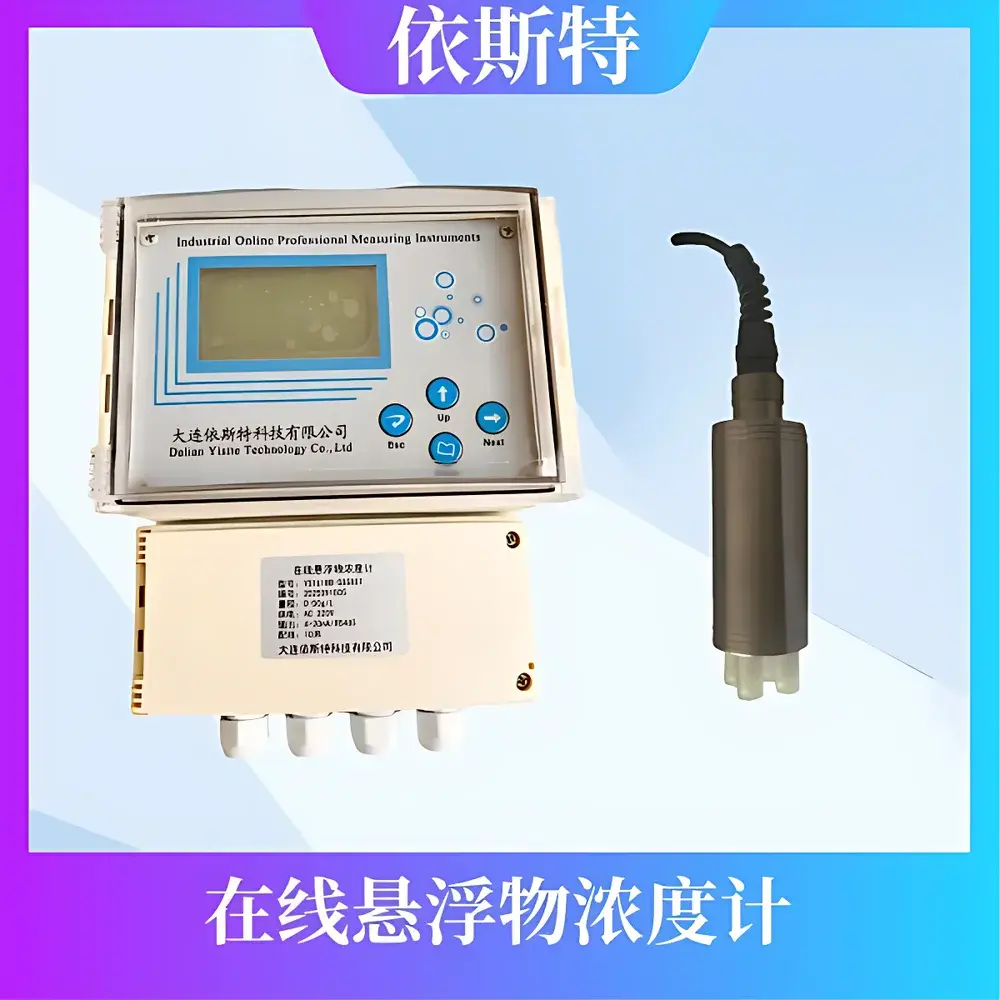
YST308B-MS880T Integrated Suspended Solids Analyzer by YST (Dalian Yist Instrument Co., Ltd.)
| Brand | YST (Dalian Yist Instrument Co., Ltd.) |
|---|---|
| Origin | Liaoning, China |
| Model | YST308B-MS880T |
| Measurement Principle | Infrared Dual-Scatter Optical Detection |
| Range | 0–5000 mg/L (extendable to 0–20,000 mg/L) |
| Accuracy | ±2% FS (0–100 mg/L), ±5% FS (100–5000 mg/L) |
| Output | RS485 with Modbus RTU Protocol |
| Power Supply | DC 12–24 V, <50 mA avg. |
| Operating Temperature | −5 to +50 °C |
| Humidity | <85% RH (non-condensing) |
| Enclosure Rating | IP68 |
| Housing Material | 316 Stainless Steel + Polyoxymethylene (POM) |
Overview
The YST308B-MS880T Integrated Suspended Solids Analyzer is an in-situ optical sensor engineered for continuous, real-time quantification of total suspended solids (TSS) concentration in aqueous environments. It operates on the principle of infrared dual-scatter optical detection — a robust methodology that minimizes interference from water coloration, turbidity artifacts, and micro-bubble entrainment commonly encountered in wastewater, surface water, and activated sludge systems. Unlike single-angle transmittance or backscatter configurations, the dual-scatter geometry enables differential signal processing, improving measurement stability across heterogeneous matrices. The device integrates sensing optics, signal conditioning electronics, temperature compensation circuitry, and communication interface into a single sealed probe assembly — eliminating external junction boxes, cable splices, or auxiliary housings typically required in modular TSS monitoring solutions. This monolithic architecture reduces calibration drift, ingress-related failure modes, and installation complexity while maintaining compliance with long-term unattended operation requirements in remote or harsh deployment settings.
Key Features
- Infrared dual-scatter optical path design with factory-calibrated reference channels to suppress chromatic and bubble-induced noise
- Integrated automatic cleaning mechanism utilizing periodic mechanical wiper actuation — programmable interval (1–24 h) and duration (5–30 s)
- IP68-rated pressure-tight housing constructed from marine-grade 316 stainless steel (wetted parts) and chemically resistant POM polymer (housing body and sealing components)
- Low-power DC operation (12–24 V, <50 mA avg.) enabling compatibility with solar-powered telemetry stations and battery-backed edge monitoring nodes
- Modbus RTU over RS485 physical layer — fully compliant with Modbus Application Protocol v1.1b, supporting standard function codes 03 (read holding registers) and 06 (preset single register)
- On-device linearization and temperature-compensated output mapping, with optional user-defined calibration points (1-point or 2-point)
Sample Compatibility & Compliance
The YST308B-MS880T is validated for use in municipal wastewater effluent, activated sludge basins, stormwater retention ponds, riverine and lacustrine surface waters, and industrial process streams containing organic particulates, mineral sediments, or bioflocs. Its optical design inherently mitigates spectral interference from humic substances and algal pigments within typical environmental UV-Vis absorption bands. While not certified to ISO 7027 (turbidity) or ASTM D3977 (TSS gravimetric method), the instrument is designed to support method correlation studies per EPA Method 160.2 and ISO 11923:1997 (water quality — determination of suspended solids by gravimetry), serving as a field-deployable surrogate for laboratory-based TSS quantification. Device firmware supports audit-trail logging of calibration events, cleaning cycles, and configuration changes — facilitating GLP-aligned operational documentation when integrated into validated monitoring networks.
Software & Data Management
The analyzer communicates exclusively via Modbus RTU, requiring no proprietary drivers or vendor-specific middleware. Register maps are published in accordance with industry-standard conventions: measured TSS value (mg/L) resides at address 40001 (holding register, UINT16 scaled ×10), temperature compensation offset at 40003, cleaning status flag at 40005, and system uptime counter at 40007. Integration with SCADA platforms (e.g., Ignition, Siemens Desigo, or EcoStruxure), cloud-based IoT gateways (AWS IoT Core, Azure IoT Hub), or open-source data loggers (Raspberry Pi + Modbus TCP bridge) is achieved using standard serial-to-IP conversion or native RS485 Modbus polling. Firmware updates are performed via UART bootloader mode using industry-standard tools (e.g., STM32CubeProgrammer), with versioning traceable in register 40010. All configuration parameters persist through power cycling, and no volatile memory is used for critical operational settings.
Applications
- Real-time optimization of sludge blanket depth and return activated sludge (RAS) flow rates in secondary clarifiers and aeration tanks
- Early-warning detection of sediment resuspension during flood events in river monitoring networks
- Performance verification of primary sedimentation, dissolved air flotation (DAF), and membrane filtration units
- Long-term ecological trend analysis in reservoirs and estuaries where seasonal particulate loading impacts light penetration and benthic health
- Compliance monitoring for discharge permits requiring TSS reporting under national regulatory frameworks (e.g., China’s GB 8978-1996, EU Urban Wastewater Treatment Directive 91/271/EEC)
FAQ
What is the recommended calibration frequency for the YST308B-MS880T in municipal wastewater applications?
Calibration should be performed at commissioning and verified quarterly thereafter; more frequent checks (bi-weekly) are advised if operating in high-fouling environments such as grit-laden influent channels or anaerobic digesters.
Can the device measure true TSS (gravimetrically defined) without lab correlation?
No — it measures optical scatter intensity correlated to suspended particle mass concentration. Field calibration against grab-sample gravimetric analysis (per ISO 11923) is required for site-specific accuracy validation.
Is the probe compatible with submersible cable extensions beyond 100 meters?
Yes, provided twisted-pair shielded RS485 cable (AWG22, 120 Ω characteristic impedance) is used with proper termination and grounding; maximum tested distance is 300 m at 9600 bps.
Does the automatic cleaning function require external water or air supply?
No — the wiper mechanism is self-contained and powered solely by the device’s internal drive circuit; no auxiliary utilities are needed.
How is temperature compensation implemented?
An embedded NTC thermistor measures probe tip temperature in real time; compensation coefficients are applied dynamically to the raw scatter signal using a second-order polynomial algorithm stored in non-volatile memory.
Related Products







