
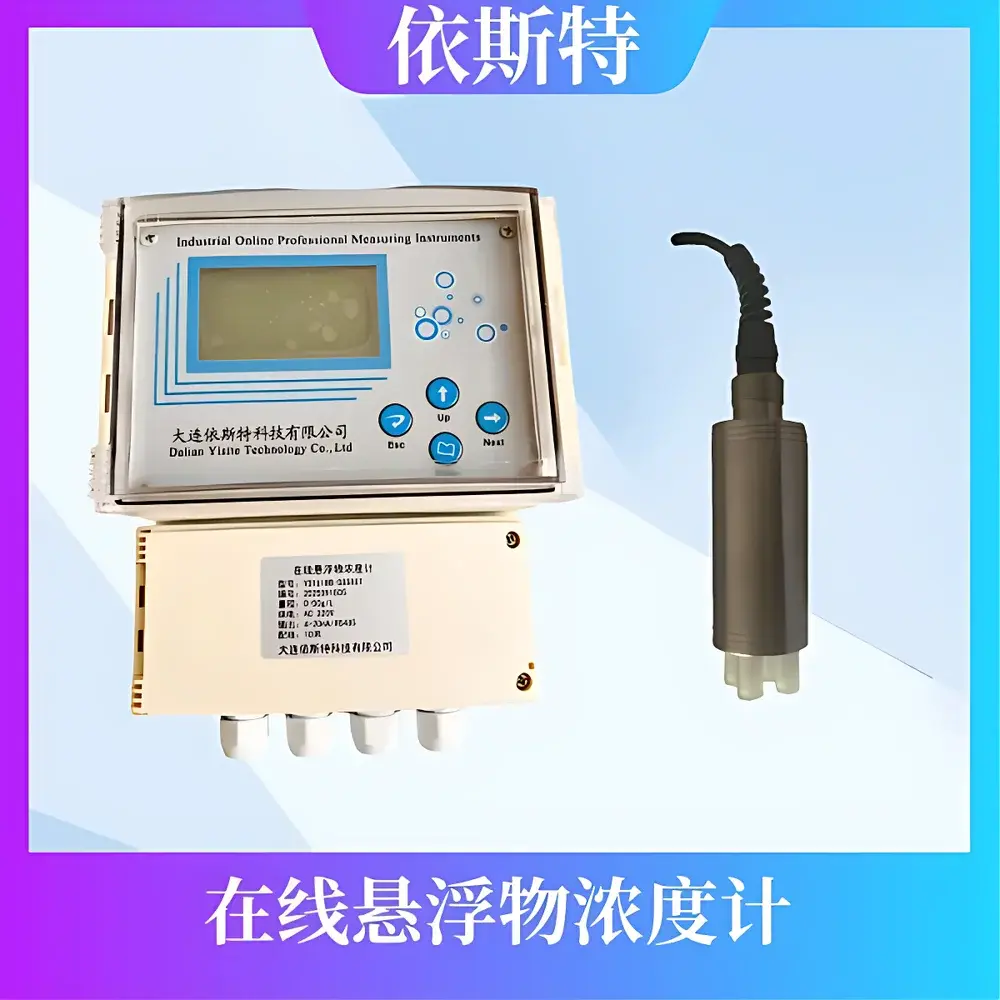
YST308B-MS880T Suspended Solids Analyzer by YST (Dalian Yist Environmental Technology Co., Ltd.)
| Brand | YST (Dalian Yist) |
|---|---|
| Origin | Liaoning, China |
| Model | YST308B-MS880T |
| Measurement Range | 0–5000 mg/L SS, 0–80.0 °C |
| Accuracy | ±1.5% FS (SS), ±0.3 °C (Temp) |
| Resolution | 1 mg/L (SS), 0.1 °C (Temp) |
| Output | 4–20 mA & RS485 MODBUS RTU |
| Power Supply | 85–265 VAC ±10%, 50 ±1 Hz, ≤3 W |
| IP Rating | IP65 |
| Installation | Panel-mount / Wall-mount / In-line pipe mount |
| Operating Environment | −10 to +60 °C, ≤90% RH, non-corrosive, no strong magnetic field |
| Compliance | HJ 212–2017 (China Emission Monitoring Data Transmission Standard) |
Overview
The YST308B-MS880T Suspended Solids Analyzer is an optical turbidimetric sensor engineered for continuous, in-situ monitoring of total suspended solids (TSS) concentration in low-infrastructure water systems. It operates on the principle of multi-beam near-infrared (NIR) light scattering—employing a quadruple optical path configuration with dual emitters and dual detectors arranged in orthogonal geometry. This architecture enables cross-validated signal acquisition, minimizing drift caused by lens fouling, air bubbles, or variable background absorbance commonly observed in rural surface water sources. Unlike single-beam transmissometers or simple LED-based turbidity sensors, the YST308B-MS880T applies real-time temperature compensation (via integrated Pt1000 thermistor) and matrix-based scatter correction algorithms to deliver stable TSS quantification across dynamic conditions—particularly relevant for raw water intakes, wastewater influent/effluent streams, and open-channel river monitoring where particulate load fluctuates rapidly during storm events or algal blooms.
Key Features
- Robust Multi-Beam Optical Architecture: Four independent NIR optical paths (850 nm) with redundant emitter-detector pairs reduce measurement uncertainty from window deposition and flow-induced shadowing.
- Integrated Temperature Compensation: High-stability Pt1000 sensor embedded in the sensing head provides continuous thermal correction of optical response, critical for accurate TSS correlation across 0–80 °C operating range.
- Field-Adapted Mechanical Design: IP65-rated enclosure with corrosion-resistant stainless-steel wetted parts (316L) and modular front-access optics enable reliable deployment in unsheltered outdoor environments—including pump stations, open channels, and elevated tank platforms.
- Multi-Mode Mounting Flexibility: Supports panel-mount (144 × 144 mm cutout), wall-mount (M4 threaded holes), and in-line pipe insertion (with optional DN50–DN150 flanged adapter), accommodating diverse civil infrastructure constraints typical of township-level utilities.
- Low-Power, Wide-Range AC Operation: Operates directly from standard utility mains (85–265 VAC, 50 Hz) with <3 W consumption—eliminating need for external power converters or uninterruptible supplies in resource-limited settings.
Sample Compatibility & Compliance
The YST308B-MS880T is validated for use in natural waters (rivers, reservoirs), treated drinking water, and municipal wastewater streams containing organic detritus, silt, clay, diatoms, and filamentous algae. Its optical calibration curve is traceable to ISO 7027:2016-compliant formazin standards and empirically adjusted for local sediment composition using regional reference samples (e.g., Yellow River loess suspensions, Northeastern Chinese lake sediments). While not certified to US EPA Method 160.2 or ISO 11923, its output meets data quality objectives specified in China’s HJ/T 91–2019 (Surface Water and Wastewater Monitoring Technical Specifications) for Class IV–V water bodies. The device supports HJ 212–2017 protocol natively—enabling direct data packet framing, encryption handshake, and heartbeat synchronization with provincial environmental monitoring platforms without middleware or protocol gateways.
Software & Data Management
The analyzer includes embedded firmware with configurable data logging (local SD card optional), real-time clock (RTC), and event-triggered alarms (e.g., high-TSS threshold, sensor fault, communication timeout). All parameters—including zero/span offsets, temperature compensation coefficients, and MODBUS slave ID—are adjustable via intuitive bilingual (English/Chinese) LCD menu with tactile keypad navigation—no PC or proprietary software required. Audit trails for configuration changes are stored with timestamps and user flags. For integration into centralized SCADA or cloud-based asset management systems, the RS485 interface supports MODBUS RTU at 9600/19200 bps with configurable parity and stop bits. Data transmission complies with GLP-aligned principles: each reading carries embedded metadata (sensor ID, timestamp, status flags, checksum), and firmware logs all communication attempts—including failed handshake sequences—for regulatory review.
Applications
- Real-time monitoring of raw water turbidity at small-scale rural waterworks to optimize coagulant dosing and prevent filter breakthrough.
- Continuous effluent TSS verification at decentralized wastewater treatment plants (≤5,000 m³/d capacity) for compliance reporting under China’s Discharge Permit System.
- Long-term trend analysis of suspended sediment transport in agricultural catchments and ecological restoration zones.
- Performance validation of constructed wetlands and sand filtration units in off-grid community water systems.
- Backup verification sensor for laboratory gravimetric TSS analysis (ISO 11923), reducing manual sampling frequency by ≥70% in routine operations.
FAQ
Is the YST308B-MS880T suitable for seawater or brackish water applications?
No. The optical calibration and wetted material compatibility are optimized for freshwater matrices (TDS < 2,000 mg/L). High chloride concentrations accelerate corrosion of internal optics mounts and induce refractive index shifts that degrade scatter linearity.
Can the device be calibrated in the field without factory support?
Yes. Zero calibration is performed using deionized water (or clean tap water filtered through 0.45 µm membrane); span calibration uses a stable formazin or polymer suspension traceable to national metrology institutes. Full two-point procedure requires <5 minutes and is guided stepwise on the LCD.
Does it meet FDA 21 CFR Part 11 requirements for electronic records?
No. The device lacks digital signature capability, role-based access control, and permanent audit trail export—features required for regulated pharmaceutical or food-grade water systems. It is intended for environmental compliance and operational optimization only.
What maintenance interval is recommended for rural deployments?
Optical window cleaning every 3–6 months depending on silt load; full sensor verification annually using certified reference suspensions. No consumables or reagents are required.
Is analog output isolated from the main power supply?
Yes. The 4–20 mA output is galvanically isolated (≥1500 VAC) and intrinsically safe per IEC 61000-4-5 surge immunity (Level 3), ensuring signal integrity in electrically noisy pump house environments.
Related Products







