
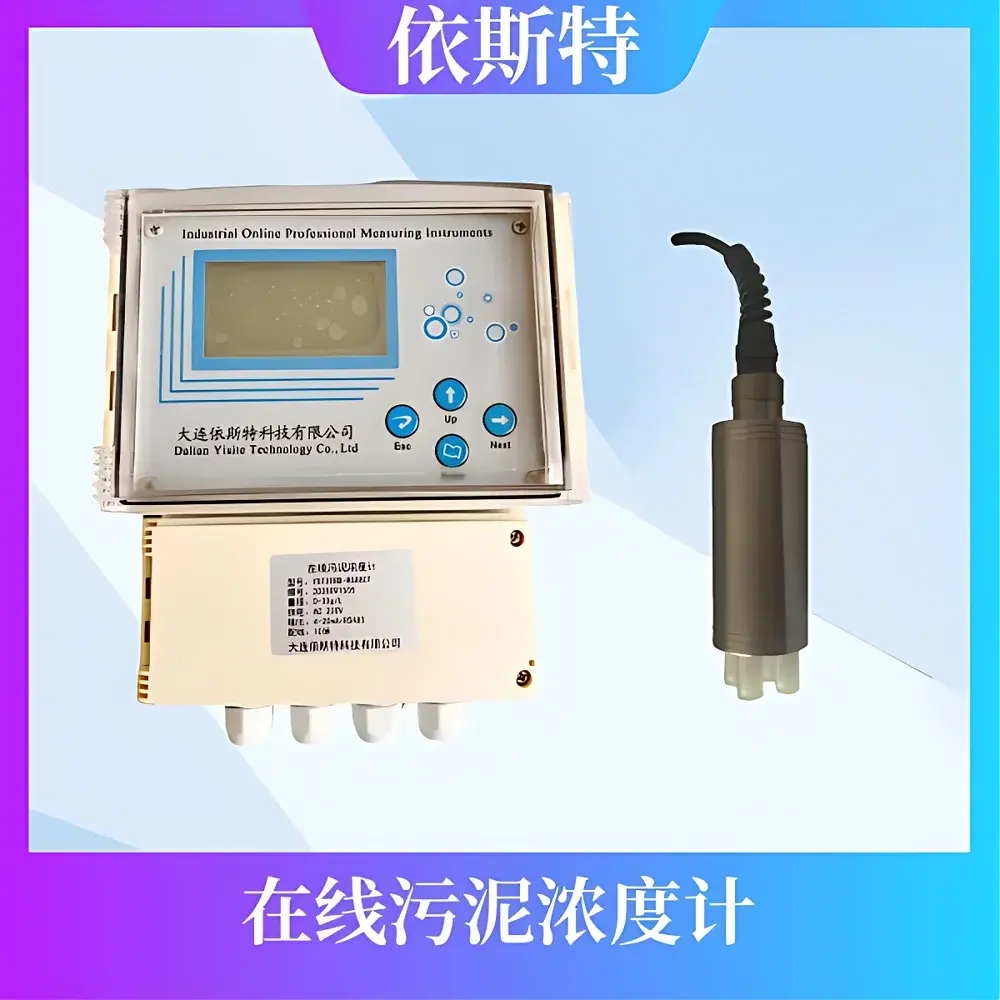
YST308T-MS870Z Sludge Concentration Monitor with Auto-Cleaning Function for Sedimentation Tanks
| Brand | YST (Dalian Yist) |
|---|---|
| Origin | Liaoning, China |
| Model | YST308T-MS870Z |
| Measurement Principle | Infrared Light Scattering |
| Range | 0–50 g/L |
| Resolution | 0.01 g/L |
| Accuracy | ±1% FS |
| Sensor Operating Temp. | 0–60 °C |
| Host Operating Temp. | 0–50 °C |
| Humidity | ≤90% RH (non-condensing) |
| Power Supply | AC 220 V ±10%, 50/60 Hz |
| Sensor IP Rating | IP68 |
| Host IP Rating | IP65 |
| Response Time (T90) | ≤10 s |
| Output Signals | 4–20 mA (load ≤500 Ω), RS485 (Modbus RTU) |
Overview
The YST308T-MS870Z Sludge Concentration Monitor is an industrial-grade, submersible optical sensor engineered for continuous, real-time measurement of suspended solids concentration in primary and secondary sedimentation tanks within municipal and industrial wastewater treatment plants. Utilizing infrared light scattering technology, the instrument quantifies sludge concentration by detecting the intensity of scattered IR radiation from suspended particles in the aqueous phase—principally activated sludge flocs, settleable solids, and biological aggregates. This non-invasive, in-situ measurement method eliminates dependence on grab sampling and laboratory analysis, enabling process engineers to monitor dynamic sludge blanket profiles, optimize sludge blanket height control, and support automated return activated sludge (RAS) and waste activated sludge (WAS) regulation. Designed for long-term deployment in harsh, high-turbidity environments, the YST308T-MS870Z integrates a mechanically actuated auto-cleaning mechanism that periodically removes biofilm and particulate fouling from the optical window—ensuring signal stability and minimizing drift over extended operational cycles.
Key Features
- Infrared light scattering principle with calibrated response to mixed liquor suspended solids (MLSS) and total suspended solids (TSS) across 0–50 g/L range
- Integrated auto-cleaning system featuring programmable cleaning intervals (user-configurable via local interface or Modbus register) to maintain optical path integrity
- 316L stainless steel sensor housing rated IP68 for permanent submersion; host enclosure rated IP65 for outdoor or control room mounting
- High-resolution analog and digital outputs: isolated 4–20 mA current loop (≤500 Ω load) and RS485 serial interface compliant with Modbus RTU protocol
- Real-time self-diagnostic capability including optical window contamination detection, cable continuity verification, and internal temperature monitoring
- Robust thermal design supporting operation at 0–60 °C (sensor) and 0–50 °C (host), with humidity tolerance up to 90% RH (non-condensing)
- T90 response time ≤10 seconds, enabling timely feedback for closed-loop control applications such as RAS flow modulation
Sample Compatibility & Compliance
The YST308T-MS870Z is validated for use in conventional activated sludge (CAS), oxidation ditch, and membrane bioreactor (MBR) secondary clarifiers, as well as primary sedimentation basins receiving domestic or mixed industrial influents. It exhibits stable performance in media containing organic colloids, mineral precipitates, and moderate concentrations of grease or surfactants. While not certified to ISO/IEC 17025 or accredited per EPA Method 160.2, the device adheres to general principles outlined in ISO 7027 (water quality — determination of turbidity) and supports data traceability requirements under GLP-aligned operational protocols. Its analog and digital outputs are compatible with SCADA, DCS, and PLC platforms commonly deployed in water utilities complying with IEC 61131-3 and ISA-88 standards. The unit does not require reagent consumption or consumable parts beyond routine O-rings and wiper blades—reducing lifecycle cost and environmental footprint.
Software & Data Management
The YST308T-MS870Z operates without proprietary software dependencies. Configuration, calibration, and diagnostic access are performed via Modbus RTU registers using standard industrial communication tools (e.g., ModScan, QModMaster) or integrated into existing plant HMIs. All output signals—including raw scattering intensity, compensated concentration value, cleaning status flag, and fault codes—are mapped to discrete holding registers for seamless integration into historian systems (e.g., OSIsoft PI, Inductive Automation Ignition). The device supports linear two-point calibration (zero and span) using reference slurry standards traceable to NIST-traceable gravimetric methods. Audit trails for calibration events, cleaning cycles, and firmware updates are maintained locally in non-volatile memory and can be retrieved remotely via Modbus read commands—supporting basic 21 CFR Part 11 alignment when deployed in GMP-regulated wastewater reuse facilities.
Applications
- Continuous monitoring of sludge blanket depth and concentration in secondary clarifiers to prevent effluent turbidity excursions
- Feedback control of return activated sludge (RAS) pump speed based on real-time MLSS distribution profiles
- Optimization of wasting schedules in conjunction with online ammonia/nitrate sensors to maintain optimal F/M ratio
- Performance validation of lamella settlers or tube settlers in compact wastewater treatment units
- Early detection of bulking events through deviation analysis of baseline scattering patterns over time
- Integration into digital twin models of wastewater treatment plants for predictive sludge management
FAQ
What maintenance is required beyond the auto-cleaning cycle?
Routine inspection every 6 months is recommended: verify O-ring integrity, inspect wiper blade wear, and perform a two-point field calibration using certified slurry standards.
Can the sensor be installed in inclined or curved tank walls?
Yes—the sensor features a universal mounting flange compatible with flat, sloped, or cylindrical surfaces; orientation must ensure unobstructed optical path and avoid direct exposure to influent jets or mechanical scraper arms.
Does the device support HART or Profibus communication?
No—only 4–20 mA analog and RS485 Modbus RTU are supported. HART or Profibus integration requires external protocol converters certified for hazardous area classification if deployed in classified zones.
How is temperature compensation handled?
Internal Pt1000 RTD measures sensor body temperature; firmware applies empirically derived compensation curves to mitigate refractive index shifts in water across 0–60 °C.
Is the unit suitable for seawater or brackish influents?
The 316L stainless steel construction provides adequate corrosion resistance for short-term exposure; however, prolonged immersion in chloride-rich media (>10,000 mg/L Cl⁻) may accelerate crevice corrosion—application-specific validation is advised.
Related Products







