
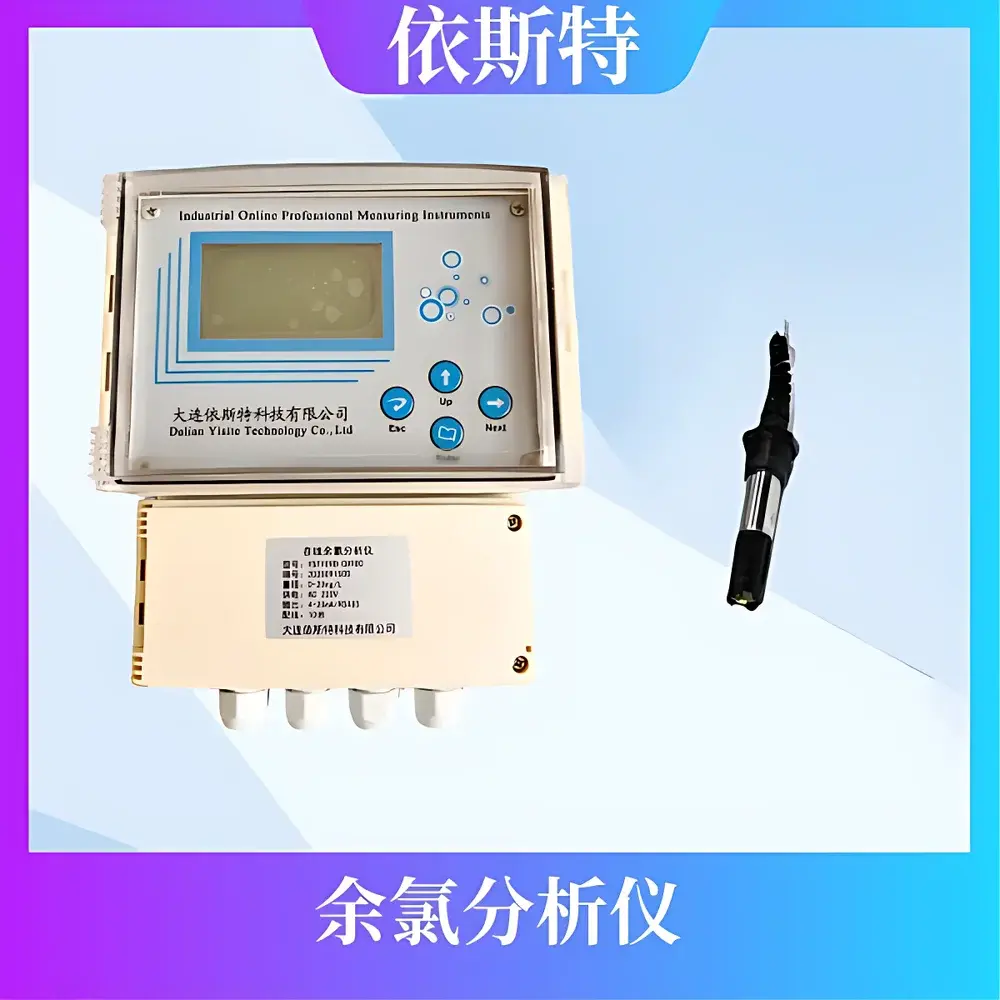
YST909B-CH980 Flanged Online Residual Chlorine and Chlorine Dioxide Analyzer
| Brand | YST (Dalian Yist Environmental Technology Co., Ltd.) |
|---|---|
| Origin | Liaoning, China |
| Model | YST909B-CH980 |
| Measurement Range | Free Chlorine 0–5 mg/L (extendable to 0–20 mg/L), Total Chlorine 0–10 mg/L (extendable to 0–50 mg/L) |
| Resolution | 0.01 mg/L |
| Accuracy | ±2% FS or ±0.02 mg/L (whichever is greater) |
| Response Time (T90) | ≤60 s |
| Operating Temperature | 0–50 °C |
| Relative Humidity | 10–90% RH (non-condensing) |
| Power Supply | AC 220 V ±10%, 50 Hz or DC 12–24 V |
| Output Signals | 4–20 mA analog, RS485 digital (Modbus RTU protocol) |
| Ingress Protection | IP65 |
| Calibration | Automatic (programmable interval) or manual |
Overview
The YST909B-CH980 Flanged Online Residual Chlorine and Chlorine Dioxide Analyzer is an industrial-grade electrochemical monitoring instrument engineered for continuous, real-time quantification of free chlorine and total chlorine concentrations in aqueous process streams. It operates on the amperometric principle, utilizing a membrane-covered, three-electrode sensor system that selectively detects hypochlorous acid (HOCl) and hypochlorite ion (OCl⁻) under controlled pH conditions—enabling stable differentiation between free and combined chlorine species. Designed for permanent installation in pressurized water distribution, wastewater effluent, and disinfection contact tank applications, the analyzer delivers trace-level sensitivity with robust interference rejection against turbidity, organic matter, and variable pH—critical for compliance-driven environments where regulatory reporting hinges on measurement integrity.
Key Features
- Flanged Process Interface: Standard DN50–DN150 (2″–6″) flange mounting (ANSI/ISO/DIN compliant) ensures leak-tight integration into pressurized pipelines without bypass loops or sample conditioning systems—reducing maintenance points and eliminating flow-dependent measurement artifacts.
- Dual-Parameter Capability: Simultaneous or selectable measurement of free chlorine (0–5 mg/L, extendable) and total chlorine (0–10 mg/L, extendable), supporting both EPA Method 334.0 and ISO 7393-2 operational frameworks.
- Environmental Resilience: IP65-rated enclosure with corrosion-resistant stainless steel (316L) wetted parts and internal temperature compensation (PT1000 sensor) maintains accuracy across ambient shifts from 0 °C to 50 °C and humidity up to 90% RH (non-condensing).
- Low-Intervention Operation: Programmable auto-calibration (interval configurable from 1–72 hours) and optional integrated cleaning cycle minimize manual intervention while preserving long-term baseline stability—validated over ≥6 months of unattended operation in municipal effluent.
- Industrial Connectivity: Dual-output architecture supports simultaneous 4–20 mA analog transmission (HART-compatible) and Modbus RTU over RS485, enabling seamless integration with PLCs (Siemens S7, Allen-Bradley ControlLogix), SCADA platforms (Ignition, WinCC), and cloud-based water intelligence systems.
Sample Compatibility & Compliance
The YST909B-CH980 is validated for direct-in-line measurement in potable water, secondary-treated wastewater, cooling tower make-up, and hospital effluent—with no pretreatment required for samples containing suspended solids ≤50 NTU or COD ≤150 mg/L. Its measurement methodology aligns with key regulatory benchmarks: it satisfies the performance criteria outlined in US EPA Guidance for Disinfectant Residual Monitoring (2021), supports compliance with WHO Guidelines for Drinking-water Quality (4th ed.), and meets functional requirements referenced in ISO 9001:2015 (Clause 8.2.4) for calibrated monitoring equipment used in quality control processes. While not certified to IEC 61508 SIL2, its architecture adheres to functional safety principles applicable to Category B equipment per EN 61511.
Software & Data Management
Local configuration and diagnostics are performed via a built-in OLED interface with tactile navigation buttons—no external PC required. All calibration events, sensor diagnostics (including membrane integrity checks and zero/slope drift logs), and alarm states (e.g., low flow detection, signal timeout) are timestamped and stored internally for ≥30 days. When connected to a supervisory system, data export follows Modbus register mapping compatible with common historian protocols (OPC UA, MQTT). Audit trails comply with GLP-aligned record-keeping practices: each calibration entry includes operator ID (optional PIN), reference standard concentration, measured value, deviation, and pass/fail status—supporting FDA 21 CFR Part 11 readiness when deployed with validated third-party data acquisition software.
Applications
- Municipal Water Distribution: Real-time tracking of residual chlorine decay along transmission mains and at critical nodes (e.g., storage tanks, booster stations) to optimize chlorination dosing and verify CT-value compliance per US EPA LT2ESWTR.
- Wastewater Disinfection Control: Closed-loop feedback for UV/chlorine hybrid systems at final effluent channels—ensuring consistent Escherichia coli log-reduction targets while minimizing disinfection byproduct (DBP) formation.
- Healthcare Facility Effluent Monitoring: Continuous verification of chlorine residuals in sterilization rinse water and decontamination discharge lines to meet CMS Condition of Participation §482.42 and local health department reporting mandates.
- Industrial Process Water: Monitoring of cooling water biocide residuals in power plants and pharmaceutical manufacturing utilities—supporting ISO 14644-1 cleanroom water specifications and EU GMP Annex 1 hygienic design validation.
FAQ
What sample pressure range is supported for flanged installation?
The unit is rated for continuous operation at static line pressures up to 10 bar (145 psi); optional high-pressure variants support up to 16 bar upon request.
Can the sensor measure chlorine dioxide (ClO₂) independently?
Yes—the CH980 variant includes a dedicated ClO₂ electrode module with separate calibration and measurement channels; cross-sensitivity to free chlorine is <5% at 2 mg/L ClO₂.
Is reagent consumption required during normal operation?
No. The amperometric sensor operates without liquid reagents; only periodic electrolyte replenishment (every 6–12 months) and membrane replacement (annually) are required.
How is temperature compensation implemented?
A PT1000 resistance thermometer embedded within the sensor body provides real-time thermal correction using the Arrhenius-based algorithm specified in ASTM D1253-20.
Does the device support remote firmware updates?
Firmware updates must be performed locally via micro-USB port using YST’s certified configuration utility; remote update capability is intentionally excluded to maintain cybersecurity integrity per NIST SP 800-82 guidelines.
Related Products







