
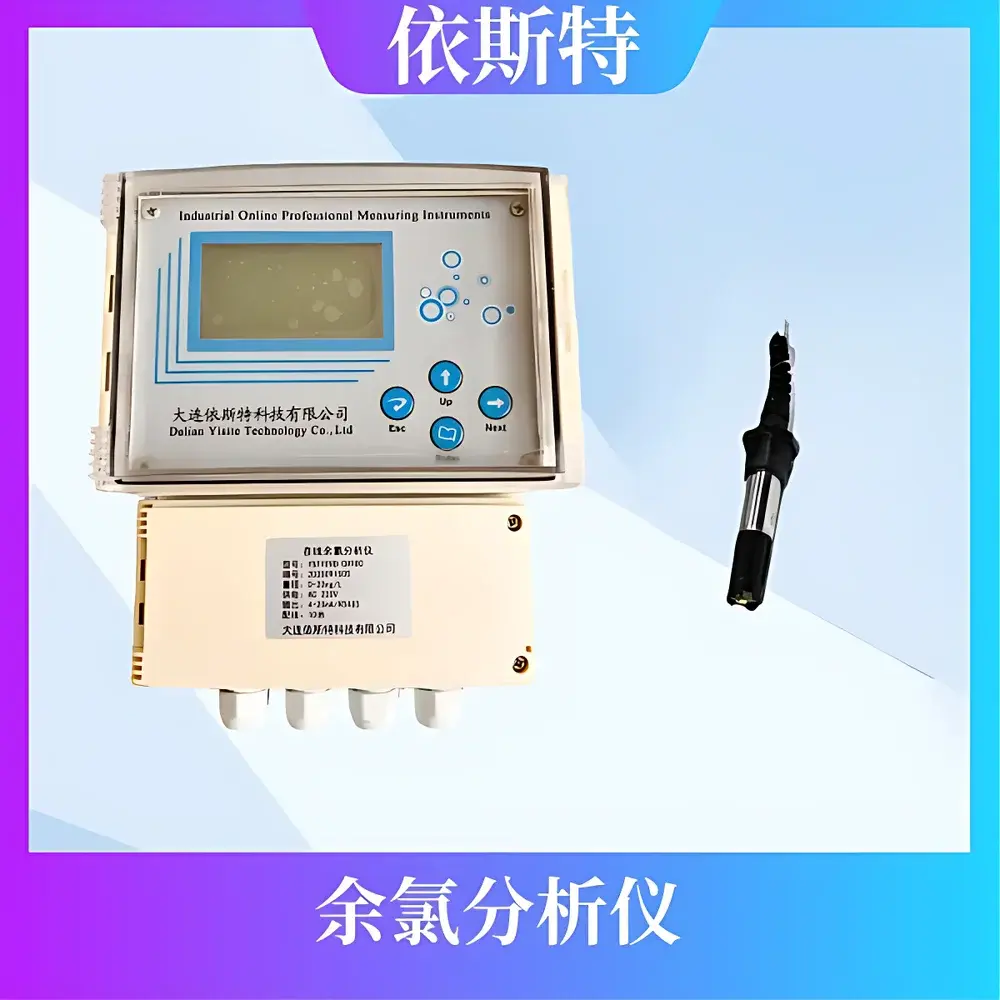
YST909B-CH980 Residual Chlorine and Chlorine Dioxide Online Analyzer
| Brand | YST (Dalian Yist) |
|---|---|
| Origin | Liaoning, China |
| Model | YST909B-CH980 |
| Measurement Principle | Modified DPD Colorimetry + Membrane-Amperometric Sensor |
| Range | 0.01–10 mg/L Free Chlorine |
| Accuracy | ≤±0.01 mg/L (0.01–1 mg/L range) |
| Drift | ≤±0.03 mg/L over 72 h |
| Power Supply | AC 220 V ±10%, 50 Hz (solar-compatible option available) |
| Output | 4–20 mA analog + RS485 Modbus RTU |
| Environmental Rating | IP65 |
| Operating Temperature | 0–50 °C |
| Relative Humidity | 10–90% RH (non-condensing) |
| Data Storage | Internal logging with trend report export capability |
| Compliance | GB/T 5750.11–2006 |
Overview
The YST909B-CH980 Residual Chlorine and Chlorine Dioxide Online Analyzer is an industrial-grade, continuous-monitoring instrument engineered for real-time quantification of free chlorine and chlorine dioxide in municipal drinking water distribution systems. It employs a dual-sensor architecture—integrating modified N,N-diethyl-p-phenylenediamine (DPD) colorimetry with a selective membrane-based amperometric sensor—to deliver high reproducibility across variable water matrices. Unlike single-technology analyzers, this hybrid approach mitigates interferences from turbidity, organic matter, and transition metals commonly present in finished water, thereby enhancing measurement robustness under fluctuating plant conditions. The analyzer operates on the principle of stoichiometric oxidation of DPD by free chlorine, generating a magenta-colored quinoneimine compound measured photometrically at 515 nm, while the amperometric channel provides complementary electrochemical detection through diffusion-controlled reduction of hypochlorous acid at a platinum working electrode. This dual-path design aligns with the methodological requirements of GB/T 5750.11–2006 and supports trace-level monitoring down to 0.01 mg/L—critical for maintaining regulatory compliance with WHO guidelines (0.2–4.0 mg/L residual chlorine) and national drinking water standards.
Key Features
- Dual-technology sensing architecture: Simultaneous DPD colorimetric and membrane-amperometric detection ensures cross-validated results and reduced false positives in complex water matrices.
- Stable long-term performance: ≤±0.03 mg/L signal drift over 72 hours demonstrates low baseline instability, minimizing recalibration frequency in unattended operation.
- Industrial environmental resilience: IP65-rated enclosure enables reliable deployment in outdoor metering kiosks, chlorination rooms, and elevated reservoir control cabinets without additional weatherproof housing.
- Flexible power integration: Standard AC 220 V operation with optional solar-compatible power management module for off-grid or remote booster station installations.
- Plug-and-play interface compatibility: Native RS485 Modbus RTU protocol and isolated 4–20 mA analog output ensure seamless integration into SCADA, PLC, and centralized water management platforms.
- On-device data governance: Internal non-volatile memory archives timestamped measurements at user-configurable intervals; CSV-formatted trend reports exportable via USB or serial interface for audit-ready documentation.
Sample Compatibility & Compliance
The YST909B-CH980 is validated for use with potable water streams exhibiting pH 6.0–8.5, turbidity <5 NTU, and total organic carbon (TOC) <3 mg/L—typical of post-filtration and post-disinfection points in conventional surface-water treatment plants. It complies with Chinese national standard GB/T 5750.11–2006 for determination of residual chlorine in drinking water and meets functional equivalency to EPA Method 334.0 and ISO 7393-2 for amperometric chlorine measurement. While not certified to IEC 61508 or SIL2, its architecture supports integration into safety-related monitoring loops when deployed per site-specific risk assessments. For GLP/GMP-aligned operations, the device supports time-stamped event logging (e.g., calibration, maintenance, alarm triggers), fulfilling basic data integrity prerequisites under Annex 11 and FDA 21 CFR Part 11 when paired with validated platform software.
Software & Data Management
The analyzer does not include embedded web server or cloud connectivity; instead, it delivers raw and processed data via deterministic serial/analogue outputs designed for ingestion by third-party supervisory systems. Its internal firmware implements linearization algorithms calibrated against NIST-traceable chlorine standards and applies temperature compensation using integrated Pt1000 thermistor input (0–50 °C range). All configuration parameters—including measurement interval, alarm thresholds, auto-zero cycle timing, and unit scaling—are accessible via Modbus register mapping (function code 0x03/0x06), enabling remote parameterization through HMI or central DCS. Historical data retention spans ≥30 days at 15-minute sampling resolution, with cyclic overwrite policy ensuring persistent storage without manual intervention. Exported CSV files include UTC timestamps, sensor status flags, and QC metadata—facilitating traceability during regulatory audits or process deviation investigations.
Applications
- Real-time disinfectant residual monitoring at plant effluent points to verify CT-value compliance prior to distribution.
- Dynamic dosing feedback control for chlorine contact tanks and booster station injectors using 4–20 mA setpoint modulation.
- Network-wide water quality surveillance across pressure zones, supporting hydraulic model validation and contamination event detection.
- Regulatory reporting support for provincial health departments requiring hourly residual chlorine logs under local drinking water ordinances.
- Performance verification of UV/chloramine secondary disinfection systems where free chlorine decay kinetics must be tracked independently.
- Rural water supply schemes with limited technical staffing, where intuitive operation and minimal preventive maintenance reduce dependency on specialized service technicians.
FAQ
Does the YST909B-CH980 measure combined chlorine (chloramines) as well as free chlorine?
No—it is optimized for free chlorine and chlorine dioxide. Combined chlorine requires separate DPD-based methodology (e.g., DPD #3 reagent addition), which is not implemented in this model.
Is field calibration possible without returning the unit to a service center?
Yes—zero and span calibration can be performed on-site using certified chlorine standard solutions (e.g., potassium permanganate-stabilized NaOCl) and the built-in calibration menu via Modbus or local keypad.
What is the expected service life of the DPD reagent cartridge and amperometric sensor membrane?
Under typical municipal usage (24/7 operation, 20 °C ambient), the DPD reagent pack lasts ≈6 months and the sensor membrane ≥12 months—both are field-replaceable consumables with documented shelf-life specifications.
Can the device operate continuously during scheduled backwashing of inline sample filters?
Yes—the analyzer includes programmable sample flow interruption tolerance (up to 15 minutes), retaining last valid reading and resuming measurement automatically upon flow restoration without data loss.
Is there a version compliant with ATEX or IECEx for explosive atmospheres?
No—this model is rated for general-purpose industrial environments only (IP65, non-hazardous location classification).
Related Products







