
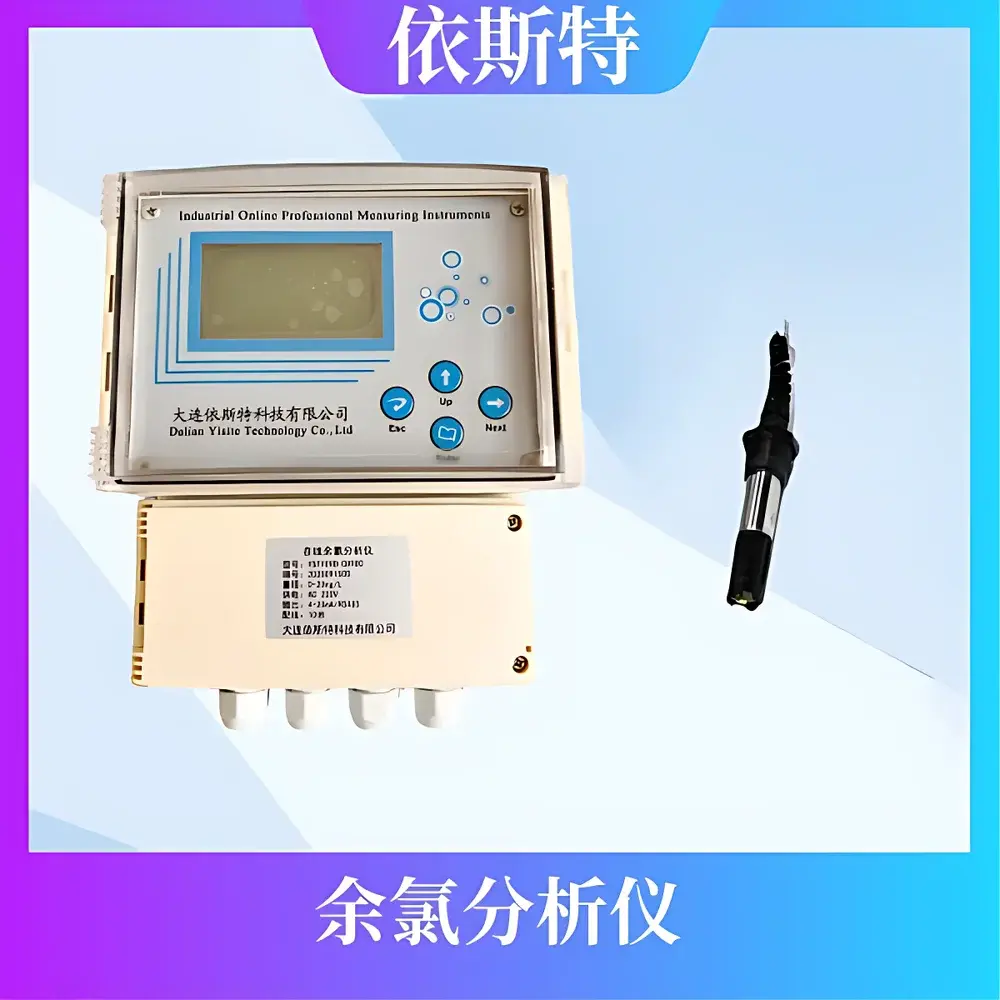
YST909B-CH980 Residual Chlorine Online Analyzer by Dalian YST
| Brand | Dalian YST |
|---|---|
| Origin | Liaoning, China |
| Model | YST909B-CH980 |
| Measurement Range | 0–1 mg/L / 0–5 mg/L / 0–10 mg/L (selectable) |
| Resolution | 0.001 mg/L (low range), 0.01 mg/L (mid/high range) |
| Repeatability | ≤1% |
| Response Time (T90) | ≤60 s |
| Operating Temperature | 0–50°C (indoor), –10–60°C (outdoor explosion-proof version) |
| Humidity | ≤90% RH (non-condensing) |
| Sample Temperature | 0–50°C |
| Sample Pressure | 0.1–0.6 MPa |
| Output Signals | 4–20 mA, RS485/RS232 (Modbus RTU) |
| Relay Outputs | 2 configurable (NO/NC, 220 VAC / 5 A) |
| Power Supply | AC 220 V ±10%, 50 Hz or DC 24 V |
| Sampling Modes | Flow-through (50–300 mL/min) and Immersion |
| Zero Drift | ±0.05 mg/L over 30 days |
| Span Drift | ±2% FS over 30 days |
| Compensation | Automatic temperature and pH compensation |
| Turbidity Tolerance | ≤100 NTU |
| pH Range for Stable Operation | 6–9 |
Overview
The YST909B-CH980 Residual Chlorine Online Analyzer is an electrochemical amperometric analyzer engineered for continuous, real-time monitoring of free chlorine concentration in treated wastewater effluent streams. It operates on the principle of selective amperometric detection using a three-electrode sensor system—working electrode, reference electrode, and counter electrode—immersed directly in the sample stream or housed within a flow cell. The instrument measures the current generated by the reduction of hypochlorous acid (HOCl) and hypochlorite ion (OCl⁻) at a fixed applied potential, which correlates linearly with residual chlorine concentration under controlled pH and temperature conditions. Designed specifically for post-disinfection process control in municipal and industrial wastewater treatment plants, the YST909B-CH980 delivers stable, trace-level quantification across three user-selectable ranges (0–1, 0–5, or 0–10 mg/L Cl₂), supporting regulatory compliance with discharge standards such as EPA Method 334.0, ISO 7393-2, and China’s HJ 586–2010.
Key Features
- Triple-range measurement capability with high-resolution detection: 0.001 mg/L resolution in low-range mode (0–1 mg/L), ensuring sensitivity for stringent discharge limits;
- Automatic dual-parameter compensation: integrated Pt100 temperature sensor and optional pH input enable real-time correction of chlorine speciation shifts caused by temperature and pH variation;
- Robust environmental rating: indoor configuration rated IP65; outdoor explosion-proof variant certified for Class I, Division 2 hazardous locations (pending third-party verification per IEC 60079-0/15);
- Low-drift architecture: verified zero drift ≤±0.05 mg/L and span drift ≤±2% FS over 30 consecutive days under continuous operation—meeting GLP-aligned stability requirements for unattended monitoring;
- Dual sampling flexibility: field-configurable for either flow-through installation (50–300 mL/min sample throughput, compatible with standard ¼” tubing and bypass manifolds) or direct immersion (with corrosion-resistant titanium or PTFE-coated sensor housing);
- Multi-protocol digital interface: native Modbus RTU support over RS485 ensures seamless integration into SCADA, DCS, or PLC-based automation systems without gateway dependency;
- Fail-safe relay logic: two programmable relays (220 VAC / 5 A) support alarm triggering, dose pump activation, or valve control based on user-defined chlorine thresholds with hysteresis and delay settings.
Sample Compatibility & Compliance
The YST909B-CH980 maintains analytical integrity in complex wastewater matrices with turbidity up to 100 NTU and pH between 6.0 and 9.0—conditions typical of secondary-treated effluent. Its amperometric sensor exhibits minimal interference from common ions including nitrate, sulfate, and chloride at concentrations encountered in municipal outfalls. While not intended for seawater or highly oxidizing industrial streams containing ozone or peracetic acid, it demonstrates reliable performance in chlorinated domestic wastewater, textile effluent, and food processing discharge. The analyzer complies with electromagnetic compatibility standards IEC 61326-1 (industrial environment) and meets CE marking requirements for EMC and LVD directives. Data integrity features—including timestamped event logging and non-volatile memory retention—support audit readiness under ISO/IEC 17025 and EPA-approved QA/QC protocols.
Software & Data Management
The embedded firmware supports local configuration via front-panel keypad and LCD display, with full parameter access—including calibration coefficients, alarm setpoints, and compensation curves—via USB-C service port or RS485 Modbus register mapping. No proprietary software is required for basic operation; however, optional YST-Link PC utility (Windows-compatible) enables batch calibration logging, trend visualization, and CSV export for LIMS integration. All calibration events, relay state changes, and sensor diagnostics are recorded with ISO 8601 timestamps and retained for ≥30 days in circular buffer memory. While the device does not implement FDA 21 CFR Part 11 electronic signature controls natively, its audit trail structure aligns with GLP documentation practices when deployed in validated environments with supplementary procedural controls.
Applications
- Municipal wastewater disinfection control: real-time feedback for chlorine dosing pumps at final effluent channels, enabling dynamic feed-forward or feedback control loops;
- Industrial pretreatment monitoring: continuous verification of chlorine residuals prior to discharge to publicly owned treatment works (POTWs), supporting NPDES permit reporting;
- Recycled water reuse systems: verification of disinfectant residual in irrigation or industrial cooling applications where microbiological safety must be assured;
- Regulatory compliance auditing: provision of time-synchronized, temperature- and pH-compensated data streams for environmental agency submissions;
- Process optimization studies: correlation of chlorine decay kinetics with hydraulic retention time, organic load, and UV transmittance in tertiary treatment trains.
FAQ
What chlorine species does the YST909B-CH980 measure?
It measures total free residual chlorine—primarily hypochlorous acid (HOCl) and hypochlorite ion (OCl⁻)—based on their collective electrochemical reducibility at the sensor surface. Combined chlorine (chloramines) is not detected unless hydrolyzed in situ via acidification, which is not supported by this model.
Is pH compensation mandatory for accurate readings?
Yes. Because the HOCl/OCl⁻ equilibrium is pH-dependent—and only HOCl contributes significantly to the measured current—the instrument requires either external pH input or manual entry of nominal pH to apply Nernst-based correction. Default compensation assumes pH 7.2 if no signal is connected.
Can the analyzer operate unattended for extended periods?
Yes. With scheduled weekly verification checks and quarterly sensor membrane replacement, the unit achieves >95% uptime over six-month deployments in climate-controlled indoor installations. Outdoor units require biannual inspection of cable glands and desiccant cartridges.
Does the device support automatic calibration?
No. Calibration is manual and performed using standardized DPD colorimetric reference solutions (e.g., 0.5 mg/L and 2.0 mg/L Cl₂). Auto-zero functionality is available but does not replace span calibration.
What maintenance intervals are recommended?
Electrolyte replenishment every 3 months; sensor membrane replacement every 6 months; flow cell cleaning (if used) monthly or per visible fouling; relay contact inspection annually.







