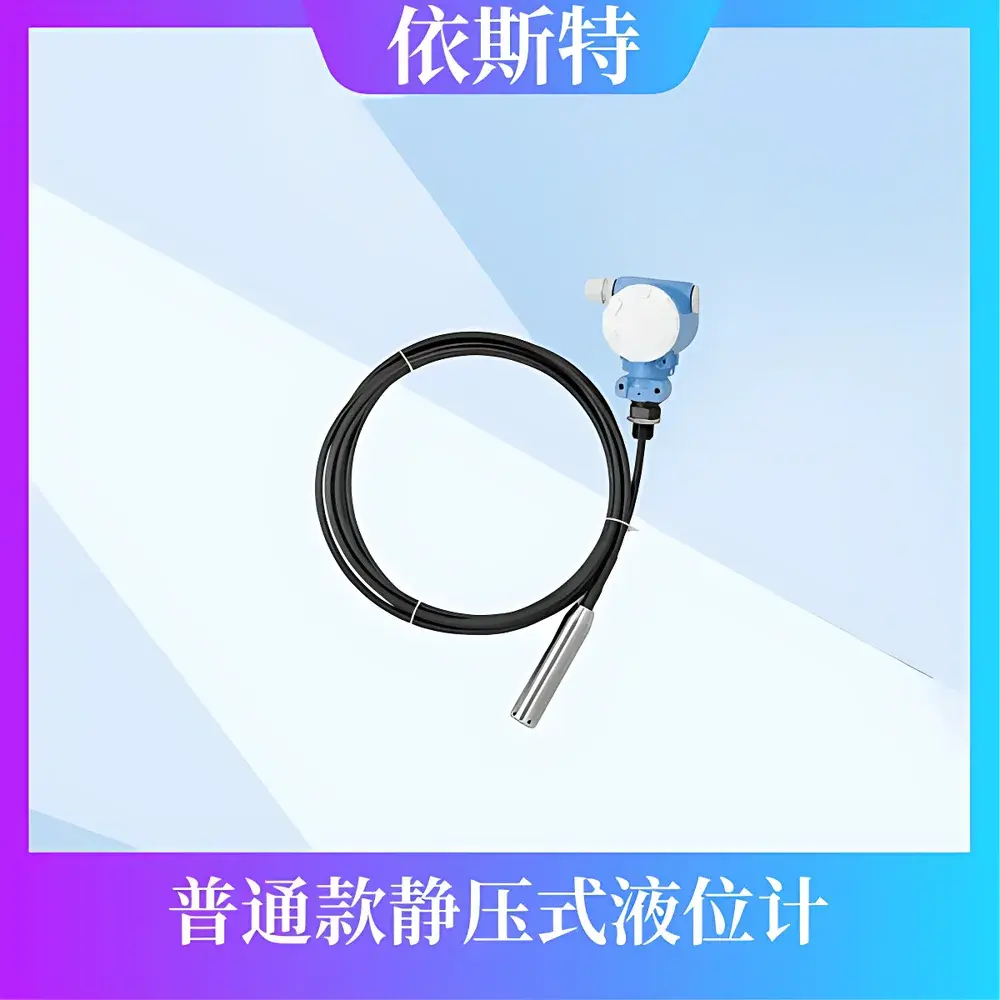
YST918S Outdoor-Ready Integrated Hydrostatic Level Transmitter
| Brand | YST (Dalian Yist) |
|---|---|
| Origin | Liaoning, China |
| Model | YST918S |
| Measurement Range | 0–50 mH₂O (customizable) |
| Accuracy | ±0.25% FS |
| Operating Temperature | −20 °C to +70 °C |
| Power Supply | 12–36 VDC (typical 24 VDC) |
| Output Signal | 4–20 mA / RS485 |
| Enclosure Rating | IP68 |
| Wetted Material | 316L Stainless Steel (optional corrosion-resistant coating) |
| Standard Cable Length | 5 m (customizable) |
Overview
The YST918S Outdoor-Ready Integrated Hydrostatic Level Transmitter is an engineered solution for continuous, high-reliability liquid level measurement in unsheltered industrial environments. Based on hydrostatic pressure principle—where liquid height is inferred from the pressure exerted by the column of fluid above the sensor—the transmitter integrates a precision piezoresistive or ceramic pressure sensing element, signal conditioning circuitry, and environmental-hardened housing into a single compact unit. Designed explicitly for deployment in open-air installations—including wastewater basins, rural water reservoirs, chemical storage tanks, and stormwater management systems—it eliminates the need for separate sensor, housing, and signal converter components. Its fully sealed construction ensures consistent performance under thermal cycling, humidity extremes, mechanical vibration, and transient immersion—making it suitable for long-term operation without shelter or protective enclosures.
Key Features
- Integrated outdoor-rated architecture: All-in-one design minimizes field assembly, reduces leak paths, and eliminates alignment or calibration drift between discrete components.
- IP68 ingress protection: Certified for continuous submersion up to 5 meters and full resistance to dust, rain, snow, and condensation—validated per IEC 60529 standards.
- Thermally compensated sensing element: Built-in temperature compensation algorithms mitigate zero and span drift across the full operating range (−20 °C to +70 °C), ensuring stable output under diurnal and seasonal ambient fluctuations.
- Dual-output flexibility: Simultaneous analog (4–20 mA, 2-wire, HART-compatible) and digital (RS485 Modbus RTU) outputs enable seamless integration with legacy PLCs, SCADA systems, and modern IIoT platforms.
- Chemically resistant wetted parts: Standard 316L stainless steel diaphragm and process connection; optional fluoropolymer or epoxy-based anti-corrosion coatings available for aggressive media including sulfide-laden wastewater, brine, or mild acidic/alkaline solutions.
- Low-maintenance operational profile: No moving parts, no purge requirements, and no recalibration needed under normal service conditions—reducing lifecycle cost and field intervention frequency.
Sample Compatibility & Compliance
The YST918S is validated for use with non-viscous, non-clogging liquids including potable water, municipal wastewater, leachate, cooling tower sumps, and industrial process fluids with specific gravity ≥ 0.8 g/cm³. It is not intended for highly viscous, abrasive, or gas-saturated media. The device complies with electromagnetic compatibility requirements per EN 61326-1 (industrial environment) and meets RoHS Directive 2011/65/EU. While not certified to ATEX or IECEx for hazardous areas, its intrinsic safety profile—low power consumption (< 1 W), absence of spark-prone components, and passive sensing principle—supports safe installation in Zone 2/Class I Div 2 locations when installed per local electrical codes. Documentation supports GLP/GMP-aligned validation protocols, including as-found/as-left calibration records and traceable test reports.
Software & Data Management
The transmitter operates autonomously without embedded firmware requiring periodic updates. Configuration—including damping time, zero/span adjustment, linearization tables, and alarm thresholds—is performed via handheld communicator (HART protocol) or Modbus-enabled configuration software. RS485 output supports multi-drop networks (up to 32 nodes), enabling centralized data aggregation in supervisory systems. Raw pressure-to-level conversion can be executed either onboard (with user-defined density input) or externally in the control system, supporting dynamic compensation for temperature- or composition-dependent fluid density changes. Audit trails for configuration changes are maintained at the host system level; while the device itself does not implement FDA 21 CFR Part 11 electronic signature functionality, its deterministic analog output and deterministic digital response ensure reproducible, timestamped data acquisition when paired with compliant DAQ infrastructure.
Applications
- Municipal wastewater infrastructure: Real-time level monitoring in open-air equalization tanks, lift stations, and final effluent channels—enabling pump staging, overflow prevention, and regulatory discharge reporting.
- Rural and decentralized water supply: Remote level telemetry from elevated reservoirs and ground-level cisterns in off-grid or low-connectivity regions, supporting predictive refill scheduling and leakage detection.
- Industrial process sumps and storage: Continuous inventory tracking of raw material tanks, coolant reservoirs, and chemical dosing vessels exposed to ambient weather—facilitating just-in-time replenishment and batch consistency control.
- Environmental monitoring networks: Integration into flood warning systems, groundwater observation wells, and stormwater retention basins where long-term stability and minimal site access are critical success factors.
FAQ
Is the YST918S suitable for submersible installation in seawater?
Yes—when equipped with optional marine-grade anti-corrosion coating and using the 316L stainless steel variant, it is rated for long-term immersion in seawater up to 50 mH₂O equivalent depth. Regular visual inspection of coating integrity is recommended in high-chloride environments.
Can the measurement range be extended beyond 50 mH₂O?
Custom calibration and sensor selection allow extension to 100 mH₂O; however, extended ranges require evaluation of cable capacitance effects on RS485 signal integrity and may necessitate shielded twisted-pair cabling and repeater placement.
Does the device support temperature-compensated density correction for variable-specific-gravity fluids?
No—the internal linearization assumes constant fluid density. For applications involving significant density variation (e.g., brine concentration shifts), external compensation must be applied in the control system using auxiliary temperature or conductivity inputs.
What is the expected service life under continuous outdoor exposure?
Based on accelerated aging tests and field deployments exceeding 5 years, the typical service life exceeds 10 years with proper mounting and avoidance of mechanical impact or sustained UV exposure beyond specified limits.
Is third-party calibration certification available?
Yes—traceable calibration certificates (ISO/IEC 17025 accredited) can be provided upon request, covering pressure points across the full span and temperature points at −20 °C, 25 °C, and +70 °C.
Related Products